
Congressional Redistricting Goes Into Overdrive
A dozen states have revised their maps or are considering doing so, while others await court decisions that could send them back to the drawing board. What was once a once-every-ten-years process is becoming a continuous cycle of redistricting.
California has confirmed that the idea of redrawing political maps only once a decade may be a thing of the past.
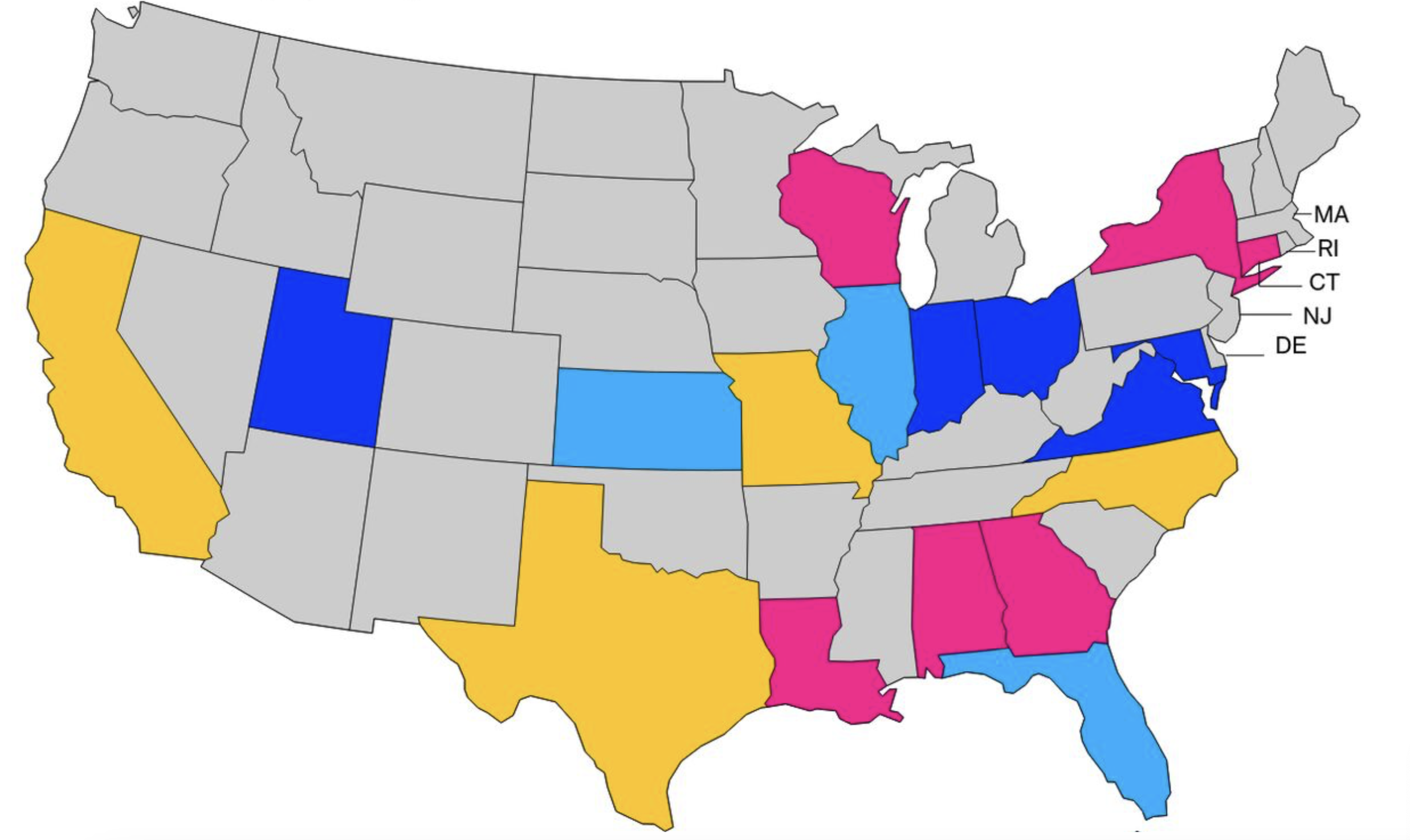
Voters there recently approved a plan to reconfigure the state’s congressional districts without waiting for a new census, following similar moves in other parts of the country.
At least a dozen states have already revised their maps or are considering doing so this year, while others await court decisions that could send them back to the drawing board. What was once a once-every-ten-years process is becoming a continuous cycle of redistricting.
John Bisognano of the National Democratic Redistricting Committee has called this trend “the era of perpetual redistricting” — an ongoing effort by both major parties to shape political boundaries ahead of each election.
Recent efforts have been driven in part by narrow congressional margins and a desire in many states to consolidate electoral advantages. States such as Texas, Missouri, North Carolina, California, Virginia, Maryland, and Illinois have all become focal points in this nationwide wave of mapmaking.
Adding to the uncertainty are legal and legislative developments, including a pending Supreme Court case that could affect minority-majority districts and proposals for more frequent population counts.
Historically, states redrew maps whenever they chose — or sometimes not at all — until Supreme Court rulings in the 1960s established the “one person, one vote” standard and effectively linked redistricting to the decennial census.
Today, technology has made the process faster and more accessible than ever; anyone with a computer can try their hand at drawing political boundaries.
Critics warn that constant redistricting could heighten polarization and erode public confidence.
“When you do it mid-decade, the entire purpose is to gain an advantage,” said Representative Kevin Kiley, a California Republican whose district was recently reshaped.
In the era of perpetual redistricting, fairness often depends on where you stand — and whose map you’re looking at.
Nov 12, 2025 — State Legislative
Latest Articles
Jul 31, 2026 - New facilities are two to three times larger than traditional commercial projects, requiring more HVAC systems, more sheet metal, more coordination, and significantly greater electrical capacity.
Jul 31, 2026 - A recent U.S. Supreme Court decision cleared a significant legal hurdle for future development, while lawmakers continue to wrestle with questions surrounding energy demand, water consumption, permitting, and infrastructure planning.
Jul 31, 2026 - Project represents one of the nation's largest transportation infrastructure investments and will restore a critical freight corridor serving the Port of Baltimore and the Mid-Atlantic region.
Privacy Policy |
Terms of Use | Contact Us
Phone: 703.803.2980 | Email:
info@smacna.org
© 1998-2026 SMACNA. All rights reserved.
Web Design & Development by Matrix Group
International, Inc.
