Read the Latest Federal Updates
Learn more about the developments from the Executive Branch and how they can impact your business.
OFFICE OF MANAGEMENT AND BUDGET
Administration backs the Senate permitting bill SMACNA urged the Senate to pass in October
November 9, 2026 · Source
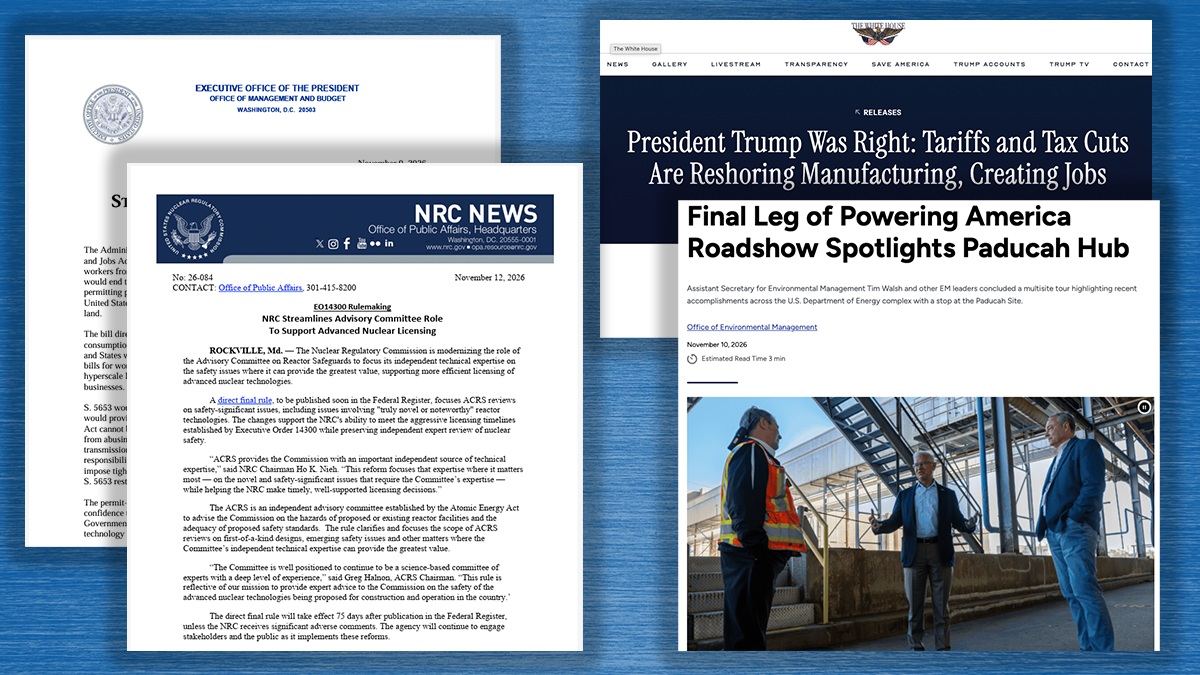
A Statement of Administration Policy says the administration strongly supports passage of S. 5653, the Bipartisan American Affordability and Jobs Act of 2026, and that the President's advisors would recommend he sign it. The provisions the statement describes include limits on the use of the National Environmental Policy Act and the National Historic Preservation Act in bad-faith litigation, restrictions on state Clean Water Act section 401 certifications used to block pipelines and other infrastructure, state assumption of Endangered Species Act section 7 consultations, tight statutory review deadlines paired with durable permit validity, streamlined hydropower and hydrokinetic licensing, and eased geothermal development. It also describes provisions under which data centers connecting at scale would pay their own transmission costs, with states empowered to use revenue from large computational loads to lower electricity bills for working families.
SMACNA wrote to the chairmen and ranking members of the Senate Environment and Public Works and Energy and Natural Resources committees on October 21 supporting the bill and urging the Senate to pass it promptly and the House to take it up without delay. That letter set out four reforms:
- Firm review timelines. Environmental assessments under the National Environmental Policy Act would generally have to be completed within one year and environmental impact statements within two, with Endangered Species Act consultations and historic preservation reviews fitting inside those timelines.
- Coordinated federal reviews. Stronger lead agency authority, a process for resolving interagency disputes that threaten review schedules, reliance on qualifying state, tribal and other federal reviews, and wider use of categorical exclusions.
- Project certainty. Projects that have secured their federal permits and authorizations would keep them absent extraordinary circumstances, a violation of law or a court order, and an agency seeking to revisit a prior approval would bear the burden of justifying that action.
- Litigation clarity. Challenges to environmental reviews and federal permit decisions would generally have to be filed within 150 days, and courts would typically return deficient approvals to the agency for correction rather than vacate them.
The letter ties the bill to the work itself. Much of the on-site mechanical and sheet metal work SMACNA members perform cannot begin until a project clears its federal approvals. When a review drags on, or an agency revokes or suspends a permit it has already issued, financing costs grow, material and equipment prices escalate, and projects that have been bid and staffed are postponed or cancelled. Contractors cannot hold skilled crews in reserve indefinitely. SMACNA's argument is that schedule predictability is what allows a contractor to plan, bid, hire and commit to apprenticeship class sizes years in advance.
THE WHITE HOUSE
Manufacturing roundup lists new plant construction, including a Carrier facility at Fort Worth
November 3, 2026 · Source
Employment in factory construction has climbed by nearly 112,000 since President Trump took office, according to a White House release that then names the plants behind the figure. Carrier has committed more than $600 million to an advanced manufacturing facility in Fort Worth. Audi is building a $4 billion factory in Georgia, which the release calls the company's first United States manufacturing plant and credits with creating 4,500 jobs. Westinghouse Electric is putting $1 billion into South Carolina to build a next-generation nuclear fuel factory.
The release also lists U.S. Steel's $3 billion investment near Pittsburgh to construct a new hot strip mill and increase annual capacity by roughly 1.3 million tons, Bombardier at $270 million, and up to $100 million from Apple for American titanium production. It puts business investment growth at 12.7 percent in the third quarter of 2026 and private investment in plants and equipment at 9.4 percent.
Reshoring release puts factory construction jobs at 120,000
November 6, 2026 · Source
A second release three days later says more than 100,000 manufacturing jobs and 120,000 factory construction jobs have been added since the President returned to office. The factory construction figure does not match the nearly 112,000 given in the November 3 roundup. The release reports that 36 percent of equipment manufacturers have reshored or are reshoring, that 63 percent are making capital investments to expand United States production, and that manufacturing expanded for a tenth straight month.
Interview remarks press data centers to build their own generation
November 9, 2026 · Source
A release quoting a 60 Minutes interview carries the President saying that "China has no problem with data centers" and that, of data centers in the United States, "I'm demanding that they build their own electric plant." The same release recites investment commitments including Apple at $600 billion with 20,000 new American hires, NVIDIA at up to $500 billion in American-made SI infrastructure, TSMC at $165 billion, and Audi at $4 billion creating about 4,500 new jobs. The remark on generation is a statement in an interview, and no order or rulemaking accompanies it.
Determination exempts federal wildfire suppression from water pollution control requirements for a year
November 10, 2026 · Source
A presidential determination finds it in the paramount interest of the United States to exempt federal wildfire suppression activity, including aerial application of fire retardant, from state, interstate, local and federal water pollution control requirements under 33 U.S.C. 1323(a). The exemption runs for the period beginning November 10, 2026 and ending November 10, 2027, and preserves 33 U.S.C. 1316 and 1317. The companion fact sheet describes it as covering the 2027 fire season and as fulfilling the permitting requirements for a year.
Executive action release reports five advanced reactors at criticality and more than 700 licensing actions
November 13, 2026 · Source
A release on results delivered through executive action says the administration has revolutionized and time-bound the nuclear regulatory process and enabled four new advanced reactors to reach criticality by July 4, 2026, and that five have now achieved criticality in total. It reports more than 700 nuclear energy licensing actions completed, supplying tens of thousands of megawatts.
DEPARTMENT OF LABOR
Final rule strips affirmative action duties from apprenticeship sponsors and adds a 60-day disclosure duty
November 6, 2026 · Source
The Employment and Training Administration published a final rule rewriting 29 CFR part 30, the equal opportunity regulation for registered apprenticeship, and amending eight sections of 29 CFR part 29, at 91 FR 70164 under RIN 1205-AC21 and Docket No. ETA-2025-0006, Federal Register document 2026-22680. It takes effect January 5, 2027, sixty days after publication, and follows the proposed rule published July 2, 2025 at 90 FR 28947. Part 30 is retitled "Prohibiting Illegal Discrimination in Registered Apprenticeship Programs" and its prior provisions are replaced with nine sections. The department describes the rule as fulfilling Executive Order 14173 and as a critical step toward the plan under Executive Order 14278 to reach 1,000,000 active apprentices. In rescinding the affirmative action requirements, it relied in part on section 703(j) of Title VII, which bars reading the statute to require preferential treatment to correct a demographic imbalance. The rule rescinds the following:
- The equal opportunity obligations of former section 30.3. Designating an individual responsible for equal opportunity, publishing and posting the equal opportunity pledge, holding orientation and periodic information sessions on the sponsor's policy, conducting universal outreach and recruitment, and providing anti-harassment training.
- The affirmative action program, at former sections 30.4 through 30.9, with the invitation to self-identify at former section 30.11. Together these required sponsors with five or more apprentices to conduct utilization analyses, set utilization goals, pursue the disability utilization goal, conduct targeted outreach, review personnel processes, and invite applicants and apprentices to self-identify as individuals with disabilities. In rescinding the invitation, the department concluded that "the best reading of section 102(d)(2)(A) of the ADA is that employers may not make disability-related inquiries of job applicants prior to an offer of employment, regardless of the employer's intent or the framing of the question," and said it will not defer to contrary guidance from the Equal Employment Opportunity Commission.
- Selection procedures at former section 30.10, including the requirement to comply with the Uniform Guidelines on Employee Selection Procedures. The department cited a June 9, 2026 opinion of the Justice Department's Office of Legal Counsel concluding that the commission's disparate-impact interpretations, including as reflected in the Uniform Guidelines, "embrace an unconstitutional reading of Title VII."
- Recordkeeping, complaints and retaliation. Sponsor recordkeeping at former section 30.12, the complaint procedures of former section 30.14 together with ETA Form 9039, and the apprenticeship-specific prohibition on intimidation and retaliation at former section 30.17.
What replaces them is a single duty. Revised section 30.3 requires sponsors to comply with all applicable federal and state laws and regulations prohibiting illegal discrimination on the basis of race, color, religion, national origin, sex, age (40 or older), genetic information or disability. Sexual orientation, which appeared in former section 30.1(a), is no longer among the enumerated bases. Section 30.1 states the purpose as establishing a uniform federal standard, and section 30.2 drops the part 30 definitions and applies those at 29 CFR 29.2. A registration agency that receives a discrimination complaint will immediately refer the individual to the Equal Employment Opportunity Commission, the Attorney General, a state fair employment practices agency or another entity with jurisdiction. Registration agencies will no longer investigate, and amended section 29.12(a) takes discrimination complaints out of the part 29 complaint process. Under section 30.5 an agency may initiate enforcement only where an enforcement entity or court with jurisdiction has made a final determination of a violation with no remaining right to appeal. It may then work with the sponsor on a compliance action plan aligned with the prescribed remedy and, if the plan is not implemented, suspend the right to register new apprentices or begin deregistration. A registration agency will assess compliance with section 30.3 concurrently with its review of the program under part 29, and new section 30.6 carries forward the provision allowing a deregistered program to be reinstated.
Section 30.5(b) carries a sponsor obligation that did not appear in the proposed regulatory text. A sponsor must disclose in writing to its registration agency, within 60 days of the final determination, any instance in which an enforcement entity or court has made a final and unappealable determination that the sponsor violated an applicable nondiscrimination law in relation to an apprentice or an applicant. The disclosure must include at a minimum copies of all relevant final determinations, judgments, decisions and orders, together with a description of any remedies the enforcement entity or court prescribed. The department added the requirement in response to comments asking how registration agencies would learn of final determinations.
Section 30.7 governs state apprenticeship agencies, and it changed materially from the proposal. Within one year of January 5, 2027, unless the Administrator grants an extension for good cause, a state agency seeking to obtain or maintain recognition must submit a state plan for nondiscrimination in apprenticeship showing that its laws, regulations, policies and operational procedures specific to nondiscrimination or equal opportunity in apprenticeship conform to part 30 and part 29. The proposal would have required state law to "conform only to" part 30; the final rule says "conform to," and confines the review to apprenticeship-specific provisions. The plan must list any state requirements that go beyond part 30, must not require a sponsor to engage in activity unlawful under federal or state nondiscrimination law, and must require state-registered programs to comply within 180 days after the Office of Apprenticeship approves it in writing. The office continues a state's recognition while it reviews, gives written notice of any nonconformity, and may begin derecognition under 29 CFR 29.14 if the state does not respond adequately within 90 days.
The department says conformity "does not mean that State laws must mirror exactly the language of the regulations, nor does it mean that any deviation will result in a finding of nonconformity," and that its review will assess whether additional state requirements frustrate or impede its authority under the National Apprenticeship Act to expand registered apprenticeship. Its examples of nonconforming provisions are laws that establish "unlawful compulsory, nonremedial group-based preference schemes for sponsors, such as affirmative action programs" and those that establish "burdensome restrictions or administrative requirements specific to apprenticeship that could restrict or inhibit the growth of Registered Apprenticeship programs." Outreach policies directed to particular demographic groups for the purpose of increasing participation must be included in the state plan.
Sponsors registered with the Office of Apprenticeship comply on January 5, 2027, and sponsors registered with a state agency comply with that state's approved plan within 180 days after the office approves it. Title VII reaches joint labor-management committees controlling apprenticeship directly, under 42 U.S.C. 2000e-2(d), so the new enforcement route reaches a joint apprenticeship and training committee, while a smaller non-joint program's coverage turns on whether its sponsor meets the statutory employer threshold at 42 U.S.C. 2000e(b). Advanced standing, direct interviews and direct entry for completers of a pre-apprenticeship or other preparatory program are unaffected, provided the sponsor records the policy and the policy allows all applicants to be equally granted that standing, as 29 CFR 29.5(b)(12) requires. On recruitment, the department says sponsors may continue lawful outreach "designed to attract and retain qualified candidates from all backgrounds" but that preferential treatment in recruitment is "inherently discriminatory in nature." It says rescinding the anti-harassment mandate "should not be construed as prohibiting such training." It also says the exemption provision at section 30.8 "does not authorize a Registration Agency to grant an exemption from the part 29 requirements, or any other applicable law, including those related to prevailing wages."
The apprenticeship agreement must now carry a statement that the apprentice will not be illegally discriminated against on the eight enumerated bases, together with a request for demographic data about the apprentice. Race, sex and ethnicity continue to be collected on a voluntary basis through ETA Form 671, and the form's section for voluntary self-reporting of disability status is discontinued. The department puts ten-year undiscounted savings at $1,016.11 million against $9.87 million in first-year costs, with roughly 59 percent of first-year savings, $53.48 million of $90.53 million, coming from eliminating equal opportunity training sessions.
Labor Department opens per-apprentice incentive payments to registered apprenticeship sponsors
November 2, 2026 · Source
Registered apprenticeship sponsors may now apply for direct payments of up to $6,000 per apprentice, under release 26-1623-NAT. Applications are accepted on a rolling basis until all available funds have been obligated, through the six organizations administering the funds. The department says that it has invested nearly $200 million in pay-for-performance incentive funds to date, and that in July it awarded nearly $162 million to five organizations. The six funds are:
- Super Intelligence, Semiconductor, and Nuclear Energy Infrastructure Apprenticeship Incentive Fund, $40 million, Jobs for the Future Inc. Of the six this is the fund whose named industries carry mechanical and sheet metal scope, since semiconductor fabrication plants and nuclear and energy infrastructure are where that work sits. It pays up to $6,000 per apprentice, $3,750 once a new apprentice has been retained 90 days and $2,250 at completion or twelve months, whichever comes first. The administering organization, rather than the department, holds and publishes the approved occupation list, so a registered occupation has to be confirmed there.
- American Manufacturing Apprenticeship Incentive Fund, $35.8 million, Arkansas Department of Commerce, Division of Workforce Services. Up to $3,500 per new apprentice, up to 200 apprentices per sponsor, with at least 90 percent of the payment passed through to the employer.
- Shipbuilding and Defense Industrial Base Apprenticeship Incentive Fund, $40 million, Florida Department of Commerce. A $2,000 baseline per new apprentice employed at least 90 days, up to $6,000 for sponsors meeting at least one strategic priority area, projected to lead to nearly 10,000 new apprentices over the next four years.
- Telecommunication Apprenticeship Incentive Fund, $29.9 million, Wireless Infrastructure Association. Up to $6,000, paid $1,500 after 90 days, $2,500 on completing related technical instruction and $2,000 on completion.
- Information Technology Apprenticeship Incentive Fund, $27 million, The Trustees of Clark University. A one-time $6,000 per eligible new apprentice employed at least 90 days.
- Transportation Automotive Technician Apprenticeship Incentive Fund, $25 million, ASE Education Foundation. $3,500 per apprentice, paid $2,500 at the 90-day benchmark and $1,000 after nine months.
Pharmacy benefit manager fee disclosure rule reaches large self-insured health plans
November 2, 2026 · Source
The Employee Benefits Security Administration published a final rule, Improving Transparency Into Pharmacy Benefit Manager Fee Disclosure, at 91 FR 69092 under RIN 1210-AB37, Federal Register document 2026-22306. It requires providers of pharmacy benefit management services, and affiliated brokerage and consulting providers, to disclose their compensation to fiduciaries of large self-insured ERISA group health plans. Covered providers must furnish detailed disclosures of compensation and advance disclosure of compensation they reasonably expect to receive, and the rule carries audit provisions so fiduciaries can verify that the disclosures are accurate. It implements ERISA section 408(b)(2)(B) for these providers as amended by the Consolidated Appropriations Act, 2026, and responds to Executive Order 14273.
The rule takes effect January 4, 2027 and applies to plan years beginning on or after July 1, 2027. It states that approximately 136 million Americans receive health coverage through ERISA-covered employer group health plans, that retail prescription drug spending amounted to nearly $495 billion in 2024 and is projected to grow 7 percent in 2025, and that employers anticipate an 11 to 12 percent increase in pharmacy costs in 2025 into 2026.
Proposed unemployment insurance rule would require five weekly work search activities, with deeming for hiring halls and apprentices
November 10, 2026 · Source
The Employment and Training Administration proposed a rule, Federal Register document 2026-22903, that would require states to make individuals complete at least five qualifying work search activities each week for which unemployment compensation is claimed, or satisfy equivalent labor force attachment criteria. The department is also considering, and seeks comment on, whether a state points-based system reaching a minimum threshold of five points would meet the requirement. State law would have to allow qualifying activities beyond employer contacts, including registration and ongoing contact with placement agencies or unions for the purpose of seeking employment. Under the labor force attachment alternative the requirement would be deemed satisfied for a union member in good standing who contacts a hiring hall at least once a week, and for an individual participating in a registered apprenticeship program, though that individual's apprenticeship wages would still be reportable.
Claimants would have to report work search activity as part of continued claim certification before payment is released, and states could not issue formal or informal warnings in place of determining ineligibility for a week in which the required activities were not completed. The proposal sets a compliance date one year from the final rule's effective date. Comments are due 60 days after publication and are filed through the Federal eRulemaking Portal at regulations.gov under Docket No. ETA-2026-0100 or RIN 1205-AC31.
DEPARTMENT OF ENERGY
Environmental Management tour maps nuclear fuel cycle construction onto remediated Oak Ridge land
November 10, 2026 · Source
Office of Environmental Management articles published on November 10 set out where private nuclear and computing construction is going on land the office has cleaned up. At Oak Ridge, Tennessee, Assistant Secretary Tim Walsh toured six nuclear sites. The article identifies TRISO-X as building what it calls North America's first commercial-scale advanced nuclear fuel facility, producing TRISO fuel pellets for X-energy reactors; Orano USA's Project IKE, under which the company plans to construct a uranium enrichment facility in Oak Ridge; Centrus's uranium enrichment centrifuge manufacturing facility; a Radiant site where microreactors will be built; and Kairos Power's Hermes reactor series.
The article also notes that the Tennessee Valley Authority's Clinch River Nuclear Site recently received a construction permit from the Nuclear Regulatory Commission for Clinch River Unit 1, a small modular reactor. At the East Tennessee Technology Park, crews have demolished more than 500 structures, and more than 2,500 acres have been transferred for economic reuse.
Paducah hub closes the roadshow with an enrichment plant already in site preparation
November 10, 2026 · Source
Environmental Management leaders closed a multisite tour at the Paducah Site in Kentucky, presenting it as an American Energy Hub alongside Portsmouth, Ohio and Oak Ridge, Tennessee. The article gives a planned investment of $100 billion to establish the Paducah hub and $650 billion in private investments announced across the hubs so far. General Matter is planning a new domestic uranium enrichment facility there, with site preparation underway and construction beginning next year. The article gives the goal as bringing domestic enrichment back at scale, with self-sufficiency targeted by 2029 from a base of less than 1 percent of global enrichment. Brookfield and NextEra announced plans earlier in the summer to develop a high-performance computing innovation campus powered by new affordable energy infrastructure.
The article describes the hubs as hosting new reactors, enrichment facilities and what it calls the nation's first privately funded commercial nuclear fuel recycling facility. At the C-333 Process Building, workers segmented 497 converters earlier this year in preparation for demolition.
Isotope Row demolition at Oak Ridge hinged on overhead ventilation and off-gas piping
November 10, 2026 · Source
The Oak Ridge Office of Environmental Management and prime cleanup contractor United Cleanup Oak Ridge finished demolishing 10 historic, highly contaminated buildings known as Isotope Row on the central campus of Oak Ridge National Laboratory. Deactivation began in 2020, and the demolition itself took only two months. The buildings, put up between the late 1940s and early 1960s, came to over 12,000 square feet, and crews removed nearly 3 million pounds of waste along with four 2,000-pound tanks of inert gas and six hot cells.
The hardest element was the overhead off-gas and central ventilation piping running 10 to 15 feet above the floor, part of which was encased in contaminated asbestos-containing concrete. Most debris was disposed of on site, and teardowns were scheduled for afternoons to limit disruption to research continuing nearby.
DEPARTMENT OF TREASURY
Treasury designates 6,576 opportunity zones effective in January
November 5, 2026 · Source
Treasury and the Internal Revenue Service designated qualified opportunity zones across all fifty states, the territories and the District of Columbia: 6,576 eligible census tracts nominated and designated, 2,594 of them rural, all effective January 1, 2027 for a ten-year term. On April 6 the two agencies released a list of 25,332 eligible census tracts for nomination, 8,334 of them in rural areas eligible for increased benefits; nominations from governors and the Mayor of the District of Columbia opened July 1; and 130 more eligible tracts were nominated in the statutory window, 28 of them rural.
The release says the incentive builds on more than $110 billion in private-sector investment since the Tax Cuts and Jobs Act of 2017, and points to the zone list and map at the Community Development Financial Institutions Fund. The companion Internal Revenue Service release is IR-2026-132.
INTERNAL REVENUE SERVICE
Retirement plan contribution limits rise for 2027
November 12, 2026 · Source
Notice 2026-66 sets the 2027 cost-of-living adjustments for retirement plans, announced as IR-2026-136. The elective deferral limit for 401(k), 403(b) and governmental 457 plans and the Thrift Savings Plan rises to $25,500 from $24,500 for 2026. The age-50 catch-up in those plans rises to $8,500 from $8,000, for a $34,000 total, and the higher catch-up for ages 60 through 63 is $11,750. The individual retirement arrangement limit stays at $7,500 and its age-50 catch-up at $1,100. The SIMPLE employee limit rises to $17,500 from $17,000, and to $19,100 from $18,100 for certain applicable SIMPLE plans, with SIMPLE catch-ups unchanged at $4,000 for employees aged 50 and over in most SIMPLE plans, at $3,850 in certain applicable SIMPLE plans, and at $5,250 for ages 60 through 63. The release refers other retirement-related adjustments to the notice itself.
NUCLEAR REGULATORY COMMISSION
Construction permit issued for a four-reactor gas-cooled plant serving Dow's Seadrift operations
November 9, 2026 · Source
The Nuclear Regulatory Commission issued a construction permit for the Long Mott Generating Station in Calhoun County, Texas, the first construction permit for a high-temperature gas-cooled reactor in nearly 60 years and the third advanced reactor construction permit the agency has issued this year. The applicant is Long Mott Energy. The plant is to be built as four X-energy Xe-100 reactors in a multimodule configuration. It will mainly produce high-temperature steam for industrial use at the Dow Seadrift Operations site, with excess electricity going to the grid.
The commission met its 18-month review schedule and completed the safety evaluation in October, a month early. It issued the environmental assessment and finding of no significant impact in May. The permit authorizes construction only, and a separate operating license is required before fuel load. Release 26-083 describes it as the agency's first approval of a multimodule advanced reactor facility, of a pebble-bed core, of online refueling, and of a high-temperature gas-cooled reactor reviewed under the Licensing Modernization Project framework.
Direct final rule narrows the reactor safeguards committee's review to safety-significant matters
November 12, 2026 · Source
The commission is issuing a direct final rule narrowing the role of the Advisory Committee on Reactor Safeguards so that its independent technical review focuses on safety-significant matters, including reactor technologies that are truly novel or noteworthy, and on first-of-a-kind designs and emerging safety issues. Release 26-084 frames the change as helping the agency meet the licensing timelines set by Executive Order 14300 while retaining independent expert review. The rule takes effect 75 days after Federal Register publication unless the agency receives significant adverse comments. Chairman Ho K. Nieh said the reform focuses that expertise where it matters most.
Also on the Radar
Department of Labor
The Mine Safety and Health Administration published an updated proposed rule on protecting miners from silica dust exposure and announced five final mine safety and health rules, both on November 10. The Veterans' Employment and Training Service announced plans on November 10 to update employment resources for service members transitioning to civilian life.
Department of the Interior
The Bureau of Land Management proposed on November 5 to revise the public land use planning regulations it first adopted in 1979, under RIN 1004-AF53, with a 60-day comment period and a virtual public information session on December 3 at 5 p.m. Mountain time. The release states that the rule would publish in the Federal Register the following week and gives no Federal Register citation or calendar comment deadline.
Environmental Protection Agency
The agency held a first public demonstration of emerging technologies for identifying lead service lines on November 10, at the Edison Environmental Center in Edison, New Jersey, and said more than 97 percent of water systems have completed their initial service line inventories.
Nov 24, 2026 — Member Update
Latest Articles
Nov 24, 2026 - The 2026 SMACNA Contractor of the Year reflects on his service to SMACNA.
Nov 24, 2026 - The 2026 SMACNA Chapter Executive of the Year discusses how critical it is to be engaged with the association and the industry.
Nov 24, 2026 - The HVAC Market Sector Council and the Construction Operations Committee toured the location to learn more about some of their evolving processes.
Privacy Policy |
Terms of Use | Contact Us
Phone: 703.803.2980 | Email:
info@smacna.org
© 1998-2026 SMACNA. All rights reserved.
Web Design & Development by Matrix Group
International, Inc.