The (not so) Secret to Data Center Success
Imagine you’re working a $100M+ job. The shop just finished building the assemblies for your first delivery and they’re in the process of being loaded onto the trailer.
Article content provided by Stratus.
You get a call from the lead engineer. There’s a proposed change. You need to quantify the work that’s been completed: the impact of the rework on an already tight schedule and the cost to re-order parts and re-assemble half the batch.
No sweat.
(Wait really?). Yes. Really.
For the dozens of contractors using Stratus to complete data center projects, this scenario is a reality.
Data center builds are coined as hyperscale and hyperspeed projects. They’re susceptible to schedule compression and rapidly changing requirements, making it more important than ever for MEP contractors to master the right tools to both build and fly the plane.
This is why we spoke with Jason Steele at Cerris Systems, Stratus user and VDC veteran, to get a better idea of what expert-level execution looks like for MEP contractors when building data center projects. Talking about the project details that would make most people sweat, Jason is as cool as a cucumber––and that’s no accident.
He’ll be the first to attest that the pace of analog design-to-fabrication methods simply won’t cut it on these types of projects. But with the right tools, people and processes in place, you can meet complexity with confidence––or as Jason says, “we’ll get it done.”
Here are just a few tips from our conversation that will help build confidence at every (inevitable) turn.
Maximize prefabrication.
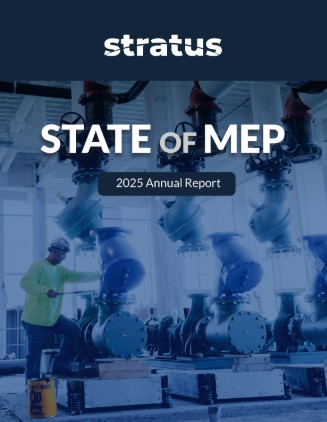
It goes without saying, but we’re going to say it; prefabrication is the most for-sure way of increasing the speed of your operations and gaining as much quality control as possible on these complex and unforgiving projects. The last thing you want on a data center project is downtime caused by system failure due to sub-optimal testing conditions, or a labor-related schedule delay that could have been prevented by maximizing off-site manufacturing efficiency gains. According to our 2025 State of MEP Report, responses from 144 MEP contractors told us that on average less than 30% of total work is prefabricated. Data centers are prime for expanding your prefab footprint as much as possible. Set the bar high, closer to 80% or more.
Tip: In order to expand your capacity, you may need to contract out the work. This is a great way to expand your prefab operations quickly but note that not all contractors have the same tools and workflows, which could cause critical production visibility breakdowns. When your prefab becomes spread across multiple shops and regions, staying coordinated with a fabrication management software could be the difference between getting ahead and falling behind.
Invest in real-time production tracking and visibility.
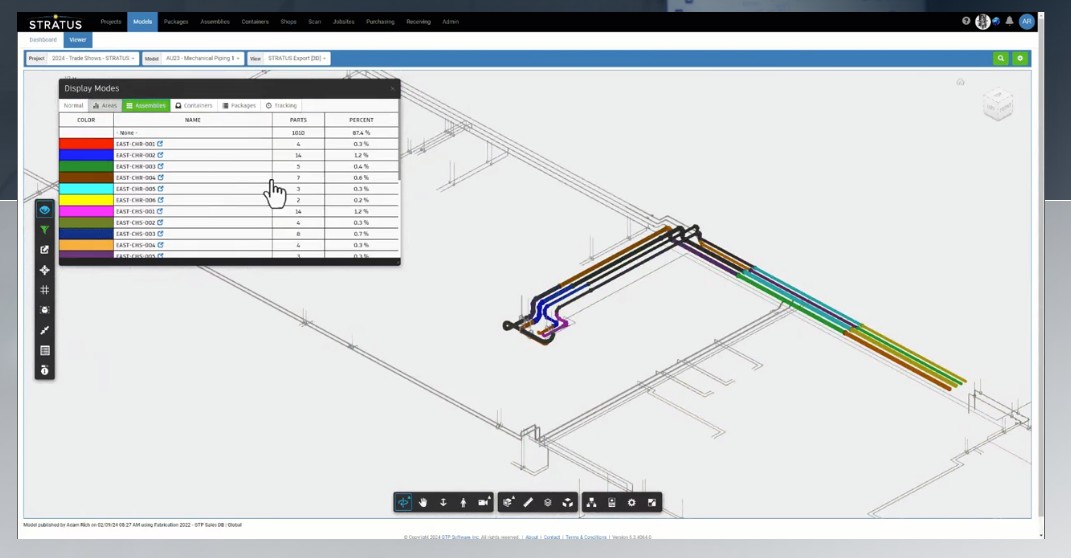
Compressed data center schedules are more likely to lead to late-stage design changes. You’ve certainly heard it before, but your timelines have also never been so tight. Staying cool under pressure requires that you can communicate fabrication progress to general contractors and owners at the drop of a hat. On data center projects, "It's not a matter anymore of whether it’s in the fab shop yet, it’s whether it’s out in the field or on a trailer on the way from Kansas City to the jobsite,” says Jason. A strong fabrication tracking tool like Stratus will be your best friend. Customize reports to fit your workflows and reference your current production status in real time to quickly quantify the impact on cost and schedule without delay.
Tip: Operational KPI tracking is one of the biggest gaps today for MEP contractors. Less than 30% track VDC productivity or material logistics cycle time.
Democratize spooling and package creation.
 When managing projects of this size––think tens of thousands of server drops––every second counts. Moving from design to assembly needs to take seconds, not weeks. A purpose-built fabrication software removes the burden and the bottleneck from your VDC team, empowering the shop and field to spool and create packages and significantly increasing spooling productivity. But that’s not the only benefit. Now, you can continue to grow your business without having to grow your VDC team at the same rate.
In summary, when hyperscaler clients demand breakneck build speeds and redesigns mid-fabrication, Stratus gives mechanical contractors like Cerris Systems the real-time visibility and workflow tools to keep prefab on track, manage design changes, and accelerate from coordinated model to shop floor to field faster than ever before.
Learn more here – stratus.build.

Contact Stratus to request a demo.
Stratus is a cloud-based software platform that revolutionizes MEP fabrication and construction management by seamlessly integrating CAD software like Revit and AutoCAD with manufacturing tools to reduce errors and boost efficiency. By leveraging digital models for precision fabrication and enabling real-time collaboration, Stratus enhances communication among teams and ensures accurate project tracking.
May 22, 2026 — Products & Services Update
Latest Articles
Sep 28, 2026 - Milwaukee Tool introduces the latest advancements in their NEXUS™ Modular Vacuum System, delivering groundbreaking innovations for jobsite cleanup.
Sep 28, 2026 - Mestek Machinery and Stratus have a partnership connecting Stratus' digital fabrication tools with the Lockformer Spiral Tubeformer, streamlining HVAC sheet metal workflows through real time data exchange.
Sep 28, 2026 - Phishing is a common method cybercriminals use to try to infiltrate businesses.
Privacy Policy |
Terms of Use | Contact Us
Phone: 703.803.2980 | Email:
info@smacna.org
© 1998-2026 SMACNA. All rights reserved.
Web Design & Development by Matrix Group
International, Inc.
