Read the Latest Round of Federal Updates
Learn more recent activity from the Executive Branch that will impact the greater industry.
Executive order routes separating service members toward registered apprenticeship and technical education
September 8, 2026 • Source
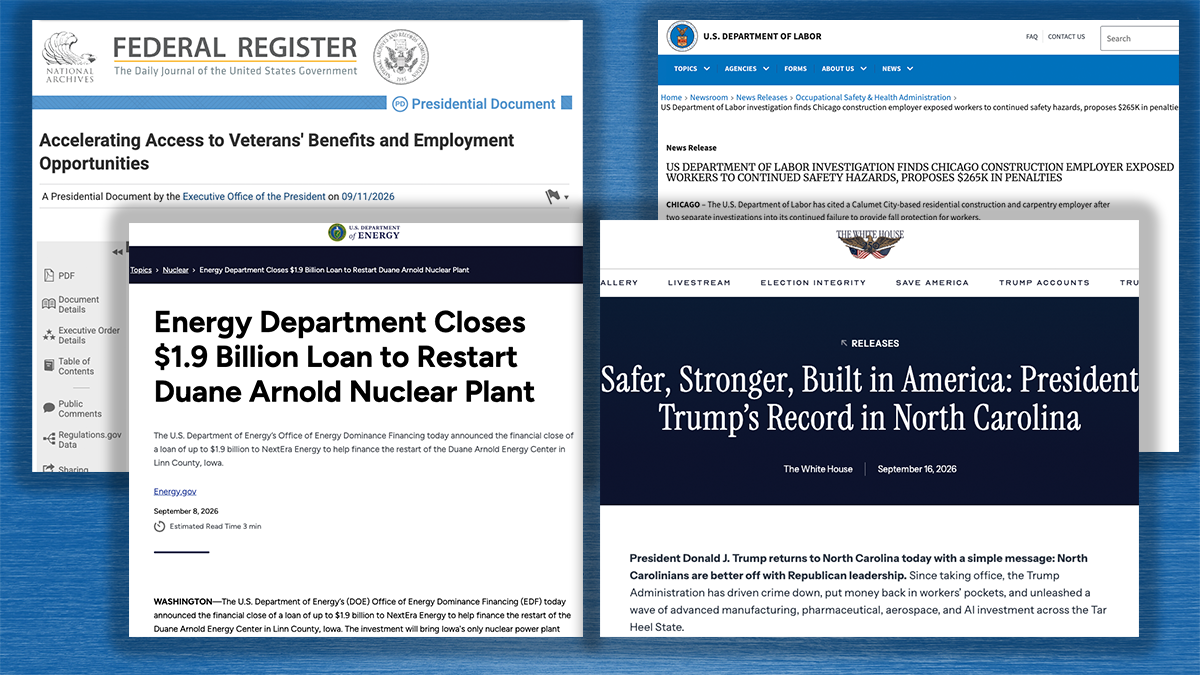
Executive Order 14426 directs the Departments of War and Veterans Affairs to share Official Military Personnel Files and Service Treatment Records permanently and prospectively, and sets deadlines for an overhaul of transition-to-employment programs. Records for current service members are to be shared on discharge within 30 days, information technology contracts reviewed and modified for interoperability within 120 days, and updated systems, policy guidance and new digital tools established within 180 days.
Section 3 requires the Secretary of War, consulting the Secretaries of Labor and Veterans Affairs, to update the Transition Assistance Program within 180 days and to update workforce programs under 10 U.S.C. 1142 through 1144 and 38 U.S.C. 4113. Separating service members are to be connected either to specific open jobs matched to their skills, through America's Talent Strategy or the Department of War's Project Patriot Pipeline, or to career and technical education, a Labor Department funded employment or training program, or a registered apprenticeship. Priority enrollment for registered apprenticeships runs through 38 U.S.C. 4215. A companion fact sheet states that record transfer currently takes an average of 90 to 180 days.
North Carolina roundup lists capital projects and building-materials tariffs
September 16, 2026 • Source
A White House release on North Carolina lists announced private capital investments in the state, several with construction employment attached: Amazon at $10 billion in Richmond County, JetZero at $4.7 billion in Greensboro, Johnson & Johnson at $2 billion in Wilson, Genentech at $2 billion in Holly Springs with 1,500 construction jobs, Biogen at $2 billion in Research Triangle, AbbVie at $1.4 billion in Durham with nearly 750 permanent and more than 2,000 construction jobs, Prysmian at $1 billion in Catawba County, Merck at $1 billion, US Forged Rings at $875 million in Hertford County, Novartis at $771 million, and STERIS at $600 million in Sanford.
LABOR
Davis-Bacon conformance and fringe benefit collection sent to OMB, comments due October 13
September 10, 2026 • Source
The Wage and Hour Division submitted for OMB review the information collection covering requests to approve conformed wage classifications and unconventional fringe benefit plans under the Davis-Bacon and Related Acts and the Contract Work Hours and Safety Standards Act. The collection carries two components: reports of conformed classifications and wage rates, used where a needed job classification is not listed in the applicable wage determination, and requests for approval of unfunded fringe benefit plans.
It carries OMB Control Number 1235-0023. The notice estimates 8,858 respondents, 8,858 responses, 2,305 annual burden hours and $75 in annual costs, and describes the covered projects as most federally financed or assisted construction, which requires payment of locally prevailing wages and fringe benefits. Comments are due October 13, 2026 and are filed through reginfo.gov. The agency contact is Nora Hernandez at 202-693-8633. The Federal Register document number is 2026-18506.
OSHA proposes $265,868 against Chicago-area residential contractor
September 15, 2026 • Source
OSHA proposed $265,868 in penalties against Martin Araujo, doing business as Araujo Construction Corp. of Calumet City, Illinois, after two investigations at residential construction worksites in the Chicago area. The agency cited two willful violations for failing to provide fall protection to workers installing roof rafters and roof sheathing at heights up to 25 feet, nine repeat violations covering head and eye protection, stairway handrails and ladder extension, one serious violation for unsafe platform access, and one other-than-serious violation for missing training certifications. The employer has 15 business days from receipt to comply, request an informal conference with the area director, or contest the findings before the Occupational Safety and Health Review Commission.
Mental health parity enforcement narrowed to three priority areas
September 8, 2026 • Source
Field Assistance Bulletin No. 2026-03, issued by Assistant Secretary Daniel Aronowitz to the Director of Enforcement and the regional directors, sets guiding principles for enforcement of the Mental Health Parity and Addiction Equity Act’s nonquantitative treatment limitation requirements. EBSA will prioritize three categories. The first is separate treatment limitations, including exclusions, where the agency will focus on blanket treatment exclusions that apply only to mental health and substance use disorder benefits. The second is medical necessity standards and the review process, covering prior authorization, concurrent review and retrospective review. The third is standards for determining network adequacy, with a focus on network admission standards and provider reimbursement methodologies.
The bulletin continues the non-enforcement policy the Departments issued in May 2025 for the 2024 parity final rule. They will not enforce, or pursue actions based on, a failure to comply occurring before a final decision in the ERIC litigation plus an additional 18 months, and that relief applies only to the portions of the 2024 rule that are new relative to the 2013 final rule. The statutory obligations as amended by the Consolidated Appropriations Act, 2021 continue to have effect, and plans, issuers and their service providers must make their comparative analyses available during EBSA investigations and to participants and beneficiaries on request.
ENERGY
Department closes loan of up to $1.9 billion for the Duane Arnold restart
September 8, 2026 • Source
The Department closed a loan of up to $1.9 billion to NextEra Energy through the Office of Energy Dominance Financing to restart the Duane Arnold Energy Center in Linn County, Iowa. The plant provides 615 megawatts of baseload capacity and ceased operations in 2020. The restart is pending Nuclear Regulatory Commission licensing approvals, with no date given. The Department says the project is expected to support nearly 1,500 construction jobs and more than 450 operations jobs and to power nearly 500,000 homes.
HOMELAND SECURITY
H-2B cap reached for the first half of fiscal 2027
September 11, 2026 • Source
U.S. Citizenship and Immigration Services announced that it has received enough petitions to reach the congressionally mandated H-2B cap for the first half of fiscal year 2027. September 4, 2026 was the final receipt date for new cap-subject H-2B petitions requesting an employment start date before April 1, 2027. Petitions received after that date are rejected.
E-Verify information collection revision open for comment through October 13
September 10, 2026 • Source
USCIS submitted a revision of the currently approved E-Verify program information collection, covering Form G-1617, for a 30-day comment period closing October 13, 2026. The notice describes no changes to the program itself.
The collection covers employer enrollment, new user and annual user training, terms of service training, queries and initial cases, and reverification. The notice estimates approximately 1.11 million annual respondents, 2,045,781 annual burden hours and $1,887,000 in annual costs. USCIS received two comments on the preceding 60-day notice. The Federal Register document number is 2026-18465.
INTERIOR
BLM sets Idaho geothermal lease sale for November 17
September 17, 2026 • Source
The Bureau of Land Management will offer 35 parcels covering nearly 113,330 acres across eight Idaho counties: Boise, Cassia, Clark, Elmore, Lemhi, Owyhee, Twin Falls and Washington. The sale runs online through EnergyNet on November 17, 2026, and leases carry an initial 10-year term. Revenue is split 50 percent to Idaho, 25 percent to the host county and 25 percent to the U.S. Treasury, with Idaho directing 90 percent of its share to the state renewable energy resources fund and 10 percent to counties for road maintenance and schools.
TRANSPORTATION
FAA distributes $1.1 billion in airport improvement grants
September 14, 2026 • Source
The FAA distributed 280 Airport Improvement Program grants totaling $1.1 billion across 46 states and three territories. Named awards include $30.7 million for runway reconstruction at Hartsfield-Jackson Atlanta International Airport, $18.9 million for terminal expansion at Shreveport Regional Airport in Louisiana, $11.5 million for a new contract tower at Mankato Regional Airport in Minnesota, and $2 million for terminal expansion at McAllen International Airport in Texas covering baggage claim, restrooms, nursing stations and ticketing. A further $43 million goes to noise mitigation at 12 airports, and $10.9 million equips 3,000 vehicles at 61 airports with vehicle movement area transmitters. The FAA separately received $16.5 million under the Working Families Tax Cuts Act to equip its own airport vehicles with the transmitters.
Runway reconstruction, terminal work and a new contract tower each carry mechanical scope, from HVAC and ductwork to piping and controls, and the noise mitigation grants fund window, door and envelope work on structures near the airports.
INTERNAL REVENUE SERVICE
Hearing scheduled on the private school nondiscrimination rule, testimony requests due November 3
September 16, 2026 • Source
The Internal Revenue Service scheduled a public hearing on REG-119986-25, Racial Nondiscrimination in Private Schools, under Docket ID IRS-2026-1189. The hearing is set for December 2, 2026 at 10:00 a.m. Eastern time by teleconference, with 10 minutes per speaker. Requests to testify, accompanied by speaker outlines, are due November 3, 2026. Registration to attend without testifying closes November 30, 2026, and accessibility requests are due November 27, 2026.
The underlying proposed rule, published at 91 FR 56811 on September 4, 2026, would provide that a private school is not described as an organization exempt from federal income tax if it maintains policies that discriminate on the basis of race, color, or national or ethnic origin in admissions, scholarships or loans, educational policies, or other school-administered or supported programs. It would apply to taxable years beginning after May 31, 2027, and would reach jointly trusteed apprenticeship and training programs in the building trades that are organized as tax-exempt educational organizations.
WAR
Army awards conditional leases for on-installation power generation at six sites
September 18, 2026 • Source
The Army announced conditional enhanced use lease awards for commercial power generation at six installations: Ameresco at Aberdeen Proving Ground, Maryland and Picatinny Arsenal, New Jersey; Indelible-Bloom at Fort Detrick, Maryland, Letterkenny Army Depot, Pennsylvania and West Point, New York; and Frontier Power USA at Tobyhanna Army Depot, Pennsylvania. The technology mix covers battery energy storage, natural gas and nuclear electric generation.
Under the lease structure at 10 U.S.C. 2667 the Army retains title while private lessees finance, design, build and operate the facilities and pay fair market value rent, preferably as in-kind consideration funding infrastructure improvements. The Army states that those improvements must comply with Davis-Bacon prevailing wages and the Buy American Act, and that full review under the National Environmental Policy Act, the Clean Air Act and the Clean Water Act is required before construction begins. Development may begin as early as 2027, with initial operating capability targeted by or ahead of 2030.
ENVIRONMENTAL PROTECTION AGENCY
Power plant carbon standards partly repealed, with the remainder proposed for repeal
September 14, 2026 • Source
EPA finalized a partial repeal of the 2024 Carbon Pollution Standards for fossil fuel-fired electric generating units and simultaneously proposed repealing the remaining greenhouse gas standards for those units. The final rule was published at 91 FR 58954 on September 17 under RIN 2060-AW55 and Docket ID EPA-HQ-OAR-2025-0124, and takes effect November 16, 2026.
The repeal rescinds the emission guidelines for existing coal-fired steam units, eliminating the 90 percent carbon capture and storage requirement for long-term units and the 40 percent natural gas co-firing requirement for medium-term units scheduled for closure. It removes the 90 percent capture standard for large modifications to coal units, and removes the Phase 2 capture standards for new combustion turbines while leaving the Phase 1 efficiency standards in place. EPA puts present-value compliance cost savings at $160 billion at a 3 percent discount rate and $95 billion at 7 percent over 2026 through 2047, with total avoided resource costs of $280 billion at 3 percent and $180 billion at 7 percent. Capture and co-firing retrofits of the kind the rescinded requirements would have compelled carry capture trains, compression, large-bore piping and tie-in scope.
The supplemental proposed rule, published at 91 FR 59002 under RIN 2060-AX00 in the same docket, would rescind the 2015 greenhouse gas findings and repeal all remaining greenhouse gas standards for these units, on the argument that EPA lacks authority under Clean Air Act Section 111 to regulate them in response to global climate change concerns. EPA projects a further $370 million in direct compliance cost savings. Comments are due November 2, 2026, and a virtual public hearing is set for October 1, 2026. Comments may be filed at regulations.gov, by email to a-and-r-docket@epa.gov, or by mail to the EPA Docket Center at 1200 Pennsylvania Avenue NW, Washington, DC 20460.
FAR COUNCIL
Part 36 rewrite would strip six construction clauses
September 18, 2026 • Source
The FAR Council published four Revolutionary FAR Overhaul proposed rules on September 18, the first tranche to reach the construction parts of the Federal Acquisition Regulation. Comments on all four are due October 19, 2026.
The proposed rule at 91 FR 59534 (RIN 9000-AO83, FAR Case 2026-010, Docket ID FAR-2026-0010) would separate the construction regulations in Part 36 from the architect-engineer regulations and would remove six construction clauses outright:
- 52.236-1, Performance of Work by the Contractor, which the rule describes as restricting competition.
- 52.236-4, Physical Data, as redundant with existing requirements.
- 52.236-19, Organization and Direction of the Work, whose requirement for full-time resident direction by an owner or senior officer the rule calls a non-statutory overreach.
- 52.236-26, Preconstruction Conference, with the requirement moved to the solicitation stage.
- 52.236-27, Site Visit, which the rule treats as inherent contracting officer authority.
- 52.236-28, Preparation of Offers, as redundant.
Duplicate publicizing text in Part 36 is removed in favor of Part 5. Part 28 on bonds and insurance receives administrative corrections and simplifications that the rule states do not substantively alter existing policy or procedures. Part 14 streamlines sealed bidding, removing redundancy and outdated provisions including facsimile bids, dropping permissive pre-bid conference language, and relocating publicizing and protest procedures. Part 52 converts to plain language and may renumber provisions and clauses under a new subpart structure. Comments are due October 19, 2026 at regulations.gov, citing FAR Case 2026-010.
Reverse auctions would be barred for complex design and construction services
September 18, 2026 • Source
The proposed rule at 91 FR 59476, RIN 9000-AO91, FAR Case 2026-006, Docket ID FAR-2026-0006, would implement the Construction Consensus Procurement Improvement Act of 2021 in Part 17 by defining complex, specialized, or substantial construction services and prohibiting reverse auctions for such services above the simplified acquisition threshold. The definition reaches site planning and design, architectural and engineering services, interior design, substantial construction work for facility, infrastructure and environmental restoration projects, and construction or substantial alteration of public buildings or public works. Existing prohibitions on reverse auctions for two-phase design-build and Brooks Architect-Engineer Act procurements are maintained.
Part 17 would also drop the non-statutory five-year contract duration limit in favor of any applicable statutory or regulatory limits, remove the limitations on using the option clauses at 52.217-6 and 52.217-7 in solicitations and contracts for services, rename 52.217-8 from Option to Extend Services to Option to Extend and allow its use for requirements other than services, and add mutual tolling language for option exercise periods during government shutdowns. Part 16 would make fixed-price contracts with performance-based considerations the default under Executive Order 14402, requiring written justification and agency head approval for other contract types, and would require brief written explanations to unsuccessful task and delivery order offerors for awards between the simplified acquisition threshold and $7.5 million. Comments are due October 19, 2026, citing FAR Case 2026-006.
Construction could qualify as a commercial service under a $9 million simplified threshold
SEPTEMBER 18, 2026 • Source
The proposed rule at 91 FR 59406 (RIN 9000-AO88, FAR Case 2026-003, Docket ID FAR-2026-0003) would allow construction to qualify as a commercial service where it is offered and sold competitively in substantial quantities in the commercial marketplace based on established catalog or market prices for specific tasks performed or specific outcomes to be achieved. Contracting officers could then use the streamlined procedures in Part 12, and the rule states that a contracting officer procuring construction as a commercial service must still comply with Part 36. The rule would also raise the simplified acquisition threshold for commercial products and services to $9 million, and to $15 million in specified emergencies or major disasters. Comments are due October 19, 2026, citing FAR Case 2026-003.
NASA
NUCLEAR REGULATORY COMMISSION
Hearings set on the Long Mott construction permit and the Belews Creek early site permit
SEPTEMBER 14, 2026 • Source
The Commission set its mandatory hearing on Long Mott Energy's construction permit application for the Long Mott Generating Station at the Dow Chemical Seadrift site in Calhoun County, Texas, for September 22, 2026 at the Bauer Community Center in Port Lavaca. The application, at NRC Docket No. 05-614 and regulations.gov Docket ID NRC-2025-0079, covers four X-energy Xe-100 small modular high-temperature gas-cooled reactors totaling 800 megawatts thermal, and the permit would authorize construction of the plant and associated common facilities. Written submissions are due by October 6, 2026.
A separate mandatory hearing on Duke Energy Carolinas' early site permit application for Belews Creek was scheduled for September 17 in Danbury, North Carolina. That application, at NRC Docket No. 52-055 and regulations.gov Docket ID NRC-2025-2161, covers a site in Stokes and Forsyth Counties and uses a plant parameter envelope spanning several vendor technologies rather than committing to a specific reactor design. The hearing record stays open for written comment through October 1, 2026.
FEDERAL ENERGY REGULATORY COMMISSION
Commission approves a substation security standard and sustains a 1,200 megawatt pumped storage license
SEPTEMBER 10, 2026 • Source
At its September open meeting the Commission approved Reliability Standard CIP-014-4 in Docket No. RD26-9-000, which requires transmission owners to assess critical substations and develop security plans. It sustained the original license for the 1,200 megawatt Goldendale pumped storage project in Washington (Project No. 14861-003) and issued a new license for the 30.75 megawatt Cornell Hydroelectric Project in Wisconsin (Project No. 2639-028).
On the gas side the Commission authorized the Kosciusko Junction Pipeline Project in Mississippi at 1.175 million dekatherms per day (CP25-547-000 and CP25-549-000), a 627,000 dekatherm per day increase on the Gator Express Pipeline (CP26-104-000), a compressor installation in Ohio adding 170,000 dekatherms per day for Texas Gas Transmission (CP26-16-000), and certificates for 311,970 dekatherms per day for UGI Auburn (CP26-9-000 and CP26-9-001).
TENNESSEE VALLEY AUTHORITY
Browns Ferry Unit 1 enters refueling and maintenance outage
SEPTEMBER 17, 2026 • Source
More than 800 contractors and shared-resource employees are supporting Browns Ferry staff through thousands of work activities during the scheduled outage on Unit 1, covering inspections, tests, maintenance and equipment replacements. TVA ties the work to its Nuclear Life Extension plan, which the authority says will add up to 244 megawatts of additional generation over 10 to 15 years.
Draft environmental statement issued for a Mississippi solar and storage project
SEPTEMBER 15, 2026 • Source
TVA released a draft environmental impact statement for the Hope Solar and Storage Project, developed by Hope SB north of West Point, Mississippi and west of US Highway 45 Alternate in Clay County. The facility would provide up to 200 megawatts AC of solar and up to 400 megawatts of four-hour battery energy storage within a 2,419-acre study area carrying approximately 1,700 acres of disturbance limits. TVA analyzed a no action and an action alternative and would enter a 20-year power purchase agreement if the project proceeds. Comments are due 15 days from September 15, 2026 and may be filed at tva.com/nepa. A final statement and decision are tentatively set for early 2027.
Sep 30, 2026 — Member Update
Latest Articles
Sep 30, 2026 - Learn more about this Chicago-based contractor’s history and how they are heading towards a bright tomorrow thanks to a recent expansion.
Sep 30, 2026 - Help us honor those colleagues, friends, and loved ones who have passed away since our last Annual Convention.
Sep 30, 2026 - SMACNA’s College of Fellows members are the top industry professionals who have made significant contributions and advancements to the sheet metal industry.
Privacy Policy |
Terms of Use | Contact Us
Phone: 703.803.2980 | Email:
info@smacna.org
© 1998-2026 SMACNA. All rights reserved.
Web Design & Development by Matrix Group
International, Inc.
