Partners in Progress: Advancing Registered Apprenticeships at the State and Local Level
SMART and SMACNA recently collaborated on a joint session on this topic at the recent conference in Orlando.
SMACNA and SMART recently came together for a powerful Partners in Progress joint presentation focused on strengthening Registered Apprenticeship Programs (RAPs) and expanding Career & Technical Education (CTE) pipelines nationwide.
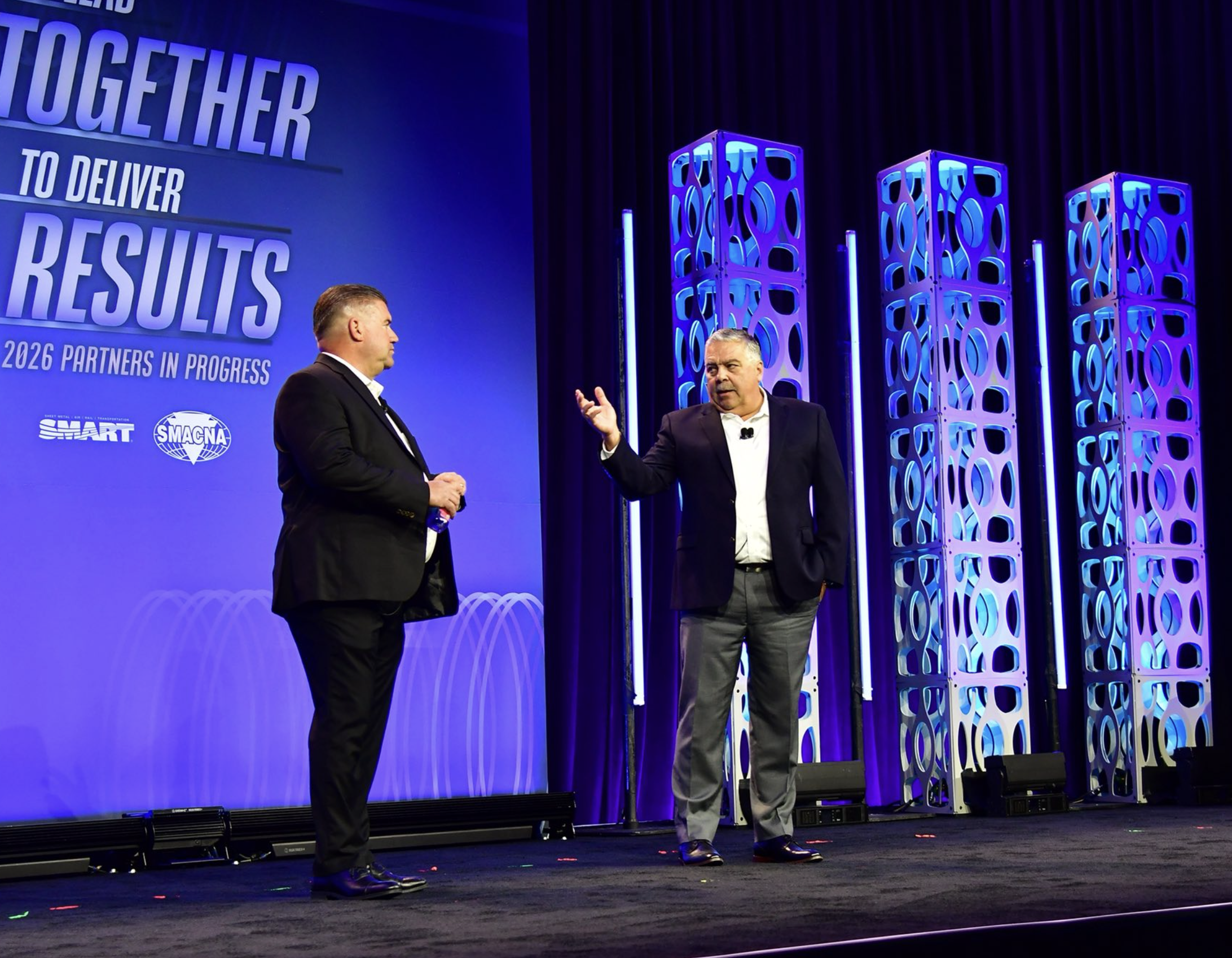 The national panel included Tiffany Finck Haynes (SMART) and Denise Murphy McGraw (SMACNA), alongside local leaders Michael Mark (SMART Local 104), Matthew W. Smith (Northern San Joaquin Valley SMACNA), and Alex Tiechner (Northern CA Valley Sheet Metal Apprenticeship and Training Center)
The discussion reinforced several key priorities we have advanced with the U.S. Department of Labor:
Protect and strengthen Registered Apprenticeship Programs — the primary source of highly skilled construction workers, with 74% of construction apprentices trained through JATCs
Maintain clear pathways from pre-apprenticeship and CTE programs into identified RAPs
Expand affordability for apprenticeship and credentialing through support of the Freedom to Invest in Tomorrow’s Workforce Act (H.R. 1151)
Promote sustained infrastructure investment, which generates $3.4 billion in GDP and 28,500 jobs for every $1 billion invested
Strengthen prevailing wage enforcement to ensure fair competition and quality outcomes
The data speaks clearly: California’s five-year completion average for sheet metal apprentices is 74.9%, well above the 65.8% average across all trades
At the local level, the presentation highlighted the strong connection between CTE programs and sheet metal apprenticeship pathways. Programs like the Engineering and Construction Academy at Lincoln High School in Stockton, CA, demonstrate what’s possible when curriculum alignment, industry partnerships, and labor-management collaboration come together.
Structured JATC tours, live demonstrations, hands-on engagement, and strong partnerships are improving recruitment, retention, and workforce readiness nationwide.
This joint effort reinforces what we know: federal and state policy must protect — not disrupt — existing apprenticeship systems and continue to strengthen the pipeline from classroom to career.
Feb 25, 2026 — State Legislative
Latest Articles
Jul 31, 2026 - New facilities are two to three times larger than traditional commercial projects, requiring more HVAC systems, more sheet metal, more coordination, and significantly greater electrical capacity.
Jul 31, 2026 - A recent U.S. Supreme Court decision cleared a significant legal hurdle for future development, while lawmakers continue to wrestle with questions surrounding energy demand, water consumption, permitting, and infrastructure planning.
Jul 31, 2026 - Project represents one of the nation's largest transportation infrastructure investments and will restore a critical freight corridor serving the Port of Baltimore and the Mid-Atlantic region.
Privacy Policy |
Terms of Use | Contact Us
Phone: 703.803.2980 | Email:
info@smacna.org
© 1998-2026 SMACNA. All rights reserved.
Web Design & Development by Matrix Group
International, Inc.
