Appeals Court Upholds Minnesota's Construction Worker Misclassification Law
On Oct. 24, the U.S. Court of Appeals for the Eighth Circuit issued a decision that should be viewed as a meaningful victory for responsible union construction contractors.
 In Minnesota Chapter of Associated Builders & Contractors v. Blissenbach, the court affirmed a lower court’s refusal to block Minnesota from enforcing its construction worker misclassification law.
Minnesota’s 2024 law imposes a 14-factor test that must be satisfied for a worker to be treated as an independent contractor in the construction industry.
This is good for union contractors. It reaffirms a state’s authority to regulate labor standards within the construction industry and prevents contractors who misclassify workers from gaining a competitive advantage by avoiding payroll taxes, insurance obligations, wage protections and collective bargaining responsibilities.
Effective March 1, Minnesota’s comprehensive 14-factor independent contractor test applies exclusively to workers engaged in commercial or residential construction or improvement services. To be considered an independent contractor, an individual operating as a business entity must meet all 14 criteria, including:
- Business Independence – The business entity must be established and maintained separately from the contractor hiring it and must provide services to multiple clients or the general public.
- Operational Capacity – The business entity must own or lease tools, equipment, vehicles or facilities necessary to perform the work.
- Legal and Tax Compliance – The business entity must hold any required MN or federal tax ID numbers, receive and retain Form 1099s when applicable, file business or self-employment tax returns and provide a W-9 when required.
- Regulatory Compliance – The business entity must carry workers’ compensation insurance (if required), a Minnesota unemployment insurance account (if required) and any required business licenses and certifications.
- Contractual Requirements – The business entity must perform work under a signed and dated “written contract" that is “fully executed” within 30 days of starting work, “identifies the specific services to be provided or performed” and “provides for compensation from the person for the services provided under the contract on a commission or per-job or competitive bid basis.”
- Payment and Invoicing – Payment must be made only upon invoices submitted in the name of the business. Cash payments do not qualify.
- Control and responsibility – The contract must give the business entity control over the means and methods of performance, and the entity must be responsible for completion of the work and liable if it is not completed.
- Risk of Profit or Loss – The entity must be able to realize a profit or suffer a loss depending on performance and expenses.
Failure to satisfy even one of the 14 factors results in the worker being classified as an “employee” and not an independent contractor under Minnesota law. The Minnesota Department of Labor and Industry (“DLI”) and the Minnesota Attorney General have enforcement authority. There also is a private right of action, through which a misclassified individual may seek compensatory damages.
- Up to $10,000 per misclassified worker
- Up to $10,000 per violation of the law’s disclosure and classification requirements
A penalty of $1,000 per day for obstructing a Minnesota DLI investigation Individuals who knowingly or repeatedly engage in any of the prohibited activities may also be held liable.
Expect more states to look to Minnesota’s law as a way to stamp out fraud in the non-union construction sector, level the competitive playing field and ensure that workers receive legal wages, benefits and protections.
Grant Collins is a specialist in labor and employment law at Felhaber Larson. Reach him at gcollins@felhabor.com
Published: January 12, 2026
IN THIS ISSUE
A Gathering to Remember: Gratitude, Growth & the Power of Community
It is always fun to bring the SMACNA convention to Maui. It was wonderful to connect with members and learn from great speakers.
A Journey Built on Opportunity: SMACNA’s New President Looks Ahead
Aloha, everyone. It means the world to me to serve as your 2025-2026 SMACNA National President.
Appeals Court Upholds Minnesota's Construction Worker Misclassification Law
On Oct. 24, the U.S. Court of Appeals for the Eighth Circuit issued a decision that should be viewed as a meaningful victory for responsible union construction contractors.
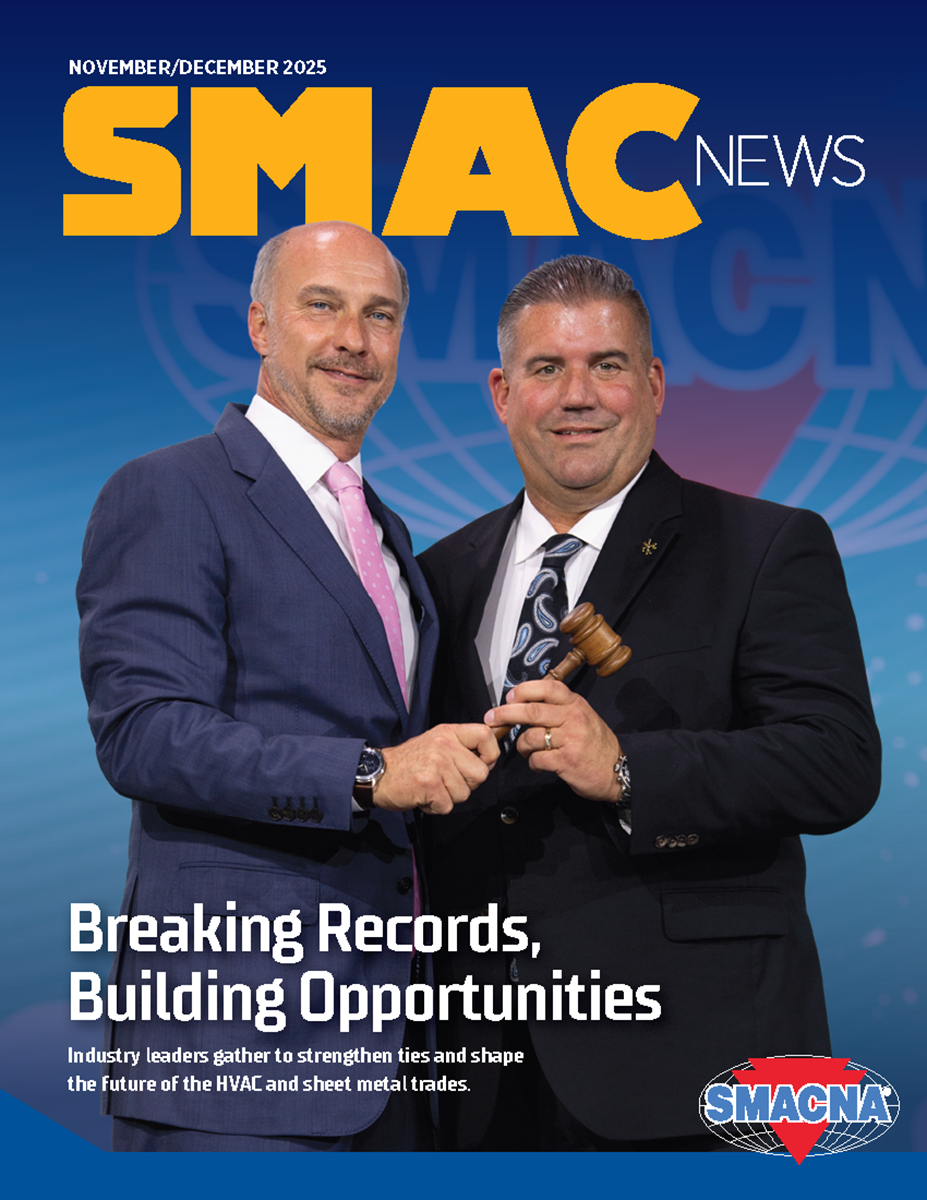
Breaking Records, Building Opportunities
Industry leaders gather to strengthen ties and shape the future of the HVAC and sheet metal trades.
Flying High Again
SMACNA member W.G. Tomko’s work on the redesigned mechanical systems at Pittsburgh International Airport was key to the $1.7-billion renovation project.
Forging the Future of Industrial Sheet Metal
Family-founded and future-focused, Vidimos Inc. stakes its reputation on precision, flexibility and a commitment to craftsmanship.
Navigating Tariffs, Tax Incentives, and Workforce Priorities
On going legislative developments and regulatory actions at the federal level continue to shape the competitive landscape, costs and project opportunities for HVAC and sheet metal contractors.
On the Brink of Change
How one residential HVAC contractor has been preparing for the A2L refrigerants transition.
On the Front Lines of Policy
Congressman Ed Case talks defense, dysfunction and the future of America’s builders.
P1 Construction Sets New Benchmark in Construction Safety with Dual Innovation Programs
SMACNA’s 2025 Safety Innovator of the Year creates a safer, more supportive culture for workers.
Raising the Bar in Brazil
Inside SMACNA Brazil’s mission to bring quality HVAC and cleaner air to the forefront.
Stainless Spires Rise Above the River
Budde Sheet Metal Works crafts soaring eagle-wing spires, blending old-school expertise and next-gen training for Dayton’s New Law Enforcement Memorial that honors fallen officers.
The Majority of SMACNA Members Need a CTO
Conferences across construction and fabrication are full of talk about analytics, metrics and KPIs.
The ROI of AI in Construction: A Financial Perspective
Contractors are increasingly presented with AI-powered tools marketed to boost efficiency and reduce risk.
Uncertainty is the New Normal
Economist Rebecca Patterson warns that tariffs will rise and AI will reshape work as the economy enters uncharted territory.
Welcome New SMACNA Members
When the Sky Isn't the Limit
Colonel Nicole Malachowski shows SMACNA how courage, change and gratitude can take leaders further than altitude ever could.
Privacy Policy |
Terms of Use | Contact Us
Phone: 703.803.2980 | Email:
info@smacna.org
© 1998-2025 SMACNA. All rights reserved.
Web Design & Development by Matrix Group
International, Inc.