Uncertainty is the New Normal
Economist Rebecca Patterson warns that tariffs will rise and AI will reshape work as the economy enters uncharted territory.
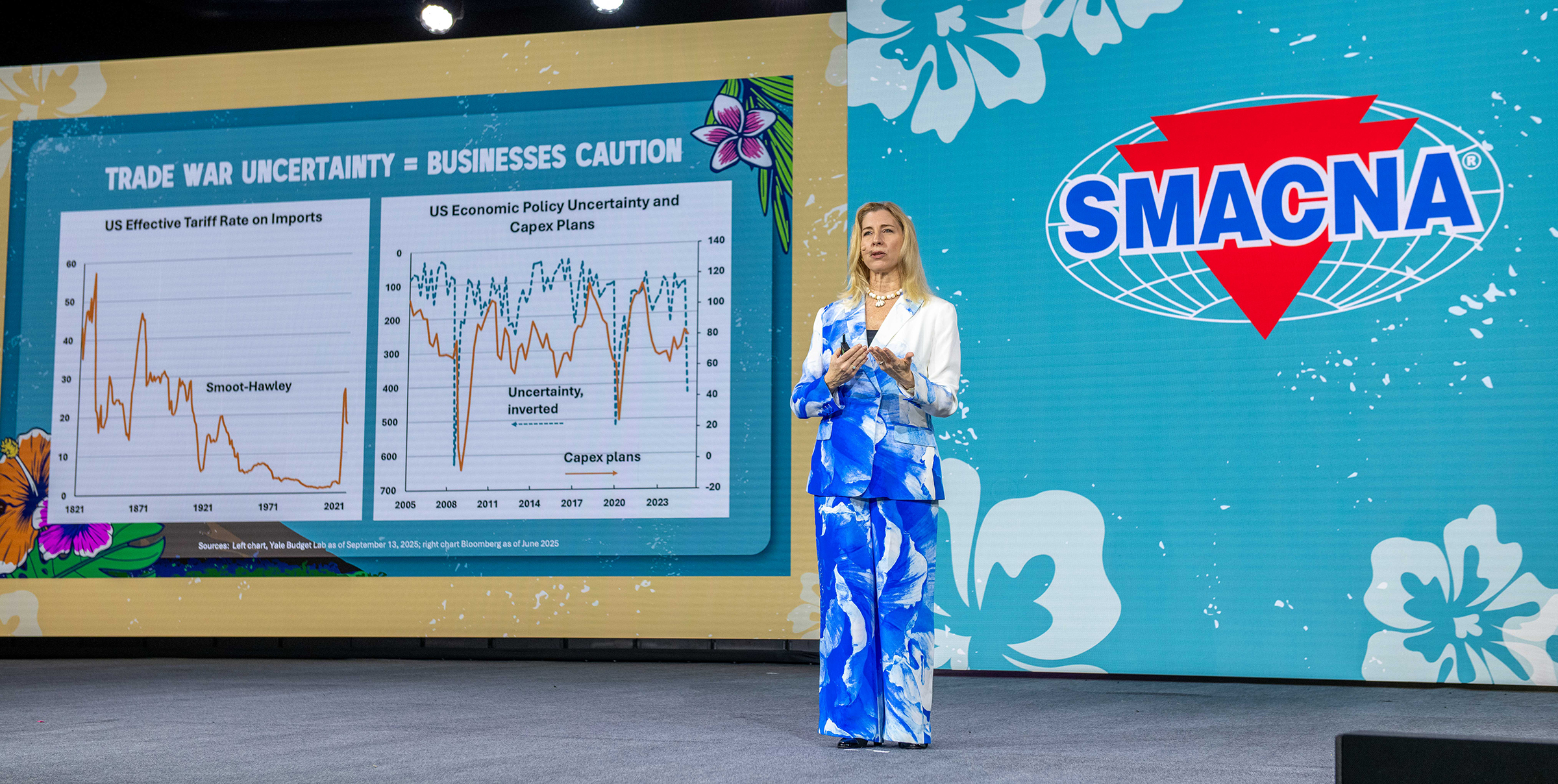 |
Rebecca Patterson talks about the economy, tariffs, and AI with the SMACNA Annual Convention audience. |
Rebecca Patterson, a globally recognized investor and macroeconomic researcher, took the SMACNA Annual Convention stage at a tipping point in economic history. This year, the challenges facing leaders in construction, procurement, and business are sharper than ever, driven by rising tariffs, shifting policy, and the accelerating march of artificial intelligence (AI).
Patterson, known for her tenure at Bridgewater Associates, Bessemer Trust, and JPMorgan, and for her inclusion on American Banker’s list of Most Powerful Women in Finance for six consecutive years, delivered candor and clarity to an audience eager for direction.
2025: A YEAR OF RISK AND RESILIENCE
“Tariffs and related policies like export controls and countervailing duties are clearly the big issue this year for supply chains,” Patterson says, underscoring both the uncertainty and inflationary pressures dogging businesses nationwide. “Prices will go higher — the question is not if, but exactly when and by how much.” Her words resonate at a time when procurement and supply chain leaders are grappling with confusion over exemption levels and political winds, with national economic emergency tariffs hanging in the balance.
When asked what keeps her up at night in 2025, Patterson is direct. “We have an uncomfortable number of questions that create risk for procurement leaders,” says the current member of the Council on Foreign Relations, the Economic Club of New York, and the Trilateral Commission. “What if America’s national economic emergency tariffs are deemed illegal? What countries are at risk of seeing tariff levels changed or delayed again?”
Given these unknowns, she advises leaders to “avoid where possible the ‘known risk areas’ — both specific goods and countries in the White House’s crosshairs — then stick to business as usual, purchasing what’s needed.”
THE DOUBLE-EDGEDSWORD OF AI
Current conversations in boardrooms are equally focused on the bottom line and on workforce disruption, Patterson shares.
“Given changing cost dynamics, companies are searching for efficiency gains and other ways to manage budgets. This increasingly includes using AI to reduce needed headcount,” she says.
She recently told Amazon’s Business Reshape audience that companies faced with rising input and AI-investment costs, along with economic uncertainty, are “planning to scale back headcount going into 2026.” In her words, “The bias is that more job cuts are coming. The offsets are personnel.”
LIVE DATA, MARKET MOVES AND UNCHARTED TERRAIN
Asked what indicators she watches closely, Patterson says, “labor-market data is top of mind. Fewer jobs would mean less spending, and that would flow through not just the U.S., but also the global economy.”
She also points to the risk of politicized central banks, warning, “If the Fed becomes politicized, you risk unanchored inflation expectations, which hurts confidence, markets, and consumers.”
Still, Patterson tries to balance realism with resourcefulness. “The best approach may be to try to avoid known risk areas, but stick to business as usual otherwise,” she advises.
If there’s one message she hopes leaders remember, it’s to pay attention, innovate, and never bet purely on yesterday’s playbook. At a “truly historic moment for the global economy,” as she calls it, that advice is more urgent than ever.
Published: January 12, 2026
IN THIS ISSUE
A Journey Built on Opportunity: SMACNA’s New President Looks Ahead
Aloha, everyone. It means the world to me to serve as your 2025-2026 SMACNA National President.
Appeals Court Upholds Minnesota's Construction Worker Misclassification Law
On Oct. 24, the U.S. Court of Appeals for the Eighth Circuit issued a decision that should be viewed as a meaningful victory for responsible union construction contractors.
ARCHITECTURAL: Stainless Spires Rise Above the River
Budde Sheet Metal Works crafts soaring eagle-wing spires, blending old-school expertise and next-gen training for Dayton’s New Law Enforcement Memorial that honors fallen officers.
Breaking Records, Building Opportunities
Industry leaders gather to strengthen ties and shape the future of the HVAC and sheet metal trades.
HVAC: Flying High Again
SMACNA member W.G. Tomko’s work on the redesigned mechanical systems at Pittsburgh International Airport was key to the $1.7-billion renovation project.
INDUSTRIAL: Forging the Future of Industrial Sheet Metal
Family-founded and future-focused, Vidimos Inc. stakes its reputation on precision, flexibility and a commitment to craftsmanship.
Navigating Tariffs, Tax Incentives, and Workforce Priorities
On going legislative developments and regulatory actions at the federal level continue to shape the competitive landscape, costs and project opportunities for HVAC and sheet metal contractors.
On the Front Lines of Policy
Congressman Ed Case talks defense, dysfunction and the future of America’s builders.
P1 Construction Sets New Benchmark in Construction Safety with Dual Innovation Programs
SMACNA’s 2025 Safety Innovator of the Year creates a safer, more supportive culture for workers.
Raising the Bar in Brazil
Inside SMACNA Brazil’s mission to bring quality HVAC and cleaner air to the forefront.
RESIDENTIAL: On the Brink of Change
How one residential HVAC contractor has been preparing for the A2L refrigerants transition.
The Majority of SMACNA Members Need a CTO
Conferences across construction and fabrication are full of talk about analytics, metrics and KPIs.
The ROI of AI in Construction: A Financial Perspective
Contractors are increasingly presented with AI-powered tools marketed to boost efficiency and reduce risk.
Uncertainty is the New Normal
Economist Rebecca Patterson warns that tariffs will rise and AI will reshape work as the economy enters uncharted territory.
Welcome New SMACNA Members
When the Sky Isn't the Limit
Colonel Nicole Malachowski shows SMACNA how courage, change and gratitude can take leaders further than altitude ever could.
Privacy Policy |
Terms of Use | Contact Us
Phone: 703.803.2980 | Email:
info@smacna.org
© 1998-2026 SMACNA. All rights reserved.
Web Design & Development by Matrix Group
International, Inc.
