The ROI of AI in Construction: A Financial Perspective
Contractors are increasingly presented with AI-powered tools marketed to boost efficiency and reduce risk.
 These technologies are gaining traction across the industry, but one critical question remains: When will the investment deliver measurable returns?
The answer is rarely straightforward. Unlike equipment with predictable depreciation schedules, AI delivers value incrementally. Upfront costs, such as data system upgrades, staff training and cybersecurity investments, are relatively easy to quantify. The returns, however, combine traditional financial metrics with harder-to-measure organizational benefits. Knowing what to track and when is essential.
AI’s financial impact develops in phases. Contractors can assess results by tracking specific indicators at each stage.
Quick Wins (0-6 Months)
- Automation of routine tasks, such as data entry, reporting and scheduling, frees teams to focus on higher-value activities.
- Back office improvements, including faster billing and invoice processing, shorten payment cycles and reduce errors. These enhancements improve cost tracking, strengthen cash flow visibility and improve forecasting confidence.
These initial efficiencies lay the foundation for deeper insights. As AI systems begin to learn from project data, contractors can expect more predictive capabilities to emerge in the months ahead.
Emerging Patterns (6-12 Months)
As systems mature, their predictive abilities show measurable impact:
- Schedule Variance: Comparing planned and actual completion dates shows whether AI is reducing schedule variance and helping mitigate delays.
- Safety Metrics: Wearables and video analytics should reduce incidents, near misses and lost workdays.
- Rework and Change Orders: Reality capture and BIM integration catch design conflicts earlier and reduce costly mid-project revisions.
As AI systems continue to learn and refine their outputs, the accumulated data begins to support more confident forecasting and strategic decision-making.
Strategic Gains (12-24+ Months)
- Improved forecasting leads contractors to steadier margins, stronger cash flow predictability and fewer emergency expenses.
- Long term planning benefits from disciplined resource allocation and better decision-making across multiple project cycles.
The workforce impact is equally important. By simplifying workflows and reducing administrative burdens, AI can improve morale, engagement and retention. In today’s competitive labor market, keeping skilled professionals delivers value that rivals financial returns.
While the path to ROI requires patience, AI will not deliver an overnight transformation. It requires investment, discipline and a broader definition of success than quarterly results alone. Contractors who track the right indicators and allow systems time to learn typically discover value that compounds over time. The real question is not whether AI delivers ROI, but whether companies are prepared to measure it on the proper timeline.
For more information, contact Ronald J. Eagar, CPA, CCIFP Partner at Grassi, at reagar@grassiadvisors.com, through www.grassiadvisors.com or at 516-336-2460.
Published: January 12, 2026
IN THIS ISSUE
A Journey Built on Opportunity: SMACNA’s New President Looks Ahead
Aloha, everyone. It means the world to me to serve as your 2025-2026 SMACNA National President.
Appeals Court Upholds Minnesota's Construction Worker Misclassification Law
On Oct. 24, the U.S. Court of Appeals for the Eighth Circuit issued a decision that should be viewed as a meaningful victory for responsible union construction contractors.
ARCHITECTURAL: Stainless Spires Rise Above the River
Budde Sheet Metal Works crafts soaring eagle-wing spires, blending old-school expertise and next-gen training for Dayton’s New Law Enforcement Memorial that honors fallen officers.
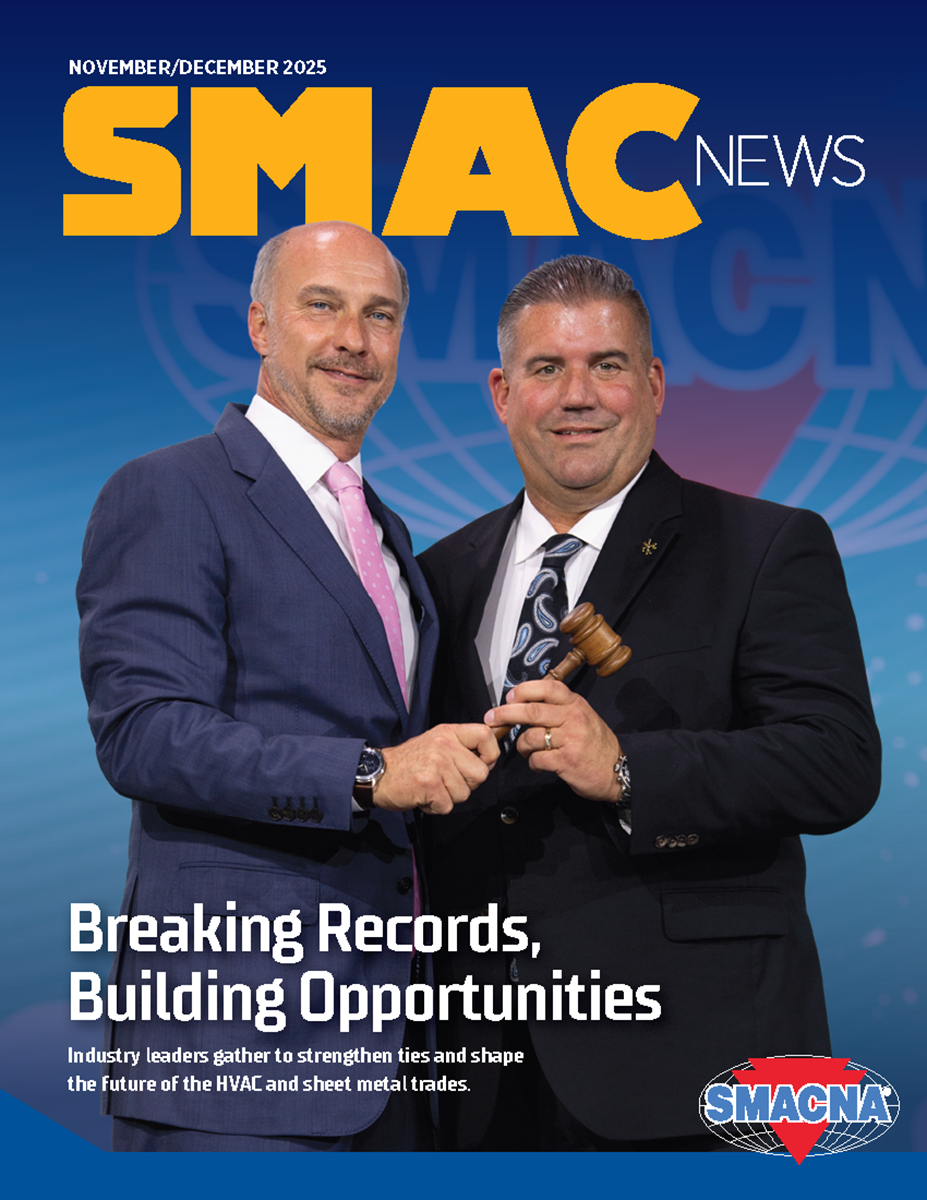
Breaking Records, Building Opportunities
Industry leaders gather to strengthen ties and shape the future of the HVAC and sheet metal trades.
HVAC: Flying High Again
SMACNA member W.G. Tomko’s work on the redesigned mechanical systems at Pittsburgh International Airport was key to the $1.7-billion renovation project.
INDUSTRIAL: Forging the Future of Industrial Sheet Metal
Family-founded and future-focused, Vidimos Inc. stakes its reputation on precision, flexibility and a commitment to craftsmanship.
Navigating Tariffs, Tax Incentives, and Workforce Priorities
On going legislative developments and regulatory actions at the federal level continue to shape the competitive landscape, costs and project opportunities for HVAC and sheet metal contractors.
On the Front Lines of Policy
Congressman Ed Case talks defense, dysfunction and the future of America’s builders.
P1 Construction Sets New Benchmark in Construction Safety with Dual Innovation Programs
SMACNA’s 2025 Safety Innovator of the Year creates a safer, more supportive culture for workers.
Raising the Bar in Brazil
Inside SMACNA Brazil’s mission to bring quality HVAC and cleaner air to the forefront.
RESIDENTIAL: On the Brink of Change
How one residential HVAC contractor has been preparing for the A2L refrigerants transition.
The Majority of SMACNA Members Need a CTO
Conferences across construction and fabrication are full of talk about analytics, metrics and KPIs.
The ROI of AI in Construction: A Financial Perspective
Contractors are increasingly presented with AI-powered tools marketed to boost efficiency and reduce risk.
Uncertainty is the New Normal
Economist Rebecca Patterson warns that tariffs will rise and AI will reshape work as the economy enters uncharted territory.
Welcome New SMACNA Members
When the Sky Isn't the Limit
Colonel Nicole Malachowski shows SMACNA how courage, change and gratitude can take leaders further than altitude ever could.
Privacy Policy |
Terms of Use | Contact Us
Phone: 703.803.2980 | Email:
info@smacna.org
© 1998-2026 SMACNA. All rights reserved.
Web Design & Development by Matrix Group
International, Inc.
