Navigating Tariffs, Tax Incentives, and Workforce Priorities
On going legislative developments and regulatory actions at the federal level continue to shape the competitive landscape, costs and project opportunities for HVAC and sheet metal contractors.
TARIFFS AND MATERIAL COSTS: A MAJOR CHALLENGE AMID SUPPLY CHAIN UNCERTAINTY
Tariffs remain a significant factor destabilizing supply chains and driving up material costs crucial to HVAC and sheet metal work, such as aluminum. Recent tariff hikes, notably driven by the Trump administration's legacy policies, have increased market uncertainty and largely functioned as hidden taxes, inflating input costs for contractors. Analysts warn of ongoing price instability due to limited domestic capacity for critical metals.
To mitigate the impact of tariffs, contractors may rely on several contractual and regulatory tools under the Federal Acquisition Regulation (FAR). For example:
- FAR 52.229-3 permits contract price increases to reflect newly imposed federal taxes, such as tariffs, provided those taxes were not anticipated in bid pricing.
- Economic Price Adjustment clauses (FAR 52.216-4) may allow contractors to request price adjustments if material cost indices rise due to tariffs.
- Those working under flexibly priced contracts can seek cost recoveries consistent with FAR 31.201-2, which defines the allowability and allocability of such costs.
Practically, contractors are advised to pre-purchase materials where feasible, identify domestic suppliers, update contract pricing provisions to accommodate cost passes, and scrutinize existing agreements for tariff-related relief or escalation clauses. These steps are vital to protect margins amid ongoing tariff volatility.
- Section 179D Energy Efficient Commercial Building Deduction allows up to $5 per square foot deductions for energy upgrade work in new or renovated projects. This incentive supports contractors specializing in energy-efficient systems.
- Bonus Depreciation and Section 179 Expensing enable faster write-offs for equipment and property investments, which can improve cash flow for contractors upgrading fleets or tooling.
- Advanced Manufacturing Investment Tax Credits (boosted from 25% to 35%) tied to CHIPS Act-facilitated domestic facility expansions open opportunities on construction projects supporting semiconductor and clean energy manufacturing.
45Q Carbon Sequestration and 45U Nuclear Energy Credits provide indirect support to contractors involved in cutting-edge clean energy infrastructure. While a political tug-of-war persists between the House and Senate over the full package, with the Senate pushing back on some health and deficit elements, the energy-related tax incentives critical to HVAC and sheet metal scopes are expected to be preserved and potentially expanded in the upcoming 2026 tax extender bills.
SMACNA advocates continue to press Congress to bolster workforce development by supporting Registered Apprenticeship Programs (RAPs) and enforcing prevailing wage laws, which are critical for union contractors. These efforts align with the demand for a highly skilled workforce capable of meeting technical challenges posed by advanced energy efficiency and federal infrastructure initiatives.
Efforts to close employee misclassification loopholes and promote Project Labor Agreements (PLAs) drive policy aims to level the playing field and protect contractor competitiveness and labor standards.
Massive federal investments under the Inflation Reduction Act (IRA), the expanded 35% tax credit within the CHIPS and Science Act, and the bipartisan Infrastructure Law continue to catalyze large-scale construction projects, from energy-efficient buildings to advanced manufacturing plants.
Despite some delays and freezes on approved projects due to budget office constraints and legal challenges, the general outlook for CHIPS and data center projects is positive. These initiatives continue to generate sustained demand for HVAC and sheet metal contractor services, particularly for energy-efficient terminal upgrades in transportation hubs, commercial retrofit,s and new clean energy facilities.
SMACNA’s political engagement efforts continue to emphasize growing bipartisan support on Capitol Hill for policies that advance contractors' economic interests. The outlook stresses building a strong, engaged coalition of legislators to embrace key industry priorities, tax incentives, and favorable regulatory frameworks.
SMACNA is expanding efforts at the state and local level, promoting far greater legislative outreach, education, and targeted advocacy to complement federal actions.
Contractor members have been encouraged to serve as "legislative ambassadors" and to participate, share updates, and insights to reinforce SMACNA’s industry voice in policymaking venues.
Contractors who stay informed and engaged with ongoing political developments, workforce initiatives, and evolving contract rules will continue to be best positioned to safeguard profitability and capitalize on the transformative projects defining the industry’s future.
Published: January 12, 2026
IN THIS ISSUE
A Journey Built on Opportunity: SMACNA’s New President Looks Ahead
Aloha, everyone. It means the world to me to serve as your 2025-2026 SMACNA National President.
Appeals Court Upholds Minnesota's Construction Worker Misclassification Law
On Oct. 24, the U.S. Court of Appeals for the Eighth Circuit issued a decision that should be viewed as a meaningful victory for responsible union construction contractors.
ARCHITECTURAL: Stainless Spires Rise Above the River
Budde Sheet Metal Works crafts soaring eagle-wing spires, blending old-school expertise and next-gen training for Dayton’s New Law Enforcement Memorial that honors fallen officers.
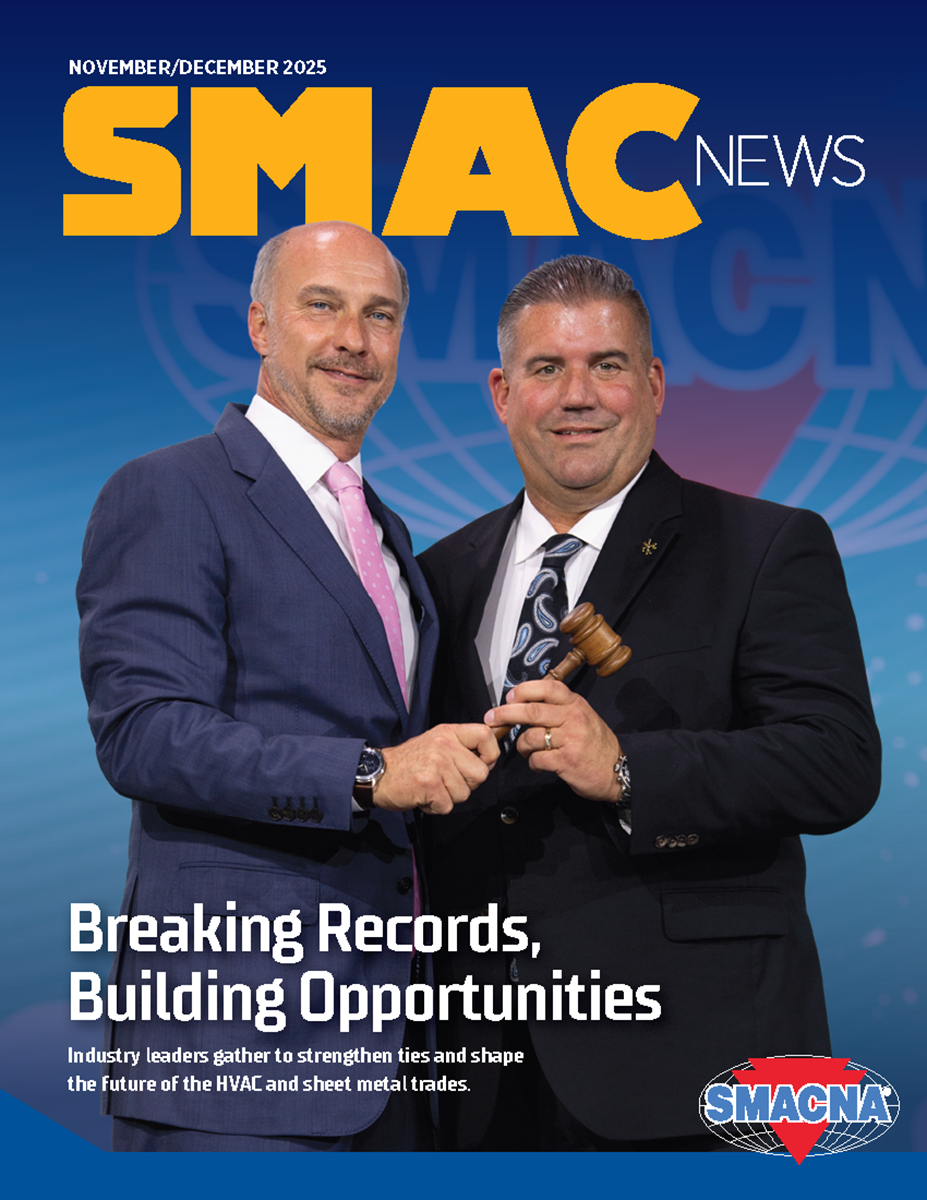
Breaking Records, Building Opportunities
Industry leaders gather to strengthen ties and shape the future of the HVAC and sheet metal trades.
HVAC: Flying High Again
SMACNA member W.G. Tomko’s work on the redesigned mechanical systems at Pittsburgh International Airport was key to the $1.7-billion renovation project.
INDUSTRIAL: Forging the Future of Industrial Sheet Metal
Family-founded and future-focused, Vidimos Inc. stakes its reputation on precision, flexibility and a commitment to craftsmanship.
Navigating Tariffs, Tax Incentives, and Workforce Priorities
On going legislative developments and regulatory actions at the federal level continue to shape the competitive landscape, costs and project opportunities for HVAC and sheet metal contractors.
On the Front Lines of Policy
Congressman Ed Case talks defense, dysfunction and the future of America’s builders.
P1 Construction Sets New Benchmark in Construction Safety with Dual Innovation Programs
SMACNA’s 2025 Safety Innovator of the Year creates a safer, more supportive culture for workers.
Raising the Bar in Brazil
Inside SMACNA Brazil’s mission to bring quality HVAC and cleaner air to the forefront.
RESIDENTIAL: On the Brink of Change
How one residential HVAC contractor has been preparing for the A2L refrigerants transition.
The Majority of SMACNA Members Need a CTO
Conferences across construction and fabrication are full of talk about analytics, metrics and KPIs.
The ROI of AI in Construction: A Financial Perspective
Contractors are increasingly presented with AI-powered tools marketed to boost efficiency and reduce risk.
Uncertainty is the New Normal
Economist Rebecca Patterson warns that tariffs will rise and AI will reshape work as the economy enters uncharted territory.
Welcome New SMACNA Members
When the Sky Isn't the Limit
Colonel Nicole Malachowski shows SMACNA how courage, change and gratitude can take leaders further than altitude ever could.
Privacy Policy |
Terms of Use | Contact Us
Phone: 703.803.2980 | Email:
info@smacna.org
© 1998-2026 SMACNA. All rights reserved.
Web Design & Development by Matrix Group
International, Inc.
