ARCHITECTURAL: How Automation is Reshaping Metalcraft
As robotic welders take their place beside skilled craftsmen, Poynter shows how automation is not erasing the human touch. Instead, it’s amplifying it, redefining what’s possible in modern architectural metalwork.
 Robotic welding is quietly remaking the architectural metals shop floor, turning once-manual, high-skill bottlenecks into predictable, data-driven production lines that can keep pace with the boldest designs.
At Poynter, Director of Specialty Metals Luke Bland has become one of the loudest voices arguing that automation is no longer a futuristic luxury. In fact, it's important for any fabricator who wants to stay in the game.
On a typical day, Bland walks through Poynter’s architectural metals operation with a checklist running in his head: labor gaps, tight schedules, demanding architects and the constant pressure to make every weld look as good as it performs. “We’re dealing with labor shortages, rising production demands and higher quality expectations than ever — something has to give,” he says
The “something,” in his view, is no longer craftsmanship but the way that craftsmanship is delivered. Poynter has invested in handheld laser welders, laser projection systems and advanced cutting equipment as a bridge into a more automated future. Each purchase is a step toward a shop where humans guide the work rather than shoulder every repetitive task.
“Our job now is to stay competitive, protect our workforce and still exceed what our customers think is possible,” Bland says.
Why Welding Became the Bottleneck
Architectural metals have always lived at the intersection of beauty and structural performance, but that balance is getting harder to maintain with traditional methods alone. Jobs keep getting more intricate — from sweeping façades to sculptural stair systems — while the pool of qualified welders shrinks and the cost of repair work climbs. “I can’t find enough people with the right skills, and when I do I can’t afford to waste them on rework,” Bland says.
He describes welding as the choke point that everything else in the project squeezes through. Delays at the weld cell cascade into blown schedules in the field, rushed installs and expensive fixes when inconsistent quality shows up on site. “Customers expect a consistent aesthetic now; they notice when one panel reads differently from the next,” he says.
Robots That Can Read the Blueprint
The new generation of welding automation that Poynter is exploring looks very different from the fenced-off, single-purpose cells that once defined robotic work. Mechanized, fully-robotic and emerging collaborative systems can now handle complex paths, tight tolerances and thin architectural materials that used to belong firmly in the realm of human finesse.
Instead of asking a programmer to write code line by line, modern systems lean on path generation software, point and click tools, simplified pendants and offline programming that lets teams “teach” the robot in a far more intuitive way.
“We used to think you needed a dedicated engineer and weeks of training; now the tech is catching up with how people actually work,” Bland explains.
One of the biggest hurdles in architectural work is simply getting unique, often oversized parts into position for a robot to reach. In some cases, that means building smart, modular tooling: tables, fixtures and adjustable nests that can be rearranged and fine-tuned quickly for different projects.
In other situations, the answer is the opposite: the automation comes to the parts. Modular robotic platforms, adjustable mounts and magnetic bases now allow welding systems to travel along large façades, frames or trusses, turning what used to be a field welding nightmare into a controlled, repeatable process.
“We have to be flexible; the work we do doesn’t fit in a neat box or on a single fixture,” Bland says.
For Bland, the most radical change may not be the robotic arm itself, but the invisible layer of data that surrounds it. Camera monitoring, live dashboards and weld data capture are beginning to turn each pass of the torch into a measurable, traceable event rather than a black box. “If we can see what’s happening in real time, we can stop treating quality as something we ‘inspect in’ at the end,” he says.
Automated testing and integrated monitoring allow teams to catch variations early, tune parameters on the fly and build a history of how successful welds behave on different materials and joints. In an industry where a flawed weld can mean both aesthetic failure and long-term structural questions, that level of transparency is quietly revolutionary.
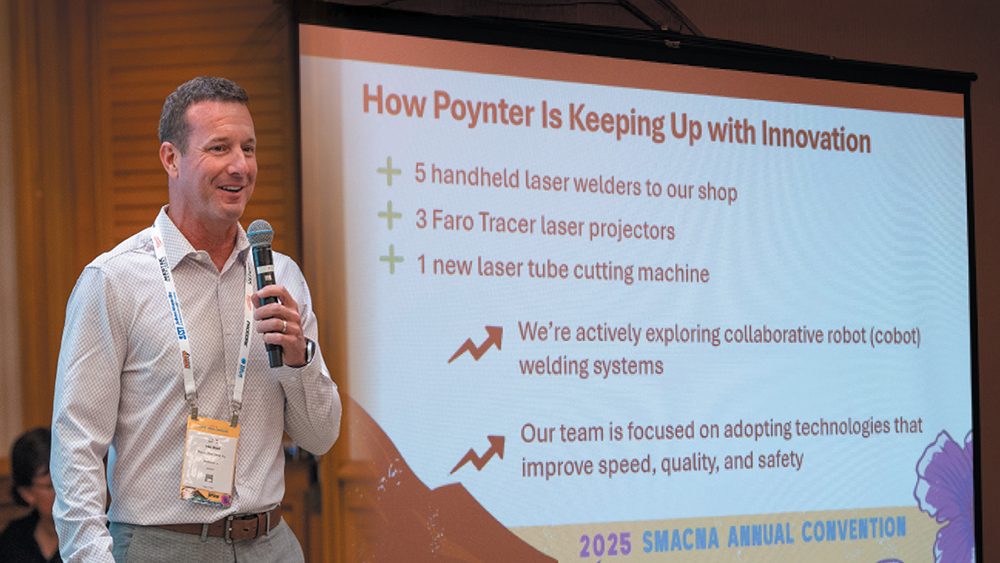
Bland likes to frame Poynter’s automation journey as a layered ecosystem, not a single machine. Five handheld laser welders now give crews the speed and low distortion benefits of laser in a flexible format, while three laser projectors guide layouts and assembly, so parts reach the weld cell lined up correctly the first time. “Every piece of tech we add has to hit the same goals: speed, quality and safety,” he says.
The shop has also added a laser tube cutting machine, which turns out precisely cut, repeatable components that make robotic welding far more predictable. Bland and his team are actively evaluating collaborative welding robots — cobots that can be wheeled up to a table or even to large assemblies — to handle repetitive joints while human welders focus on the trickiest details.
“We’re not trying to replace welders; we’re trying to give them the best tools we can,” he says.
Automation does not erase the human factor; it changes who is needed and what they do. Bland is candid about the cultural and educational lift required to make advanced systems work. “You still need people who understand welding fundamentals; now you’re asking them to think like process owners, not just operators,” he says.
Traditional robotic programming often demanded computer skills, engineering support and weeks of off-site classes, a barrier for smaller shops and mid-career welders. Newer interfaces, more intuitive software and collaborative modes are lowering that bar, but Bland argues that intentional training — time, mentorship and a clear path from hood down welding to supervising automated cells — is what will really move the needle.
Beyond the Weld: What Comes Next
Looking ahead, Bland sees a convergence of trends that will only accelerate this transformation: cheaper hardware, faster communication, more computing power and a tide of AI-driven tools that promise to make welding systems more adaptive and self-correcting. “You hear it everywhere — AI, AI, AI — but for us it’s about using that intelligence to make better decisions on the floor, not chasing buzzwords,” he says.
Published: March 6, 2026
IN THIS ISSUE
ARCHITECTURAL: How Automation is Reshaping Metalcraft
As robotic welders take their place beside skilled craftsmen, Poynter shows how automation is not erasing the human touch. Instead, it’s amplifying it, redefining what’s possible in modern architectural metalwork.
Government and Public Affairs Issues Update
Last year, the Government Affairs Department quietly but effectively worked diligently to produce significant legislative victories on behalf of SMACNA members.
How Contractors Can Avoid Three Common Mistakes During Periods of Growth
Periods of growth are exciting for any contractor, indicating strong demand and the opportunity to expand into new markets, larger projects or project types.
HVAC: Rewiring the Legacy
How a third-generation contractor is blending craftsmanship and code to keep Western Sheet Metal competitive in an industry racing toward automation.
INDUSTRIAL: Rethinking Project Management
How to know when it’s time to upgrade from a patchwork of manual tracking tools to a disciplined, digital backbone.
Ins and Outs of Automation
As we kick off 2026, AI and automation continue to be hot topics across many industries, and construction is no exception.
LAX’s Modular Marvel Takes Flight
Imagine nine massive concourse modules, each the size of a football field, creeping across Los Angeles International Airport’s tarmac at dawn, like gigantic puzzle pieces sliding into place.
Meet SMACNA’s New President Todd Hill
Ventcon’s innovator leads SMACNA in 2026. In the humming workshops of Troy, Michigan, where sheet metal bends to the will of skilled hands, Todd Hill has forged an impressive career.
Ninth Circuit Clarifies the Scope of the “Building and Construction Industry” Exemption for Withdrawal Liability
On Jan. 5, the U.S. Court of Appeals for the Ninth Circuit issued a decision relevant to union contractors.
PDX Terminal Expansion Brings Forest Canopy Over Concourses
Picture walking through Portland International Airport’s expanded main terminal, dappled light filtering through a 9-acre mass timber roof onto a grove of live trees below just like a Pacific Northwest forest sprouting right over security checkpoints.
Renaissance in the Steel City: PIT’s HVAC Revival
Imagine stepping into Pittsburgh International Airport’s (PIT) reborn terminal, where the ghost of its 1990s “airport of the future” glory hums anew, minus the unused gates and empty shops but brimming with streamlined efficiency.
RESIDENTIAL: Boost Your Residential HVAC Business with Social Media
Unlock the power of social media with practical strategies designed to grow your business, deepen customer relationships and stand out in a competitive market.
Strengthening Labor Harmony and Industry Bonds
SMACNA's New CEO talks about his vision for the association and why labor relations are a bedrock of any construction-aligned association.
TESTING ADJUSTING AND BALANCING: Certifying Medical-Grade HVAC Performance in a New Hospital Tower
SMACNA TAB contractor Northstar Environmental is ensuring that the HVAC system at a soon-to-open Pittsburgh hospital expansion meets the facility’s stringent expectations.
The Connector: How Frank Wall’s Collaborative Vision is Shaping SMACNA’s Next Era
When Frank Wall steps into a room, he carries more than four decades of industry experience.
The Infrastructure Work Pipeline
How transportation policy can become real work for HVAC and sheet metal contractors.
Welcome New SMACNA Members
Where Craft Meets Character
B.J. Giri never chased the spotlight. Instead, the 2025 SMACNA Contractor of the Year built a career and a company by listening first, mentoring deeply and proving that leadership in the trades is as much about people as it is about precision.
Privacy Policy |
Terms of Use | Contact Us
Phone: 703.803.2980 | Email:
info@smacna.org
© 1998-2026 SMACNA. All rights reserved.
Web Design & Development by Matrix Group
International, Inc.
