Government and Public Affairs Issues Update
Last year, the Government Affairs Department quietly but effectively worked diligently to produce significant legislative victories on behalf of SMACNA members.
 This report will spotlight the hard-fought battles in Washington and across the states from the 119th Congress, as well as how members can engage in crucial legislative advocacy during this election year. While the ever-changing and historic level steel, aluminum and copper tariff rates were predicted in our 2025 and 2026 outlooks, and the political environment remains ever challenging, there have been many significant advances for industry policy goals to date, with many more challenges ahead until the November elections.
We are now at the halfway point in the 119th Congress, and our top goal remains unchanged: protect what matters most to the majority of our members in the now-enacted tax package, such as bonus depreciation, equipment expensing, estate tax permanence, SALT cap increases and the R&D tax credits. To do so, we have also joined countless coalition allies to score a number of real victories to extend important tax incentives for efficiency, CHIPS and energy grid enhancement enabling the fast-growing wave of data center projects.
Often success is measured in the number of laws and programs you preserve, not the new laws you help pass each session. Joining with our coalition allies, we helped to push back efforts to eliminate tax preferences for municipal bonds, preserved state and local tax deductions for businesses and stopped the efforts to tax employee fringe benefit plans. All these defensive efforts preserved construction markets and sustained the integrity of employee benefit plans, no minor achievement.
SMACNA has been active on Capitol Hill in recent years consistently advocating for the Small Business Payment for Performance Act. Changes to federal construction contracts, commonly referred to as change orders, are inevitable on complex projects. Federal agencies frequently issue unilateral change orders without timely formalization or compensation, forcing contractors to finance government-directed work for extended periods.
The legislation would allow small businesses to request an equitable adjustment when a contracting officer issues a change order without the contractor’s agreement and would require the federal government to pay no less than fifty percent of the estimated cost of the change order upon receipt of the equitable adjustment request.
SMACNA has met with dozens and dozens of Members of Congress and staff in congressional offices to build bipartisan support and advance the bill through the House and Senate Small Business Committees, emphasizing the impacts on cash flow, workforce stability, and project delivery.
SMACNA is supporting and urging co-sponsorship of legislation introduced by Representatives Mike Thompson (D-CA) and Richard Neal (D-MA) to restore renewable energy and energy efficiency tax incentives originally enacted under the Inflation Reduction Act. The legislation would reinstate investment and production tax credits for renewable power generation, extend incentives for energy efficient buildings and homes, support domestic manufacturing of clean energy components, and restore clean vehicle and clean hydrogen production credits.
SMACNA is educating Members of Congress on the implications of this legislation sure to impact and lower energy costs, boost construction demand, domestic manufacturing, and support efforts to address critical workforce needs.
SMACNA submitted a formal statement to the House Energy and Commerce Committee for the Energy Subcommittee hearing titled “Building the American Dream Examining Affordability, Choice, and Security in Appliance and Buildings Policies.”
SMACNA reaffirmed support for modern, consensus-based building energy codes and federal appliance efficiency standards, emphasizing cost savings, safety, disaster resilience and national energy security.
SMACNA submitted a written hearing statement to the House Committee on Education and the Workforce opposing the Modern Worker Empowerment Act and the Modern Worker Security Act. SMACNA expressed support for the Department of Labor’s 2024 final rule reaffirming the multifactor economic reality test for employee classification and raised concerns that the proposed legislation would undermine long-standing judicial precedent and competitive fairness in construction.
SMACNA continues to engage Members of Congress, especially the Senators on the Senate Health, Education, Labor and Pensions Committee to advocate for the value of registered apprenticeship programs and debt-free workforce pipelines delivered in partnership with SMART.
The American Energy Independence and Affordability Act (H.R. 5862) was introduced by SMACNA champion Rep. Thompson (D-CA) and is cosponsored by 117 House members.
What H.R. 5862 does:
Restores the full clean electricity production and investment tax credits for wind, solar and other zero-emission power sources.
Extends incentives for energy efficient homes and commercial buildings, helping families and businesses cut utility bills through modern, efficient technologies.
Reinstates clean-vehicle tax credits for consumers and businesses to accelerate America's transition to electric and zero-emission vehicles.
Supports domestic manufacturing of clean energy components and strengthens the U.S. technology supply chains.
- Extends the clean hydrogen production credit, advancing next-generation clean fuel production.
Businesses are already feeling the pain from higher energy costs and supply-chain shocks caused by uncertain but record tariffs.
This legislation would deliver real relief by restoring incentives that make homes more efficient, help lower energy bills, support clean and renewable power, and expand access to affordable clean vehicles.
We believe restoring these incentives will strengthen our energy independence, lower utility bills, boost domestic production and create thousands of good-paying, high-skill jobs in the United States.
Published: March 6, 2026
IN THIS ISSUE
ARCHITECTURAL: How Automation is Reshaping Metalcraft
As robotic welders take their place beside skilled craftsmen, Poynter shows how automation is not erasing the human touch. Instead, it’s amplifying it, redefining what’s possible in modern architectural metalwork.
Government and Public Affairs Issues Update
Last year, the Government Affairs Department quietly but effectively worked diligently to produce significant legislative victories on behalf of SMACNA members.
How Contractors Can Avoid Three Common Mistakes During Periods of Growth
Periods of growth are exciting for any contractor, indicating strong demand and the opportunity to expand into new markets, larger projects or project types.
HVAC: Rewiring the Legacy
How a third-generation contractor is blending craftsmanship and code to keep Western Sheet Metal competitive in an industry racing toward automation.
INDUSTRIAL: Rethinking Project Management
How to know when it’s time to upgrade from a patchwork of manual tracking tools to a disciplined, digital backbone.
Ins and Outs of Automation
As we kick off 2026, AI and automation continue to be hot topics across many industries, and construction is no exception.
LAX’s Modular Marvel Takes Flight
Imagine nine massive concourse modules, each the size of a football field, creeping across Los Angeles International Airport’s tarmac at dawn, like gigantic puzzle pieces sliding into place.
Meet SMACNA’s New President Todd Hill
Ventcon’s innovator leads SMACNA in 2026. In the humming workshops of Troy, Michigan, where sheet metal bends to the will of skilled hands, Todd Hill has forged an impressive career.
Ninth Circuit Clarifies the Scope of the “Building and Construction Industry” Exemption for Withdrawal Liability
On Jan. 5, the U.S. Court of Appeals for the Ninth Circuit issued a decision relevant to union contractors.
PDX Terminal Expansion Brings Forest Canopy Over Concourses
Picture walking through Portland International Airport’s expanded main terminal, dappled light filtering through a 9-acre mass timber roof onto a grove of live trees below just like a Pacific Northwest forest sprouting right over security checkpoints.
Renaissance in the Steel City: PIT’s HVAC Revival
Imagine stepping into Pittsburgh International Airport’s (PIT) reborn terminal, where the ghost of its 1990s “airport of the future” glory hums anew, minus the unused gates and empty shops but brimming with streamlined efficiency.
RESIDENTIAL: Boost Your Residential HVAC Business with Social Media
Unlock the power of social media with practical strategies designed to grow your business, deepen customer relationships and stand out in a competitive market.
Strengthening Labor Harmony and Industry Bonds
SMACNA's New CEO talks about his vision for the association and why labor relations are a bedrock of any construction-aligned association.
TESTING ADJUSTING AND BALANCING: Certifying Medical-Grade HVAC Performance in a New Hospital Tower
SMACNA TAB contractor Northstar Environmental is ensuring that the HVAC system at a soon-to-open Pittsburgh hospital expansion meets the facility’s stringent expectations.
The Connector: How Frank Wall’s Collaborative Vision is Shaping SMACNA’s Next Era
When Frank Wall steps into a room, he carries more than four decades of industry experience.
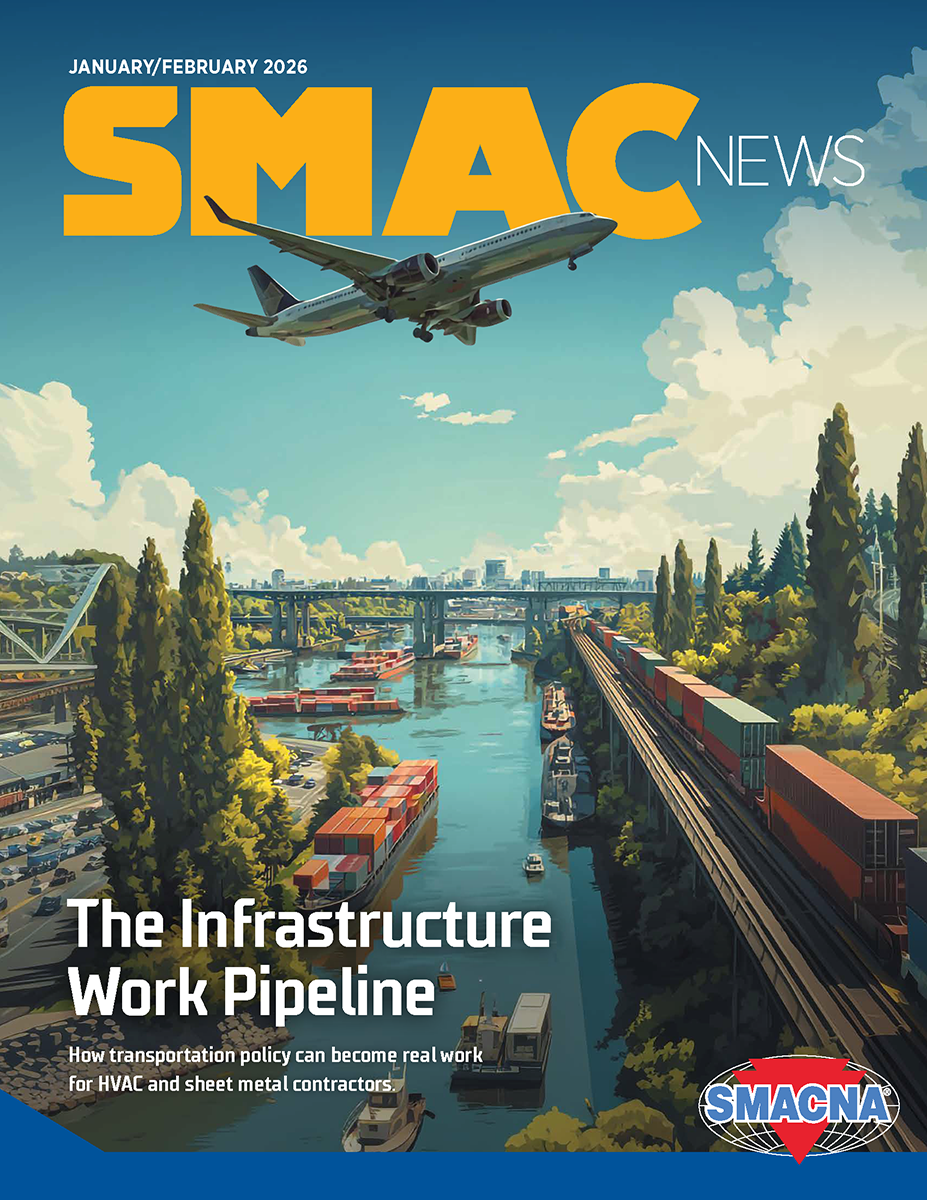
The Infrastructure Work Pipeline
How transportation policy can become real work for HVAC and sheet metal contractors.
Welcome New SMACNA Members
Where Craft Meets Character
B.J. Giri never chased the spotlight. Instead, the 2025 SMACNA Contractor of the Year built a career and a company by listening first, mentoring deeply and proving that leadership in the trades is as much about people as it is about precision.
Privacy Policy |
Terms of Use | Contact Us
Phone: 703.803.2980 | Email:
info@smacna.org
© 1998-2026 SMACNA. All rights reserved.
Web Design & Development by Matrix Group
International, Inc.
