Ins and Outs of Automation
As we kick off 2026, AI and automation continue to be hot topics across many industries, and construction is no exception.
 This article focuses on automation, but AI can easily be substituted in as well. While concerns often resurface during election cycles, the reality is that automation has been part of our industry for decades. Rather than embracing it blindly or resisting it outright, it’s worth looking at how these tools may actually affect our workforce and our work.
The most common concern is job loss. This fear is valid and deserves to be addressed thoughtfully. Some roles do disappear when automation is introduced, but that does not automatically translate to net job loss. A frequently cited example is the introduction of ATMs in the 1970s. While many expected bank tellers to be replaced, banks ultimately hired more employees as automation reduced routine tasks and enabled expansion. The work ended up changing, often becoming more customer focused and meaningful.
A similar dynamic exists in construction. Equipment such as coil lines, plasma and laser tables, and multi-axis cutters can reduce labor on repetitive cutting tasks. But when viewed across the full workflow, one or two operators can feed multiple downstream workstations. Automation removes bottlenecks and allows more people to stay productive in higher-skill assembly, welding, and installation work.
Another concern is the loss of craft. In practice, the craft doesn’t disappear, it just shifts. Tradespeople still rely on deep knowledge to ensure machines produce accurate, high-quality parts. The most demanding skill often shows up later in the process, where workers assemble complex systems, adapt to changing jobsite conditions, and ensure components fit into a constantly evolving building.
Automation also enables contractors to take on more work. While labor hours may be reduced on individual assemblies or projects, improved speed and accuracy allow firms to bid competitively and increase overall capacity. With strong backlogs across much of the industry, efficiency gains often translate into more total work, not less.
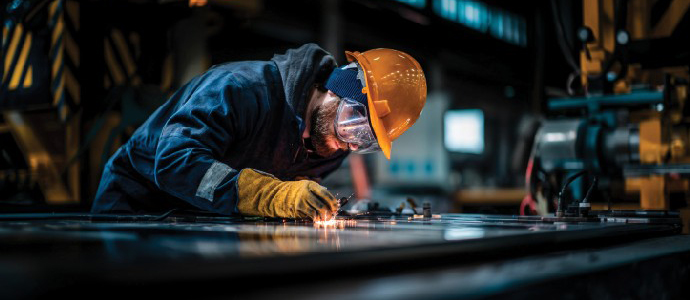
One of construction’s strengths is how these tools are developed and adopted. Many automation solutions are created in collaboration with contractors, unions, and shop workers, with a focus on improving safety and efficiency rather than replacing people. That collaboration has also created new roles in engineering, installation, and maintenance.
Automation isn’t going away. What matters is how we continue to adopt it thoughtfully, collaboratively, and with respect for the workforce that makes this industry run.
Published: March 6, 2026
IN THIS ISSUE
ARCHITECTURAL: How Automation is Reshaping Metalcraft
As robotic welders take their place beside skilled craftsmen, Poynter shows how automation is not erasing the human touch. Instead, it’s amplifying it, redefining what’s possible in modern architectural metalwork.
Government and Public Affairs Issues Update
Last year, the Government Affairs Department quietly but effectively worked diligently to produce significant legislative victories on behalf of SMACNA members.
How Contractors Can Avoid Three Common Mistakes During Periods of Growth
Periods of growth are exciting for any contractor, indicating strong demand and the opportunity to expand into new markets, larger projects or project types.
HVAC: Rewiring the Legacy
How a third-generation contractor is blending craftsmanship and code to keep Western Sheet Metal competitive in an industry racing toward automation.
INDUSTRIAL: Rethinking Project Management
How to know when it’s time to upgrade from a patchwork of manual tracking tools to a disciplined, digital backbone.
Ins and Outs of Automation
As we kick off 2026, AI and automation continue to be hot topics across many industries, and construction is no exception.
LAX’s Modular Marvel Takes Flight
Imagine nine massive concourse modules, each the size of a football field, creeping across Los Angeles International Airport’s tarmac at dawn, like gigantic puzzle pieces sliding into place.
Meet SMACNA’s New President Todd Hill
Ventcon’s innovator leads SMACNA in 2026. In the humming workshops of Troy, Michigan, where sheet metal bends to the will of skilled hands, Todd Hill has forged an impressive career.
Ninth Circuit Clarifies the Scope of the “Building and Construction Industry” Exemption for Withdrawal Liability
On Jan. 5, the U.S. Court of Appeals for the Ninth Circuit issued a decision relevant to union contractors.
PDX Terminal Expansion Brings Forest Canopy Over Concourses
Picture walking through Portland International Airport’s expanded main terminal, dappled light filtering through a 9-acre mass timber roof onto a grove of live trees below just like a Pacific Northwest forest sprouting right over security checkpoints.
Renaissance in the Steel City: PIT’s HVAC Revival
Imagine stepping into Pittsburgh International Airport’s (PIT) reborn terminal, where the ghost of its 1990s “airport of the future” glory hums anew, minus the unused gates and empty shops but brimming with streamlined efficiency.
RESIDENTIAL: Boost Your Residential HVAC Business with Social Media
Unlock the power of social media with practical strategies designed to grow your business, deepen customer relationships and stand out in a competitive market.
Strengthening Labor Harmony and Industry Bonds
SMACNA's New CEO talks about his vision for the association and why labor relations are a bedrock of any construction-aligned association.
TESTING ADJUSTING AND BALANCING: Certifying Medical-Grade HVAC Performance in a New Hospital Tower
SMACNA TAB contractor Northstar Environmental is ensuring that the HVAC system at a soon-to-open Pittsburgh hospital expansion meets the facility’s stringent expectations.
The Connector: How Frank Wall’s Collaborative Vision is Shaping SMACNA’s Next Era
When Frank Wall steps into a room, he carries more than four decades of industry experience.
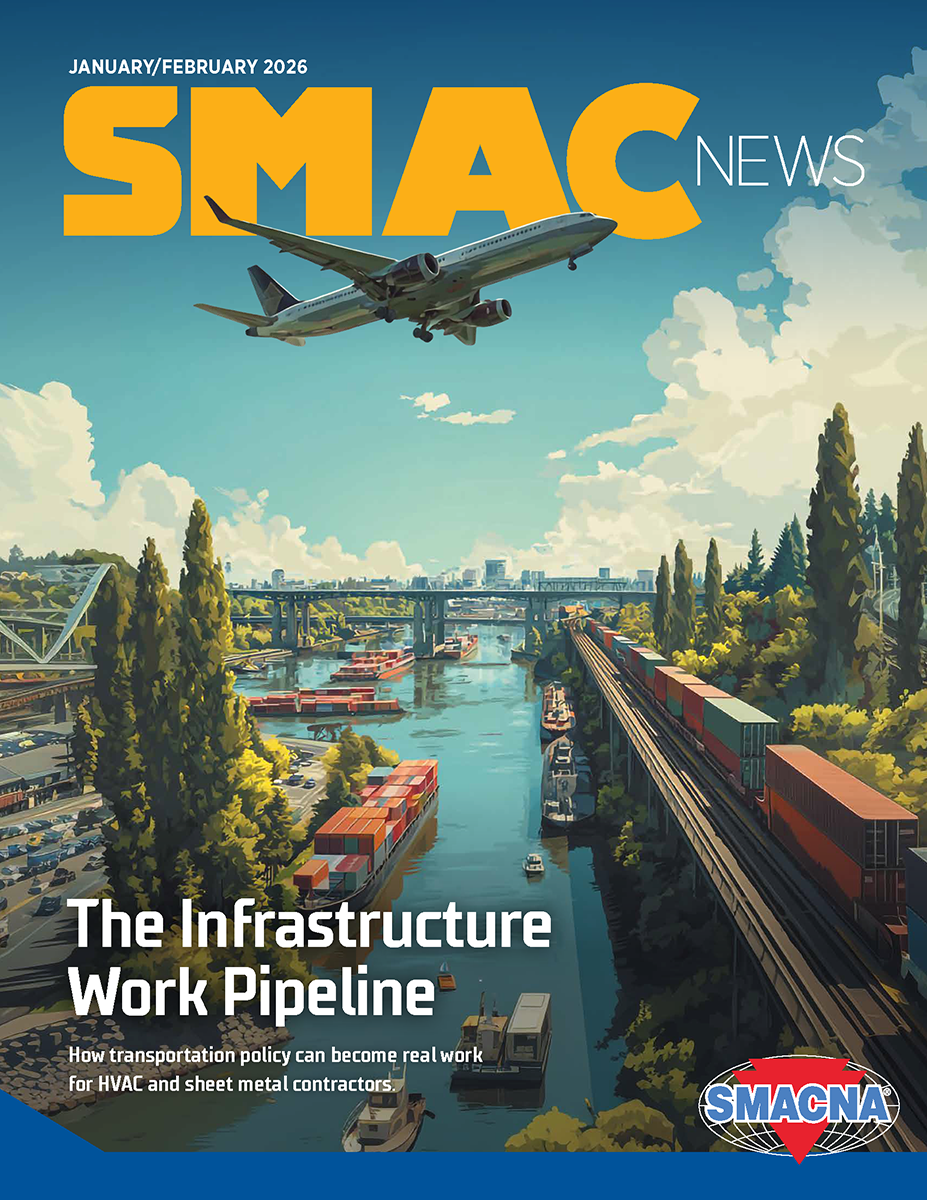
The Infrastructure Work Pipeline
How transportation policy can become real work for HVAC and sheet metal contractors.
Welcome New SMACNA Members
Where Craft Meets Character
B.J. Giri never chased the spotlight. Instead, the 2025 SMACNA Contractor of the Year built a career and a company by listening first, mentoring deeply and proving that leadership in the trades is as much about people as it is about precision.
Privacy Policy |
Terms of Use | Contact Us
Phone: 703.803.2980 | Email:
info@smacna.org
© 1998-2026 SMACNA. All rights reserved.
Web Design & Development by Matrix Group
International, Inc.
