Ninth Circuit Clarifies the Scope of the “Building and Construction Industry” Exemption for Withdrawal Liability
On Jan. 5, the U.S. Court of Appeals for the Ninth Circuit issued a decision relevant to union contractors.
 In Walker Specialty Construction Inc. v. Board of Trustees of the Construction Industry and Laborers Joint Pension Trust for Southern Nevada, the court held that asbestos abatement work qualifies as “building and construction industry” work under the Multiemployer Pension Plan Amendments Act of 1980 (“MPPAA”).
The decision clarifies what constitutes “building and construction industry” work for purposes of the MPPAA’s special withdrawal liability rules. In doing so, the court rejected the idea that only new construction qualifies. Instead, the court adopted a well-established definition of construction that includes work necessary to make a building usable, including “maintenance, repair and alterations that are essential to a building or structure’s usability.”
Under the MPPAA, an employer that withdraws from a multiemployer pension plan is generally required to pay its share of the plan’s unfunded vested benefits. This can result in substantial withdrawal liability.
Congress, however, created a special rule for employers in the “building and construction industry.” If certain conditions are met, construction employers are not automatically treated as having withdrawn merely because they stop operating in a particular geographic area.
The Ninth Circuit explained the policy rationale for this exception: “Congress created this exception because of ‘the transitory nature of contracts and employment in the building and construction industry.’”
As the court explained, when a contractor leaves a market, that does not necessarily mean the pension plan is harmed:
The construction industry as a whole does not necessarily shrink when a contributing contractor leaves the industry; employees are often dispatched to another ... contractor in the area that contributes to the multiemployer pension plan on their behalf. Thus, as long as the base of construction projects in the area covered by the plan is funding the plan’s obligations, the plan is not threatened when an individual employer withdraws.
This reflects the real-world nature of construction: projects are temporary, contractors move in and out of jurisdictions, and workers often continue covered employment with other signatory employers.
Because the term “building and construction industry” had a settled meaning prior to the MPPAA’s enactment, we infer that Congress was aware of and intended to incorporate this definition when it enacted the “building and construction industry” exception in the MPPAA.
In other words, Congress did not intend to invent a new definition. It intended to use the same one that already existed under federal labor law.
The NLRB’s definition of the “building and construction industry” is not limited to new buildings. The Ninth Circuit quoted prior NLRB decisions describing construction as: “the erection, maintenance and repair . . . of immobile structures and utilities . . . which become integral parts of structures and are essential to their use for any general purpose.” The court also noted that the NLRB had previously concluded that “construction” includes “new work, additions, alterations and repairs.”
The pension fund attempted to characterize asbestos abatement as superficial or cosmetic. The Ninth Circuit rejected that view.
Because the work involved structural alteration and repair of core building components, the court concluded that the work fell squarely within the NLRB’s settled definition of “building and construction industry” work.
Rather than adopting a narrow definition limited to the erection of new buildings or structures, the court held that the phrase incorporates the settled meaning developed under federal labor law.
Published: March 6, 2026
IN THIS ISSUE
ARCHITECTURAL: How Automation is Reshaping Metalcraft
As robotic welders take their place beside skilled craftsmen, Poynter shows how automation is not erasing the human touch. Instead, it’s amplifying it, redefining what’s possible in modern architectural metalwork.
Government and Public Affairs Issues Update
Last year, the Government Affairs Department quietly but effectively worked diligently to produce significant legislative victories on behalf of SMACNA members.
How Contractors Can Avoid Three Common Mistakes During Periods of Growth
Periods of growth are exciting for any contractor, indicating strong demand and the opportunity to expand into new markets, larger projects or project types.
HVAC: Rewiring the Legacy
How a third-generation contractor is blending craftsmanship and code to keep Western Sheet Metal competitive in an industry racing toward automation.
INDUSTRIAL: Rethinking Project Management
How to know when it’s time to upgrade from a patchwork of manual tracking tools to a disciplined, digital backbone.
Ins and Outs of Automation
As we kick off 2026, AI and automation continue to be hot topics across many industries, and construction is no exception.
LAX’s Modular Marvel Takes Flight
Imagine nine massive concourse modules, each the size of a football field, creeping across Los Angeles International Airport’s tarmac at dawn, like gigantic puzzle pieces sliding into place.
Meet SMACNA’s New President Todd Hill
Ventcon’s innovator leads SMACNA in 2026. In the humming workshops of Troy, Michigan, where sheet metal bends to the will of skilled hands, Todd Hill has forged an impressive career.
Ninth Circuit Clarifies the Scope of the “Building and Construction Industry” Exemption for Withdrawal Liability
On Jan. 5, the U.S. Court of Appeals for the Ninth Circuit issued a decision relevant to union contractors.
PDX Terminal Expansion Brings Forest Canopy Over Concourses
Picture walking through Portland International Airport’s expanded main terminal, dappled light filtering through a 9-acre mass timber roof onto a grove of live trees below just like a Pacific Northwest forest sprouting right over security checkpoints.
Renaissance in the Steel City: PIT’s HVAC Revival
Imagine stepping into Pittsburgh International Airport’s (PIT) reborn terminal, where the ghost of its 1990s “airport of the future” glory hums anew, minus the unused gates and empty shops but brimming with streamlined efficiency.
RESIDENTIAL: Boost Your Residential HVAC Business with Social Media
Unlock the power of social media with practical strategies designed to grow your business, deepen customer relationships and stand out in a competitive market.
Strengthening Labor Harmony and Industry Bonds
SMACNA's New CEO talks about his vision for the association and why labor relations are a bedrock of any construction-aligned association.
TESTING ADJUSTING AND BALANCING: Certifying Medical-Grade HVAC Performance in a New Hospital Tower
SMACNA TAB contractor Northstar Environmental is ensuring that the HVAC system at a soon-to-open Pittsburgh hospital expansion meets the facility’s stringent expectations.
The Connector: How Frank Wall’s Collaborative Vision is Shaping SMACNA’s Next Era
When Frank Wall steps into a room, he carries more than four decades of industry experience.
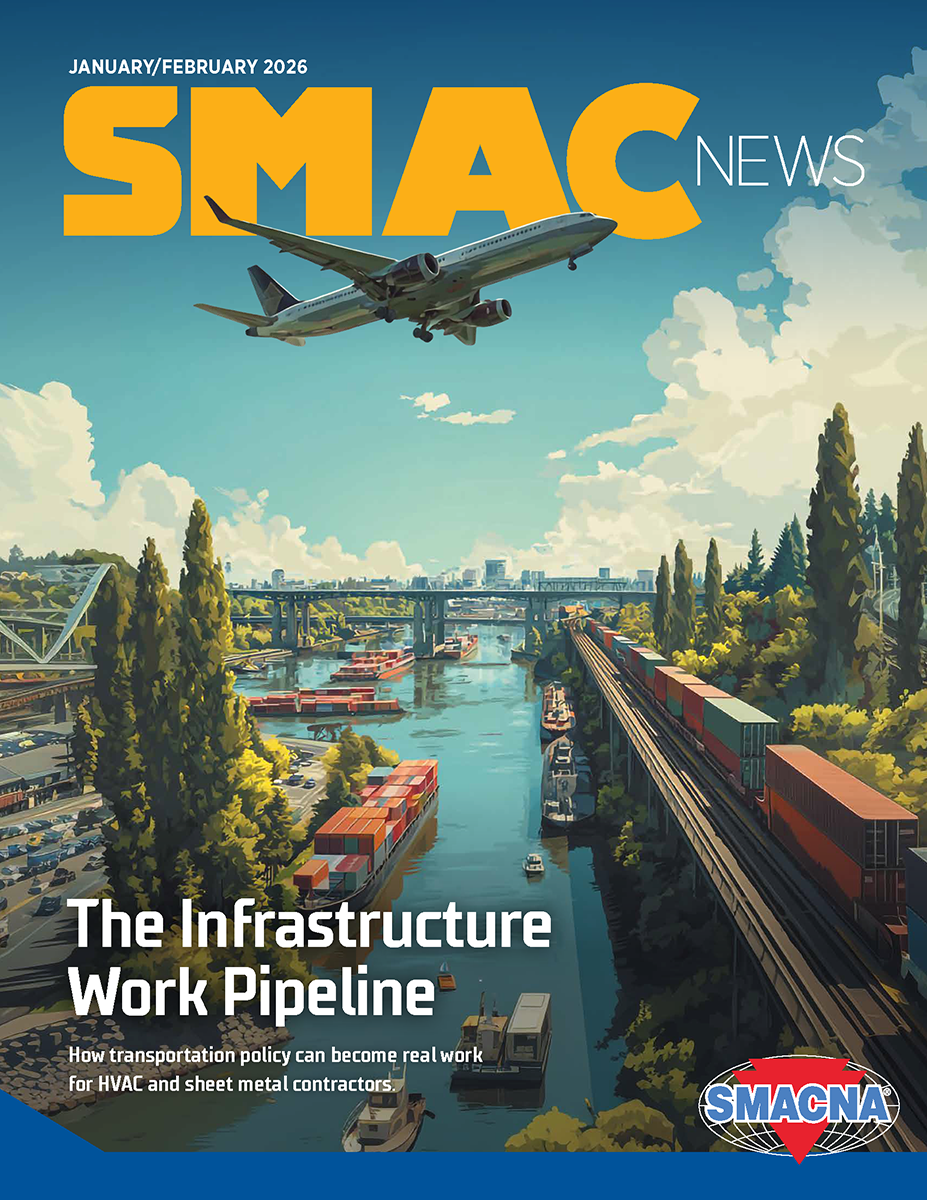
The Infrastructure Work Pipeline
How transportation policy can become real work for HVAC and sheet metal contractors.
Welcome New SMACNA Members
Where Craft Meets Character
B.J. Giri never chased the spotlight. Instead, the 2025 SMACNA Contractor of the Year built a career and a company by listening first, mentoring deeply and proving that leadership in the trades is as much about people as it is about precision.
Privacy Policy |
Terms of Use | Contact Us
Phone: 703.803.2980 | Email:
info@smacna.org
© 1998-2026 SMACNA. All rights reserved.
Web Design & Development by Matrix Group
International, Inc.
