ARCHITECTURAL: Once in a Lifetime in Copper
Baker Group’s restoration of Iowa’s Webster County Courthouse involved a leaning clock tower, stamped rosettes from overseas and 10,000 hours of field work.
The clock tower of the Webster County Courthouse had been watching over downtown Fort Dodge, Iowa, since 1902. For more than a century, it marked the hour with a bell cast in 1882, its copper skin aging to the deep green patina only time and weather produce.
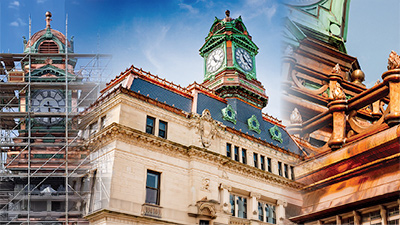
But by the time Jeff Hawkins got the call, the tower was doing more than aging; it was leaning. Three feet off plumb and visibly deteriorating, it had become a civic emergency wrapped in historic copper.
“The county’s driving force was this tower, and it was leaning 3 feet in one direction,” says Hawkins, a Project Manager with Baker Group who has spent 42 years in the sheet metal trade. “It was starting to fall apart.”
What followed was an 18-month restoration that Hawkins describes as the most complex project of his career — a $2.5-million undertaking that logged 10,000 hours of field installation time, survived a global pandemic, worked through Iowa winters at the edge of what soldering can physically tolerate and ultimately sent Fort Dodge’s most beloved landmark back into the skyline looking exactly as it did when Grover Cleveland was still alive.
A Building Worth Saving
The Webster County Courthouse is not a building that blends into its surroundings. Designed by Milwaukee architect Henry C. Koch — the same man who designed Milwaukee City Hall — and completed in 1902 at a cost of roughly $100,000, the four-story Classical Revival limestone structure sits directly on a downtown corner with no open space around it. Its mansard roofs and copper-clad clock tower rise out of the streetscape like something transplanted from a European capital. It has been on the National Register of Historic Places since 1981.
After suffering storm damage in 2018, a detailed engineering inspection uncovered what routine maintenance had obscured for years: the clock tower’s interior timber framing had rotted through from decades of moisture exposure, the structure itself had shifted measurably off vertical and significant architectural features, including cresting, decorative copper elements and stamped ornamental details, had been removed or lost during earlier, less careful repair attempts. The county wanted it all back.
The project went to public bid. Baker Group, an Ankeny-based employee-owned specialty contractor founded in 1963 that has grown into one of the Midwest’s largest full-service mechanical and sheet metal contractors with more than 1,500 employees, had an existing relationship with the general contractor, Neumann Brothers. Hawkins had been doing architectural copper work long enough that this kind of project found him. He priced it, Baker Group won it, and in January 2020 they started pulling together the people and materials needed to bring a 120-year-old building back to itself.
COVID, Copper and a Clock Tower
Baker Group got the job in January or February of 2020, Hawkins says, right before COVID-19 shut everything down in March. The stamped rosette ornaments — decorative acorn-shaped elements that ring the base of the tower and accent the smaller decorative structures called pilothouse dormers — were being produced overseas by a firm that fabricates them through a process involving clay models, custom molds and metal stamping that Baker Group’s shop doesn’t perform. The overseas supplier shut down before the order shipped.
“We had gone through the whole process with them — getting everything developed, getting everything ready to go — and then they shut down,” Hawkins says. The supply chain disruption cascaded from there.
On the job site, COVID forced the kind of crew management that no project estimator plans for. “We tried to separate them out and keep them separate so you have different groups,” Hawkins says. “When one group would get sick, they’d be gone, and another group would step in and keep doing the work.” In the shop, where fabrication of the tower’s custom copper elements was underway, cases moved through the workforce unpredictably.
The Tower, Piece by Piece
Once work was underway on the structure itself, the complexity of the copper scope came into full view. The approach to the clock tower restoration was methodical: Baker Group crews went to the courthouse at night, staged on the scaffolding and performed a full 3D laser scan of every level of the tower. That scan package went to the general contractor, who used it to plan the reconstruction of the internal steel structure and sheathing behind the copper skin — down to nothing before it was rebuilt.
“We tore all of that off — all the structure, the plywood and everything, just down to almost nothing,” Hawkins says. “And then they rebuilt the whole thing back up, and then we put the pieces back on.”
The challenge was that the historic copper pieces removed from the tower had to fit again on a structure that had been fully rebuilt. Every element had to match — both the salvaged original copper that the architect specified be reused and the new copper fabricated to replace what was beyond repair. “They had to fit again,” Hawkins says. “So, there was a lot of communication on that, back and forth.”
The heat involved in resoldering salvaged copper creates its own risks. Old solder joints break apart. Weakened sections of sheet that look stable come apart when heat is applied. “You would put heat on it, and it would be fine, but then if you overdid it, you would have to redo the whole thing,” Hawkins says. “That’s a huge challenge.”
Most of the tower’s copper elements were fabricated in Baker Group’s sheet metal shop. The exceptions were the purchase globe finials and a clove relief casting that was sourced from a supplier but installed by Baker Group’s crew. The stamped rosettes and ornamental details on the pilothouse structures eventually arrived from overseas once supply chains reopened.
And then there were the pigeon holes. “People in small-town Iowa used to take guns and shoot pigeons away,” Hawkins says, describing what crews find when they get into old copper on historic buildings throughout the region. On the Webster County tower, crews discovered approximately 150 bullet holes in some sections of copper where gunfire had been used to discourage roosting birds over the decades. “We’d get up there and find 150 holes where we expected maybe 20,” he says. Each one required assessment, documentation and a conversation with the architect about what constituted a repair versus a change order.
Working Through an Iowa Winter
The original project schedule called for just over a year of work. It ran nearly two years, from March 2020 to summer 2021, with the county holding a formal rededication ceremony on Oct. 1, 2021.
Some of the schedule pressure came from a county-imposed deadline. RAGBRAI, the annual bicycling event that brings thousands of riders across Iowa, was routing through Fort Dodge and county officials wanted the scaffold down and the courthouse gleaming before cyclists arrived.
The rest of the schedule pressure came from physics. Copper soldering requires heat, and below 15 degrees Fahrenheit, a soldering iron cannot maintain the temperature needed to properly sweat a joint. “Below 15 degrees, I will not be soldering because I cannot keep the iron hot enough to do the proper sweating,” Hawkins says. But the project couldn’t stop for Iowa winters, so the general contractor wrapped the entire scaffold structure in plastic sheeting and heated the enclosed space to bring the working temperature above that threshold.
The courthouse never closed during the entire restoration. Employees worked around the scaffold, hearings continued in the courtroom and county business proceeded as normal, which meant Baker Group’s lifts, rigging operations and material deliveries had to be choreographed around the building’s daily rhythms.
“We also had to make sure they were safe — when can we lift, when we cannot,” Hawkins says.
One for the Career File
Baker Group’s core business is small- to large-scale commercial and industrial mechanical work — HVAC, plumbing, piping, electrical, automation, security systems and the stainless-steel specialty work that serves data centers and advanced manufacturing facilities. The company operates across Iowa and into Missouri from multiple offices and has earned national recognition for both its project work and its safety culture. Its guiding principle on that front is to “make sure the guys go home every night,” Hawkins says. “That’s our motto.”
Architectural copper is a specialty within a specialty, and at Baker Group, Hawkins is one of the experts. “I’m kind of an oddball around here,” he says. “I do all the copper work, which I’ve done all my life.” He’s training a successor now — someone six or seven months into learning the craft — with an eye toward eventually retiring. But the Webster County project is the one he returns to when describing what the work means. As Hawkins says, “It was a once-in-a-lifetime job for me.”
Published: September 17, 2026
IN THIS ISSUE
Adapt to Remain Competitive
When I started as an apprentice 36 years ago, the sheet metal industry looked very different than it does today.
ARCHITECTURAL: Once in a Lifetime in Copper
Baker Group’s restoration of Iowa’s Webster County Courthouse involved a leaning clock tower, stamped rosettes from overseas and 10,000 hours of field work.
Capitol Hill Update: Housing Bill Could Speed HVAC Work
The bipartisan 21st Century ROAD to Housing Act may be more than a housing policy win.
Chapter Spotlight: How SMACNA St. Louis Built a Union Model That Still Works
Through rebate programs, training partnerships and close coordination with Local 36, the chapter has preserved market share and strengthened its contractor network.
Eli Howard Named SMACNA COO
SMACNA appointed Eli P. Howard, III as the organization’s new Chief Operating Officer.
I’ve Been Collecting All This Data. Now What?
Effective data management is the foundation of any successful data-driven initiative.
INDUSTRIAL: Inside the $100-Billion Micron Megafab Campus
As site work begins on one of the largest private construction projects in U.S. history, central New York’s sheet metal industry braces for an unprecedented test of capacity, timing and labor.
Leading Without Limitations
Across the country, women are becoming an increasingly visible force on sheet metal and HVAC jobsites and within SMACNA committees. These professionals talk about what it took to get in, stay in and start pulling others in behind them.
RESIDENTIAL: How One Illinois Contractor Turned Classic Trucks Into Marketing Machines
Mendel Plumbing & Heating’s themed fleet promotes everything from cancer awareness to local nonprofits, proving that community engagement can double as powerful advertising.
Sonderling Visit Shows the Trades a Path Forward
Acting U.S. Labor Secretary Keith Sonderling visited Pennsylvania’s Luzerne County Community College, where union contractors and educators made the case for apprenticeships, early recruitment and stronger career pathways in HVAC and sheet metal.
TESTING, ADJUSTING AND BALANCING: A Prescription for Healthy IAQ
SMACNA of Oklahoma member McIntosh Corp.’s TAB work helps patients, staff and visitors breathe clean air in a new Tulsa hospital tower.
Why Job Costing Still Breaks Margin Visibility for Construction Firms
Financial pressure in construction rarely appears all at once.
Privacy Policy |
Terms of Use | Contact Us
Phone: 703.803.2980 | Email:
info@smacna.org
© 1998-2026 SMACNA. All rights reserved.
Web Design & Development by Matrix Group
International, Inc.
