INDUSTRIAL: Inside the $100-Billion Micron Megafab Campus
As site work begins on one of the largest private construction projects in U.S. history, central New York’s sheet metal industry braces for an unprecedented test of capacity, timing and labor.
This year, Syracuse is the site of what may be one of the largest private construction projects in U.S. history — a semiconductor campus with no precedent in scale.
In January, Micron Technology broke ground on its Clay, New York, megafab. The company has committed up to $100 billion over more than 20 years to construct four fabrication buildings, each spanning 2 million square feet with 600,000 square feet of cleanroom space inside. The U.S. Secretary of Labor called it “the largest construction project labor agreement in U.S. history.” For SMACNA contractors, the project represents both an opportunity and a logistical puzzle that has no playbook.

“We are all gas and no brakes,” Micron’s Construction Executive Jeffrey Mainment told Earl Hall, Executive Director of the CNY Sheet Metal Contractors Association and the Construction Employers Association of Central New York, who negotiates building trades bargaining agreements for the project’s signatory employers. As of summer, Hall says, Micron sits four months ahead of schedule.
A CHIPS and Science Act Project
The Clay campus exists because of the CHIPS and Science Act, the federal subsidy program designed to bring semiconductor manufacturing back onshore after decades of production migrating overseas. In April 2024, the Department of Commerce reached a preliminary agreement to provide up to $6.1 billion in direct CHIPS Act funding to support construction of two fabs in Clay along with a third fab in Boise, Idaho, unleashing $50 billion in private investment by 2030 as the first step toward Micron’s broader U.S. expansion plans. New York separately made up to $5.5 billion available through its Green CHIPS incentive program over the project’s life.
The scale reflects supply chain strategy, as well as chip demand. He adds that Micron’s project labor agreement calls for up to five fabrication buildings, but the company’s draft environmental impact statement outlines plans for four, with Onondaga County securing additional land across the street to house Micron’s supply chain partners. The goal is to make it worthwhile for those partners to relocate their own operations to central New York rather than ship materials from elsewhere.
The timeline has already shifted once. After nearly two years of schedule drift, environmental filings confirmed in late 2025 that construction of the first fabrication plant would begin in mid-2026, with the final Environmental Impact Statement revising the operating date for the first plant to 2030. Hall confirms that target: site work and preconstruction began in January, pile driving starts later this summer, and the goal is to pour foundations on the first 2-million-square-foot building by the fourth quarter of 2026.
The Scope and the Wait
For sheet metal and HVAC contractors, the most important detail may be the timeline. Hall estimates sheet metal/HVAC work won’t begin until late 2027 or 2028 once the building shells are complete. During peak construction phases, up to 4,000 construction workers will be on-site simultaneously, according to public project documentation — a figure Hall corroborates.
Bechtel was named construction manager for the building phase, meaning the bidding process for trade contractors, including HVAC and sheet metal scope, will likely run through a standard RFP process once the company is ready to release bidding documents. Hall says that probably won’t happen until mid-to-late 2027.

The Real Challenge Is the Workforce
Ask Hall what worries him most about a project this size, and the answer is regional capacity.
“A big challenge with these megaprojects is that we’ve got to make sure we have enough contractors and union labor available to service traditional customers of our signatory employers,” Hall says.
To manage risk, SMACNA and the SMART union run a national program aimed at megaprojects and designed to import labor from other states without depleting the workforce available for the region’s existing customers. Hall says local business manager Michael Moran of Sheet Metal Workers Local 58 is closely tracking workforce timing and will have firmer projections by year’s end.
A second challenge has already cost the project at least one bidder. Liquidated damages clauses — financial penalties triggered when a contractor misses a scope completion deadline — are standard in construction contracts, Hall says, but the severity of the penalty and the aggressiveness of the compressed schedule are what give contractors pause. “We’ve already seen at least one contractor of significant size say, ‘No thank you, I’m walking away from it,’” Hall says. With other construction work available in the region, he expects more contractors to walk if liquidated damages terms can’t be negotiated down to something manageable.
A Project Without a Benchmark
Much of what makes the Clay megafab difficult to plan around is its sheer novelty. The large firms brought in from Connecticut, Boston and New Jersey have built projects like this before, Hall says, but for central New York’s regional ecosystem, nothing compares. Micron is reportedly using a parallel facility under construction in Boise, Idaho, as a model for how to execute the work, but Hall says the lessons from that project are new even to Bechtel’s New York team.
“It will disrupt the ecosystem here in central New York — make no mistake about that,” Hall says. “I just don’t know what that’s going to look like when we’re done.”
What he is certain of is that the opportunities the project creates for the regional construction economy outweigh the disruption, provided contractors and labor partners stay nimble. Project owners, he predicts, will have to accept that major construction work costs and timelines are rising and that contractors will be more selective about which contractual terms they’re willing to accept.
“The success of projects like Micron won’t be determined solely by engineering or financing — it will depend on the industry’s ability to move skilled labor where it’s needed while continuing to serve existing customers,” says Jason Watson, SMACNA Executive Director of Labor Relations. “It is a total team effort between labor and management. Successfully delivering projects of this scale requires close coordination, workforce planning and a shared commitment from everyone involved.”
SMACNews will update members on the Micron megafab as sheet metal bidding opens and construction progresses.
Published: September 17, 2026
IN THIS ISSUE
Adapt to Remain Competitive
When I started as an apprentice 36 years ago, the sheet metal industry looked very different than it does today.
ARCHITECTURAL: Once in a Lifetime in Copper
Baker Group’s restoration of Iowa’s Webster County Courthouse involved a leaning clock tower, stamped rosettes from overseas and 10,000 hours of field work.
Capitol Hill Update: Housing Bill Could Speed HVAC Work
The bipartisan 21st Century ROAD to Housing Act may be more than a housing policy win.
Chapter Spotlight: How SMACNA St. Louis Built a Union Model That Still Works
Through rebate programs, training partnerships and close coordination with Local 36, the chapter has preserved market share and strengthened its contractor network.
Eli Howard Named SMACNA COO
SMACNA appointed Eli P. Howard, III as the organization’s new Chief Operating Officer.
I’ve Been Collecting All This Data. Now What?
Effective data management is the foundation of any successful data-driven initiative.
INDUSTRIAL: Inside the $100-Billion Micron Megafab Campus
As site work begins on one of the largest private construction projects in U.S. history, central New York’s sheet metal industry braces for an unprecedented test of capacity, timing and labor.
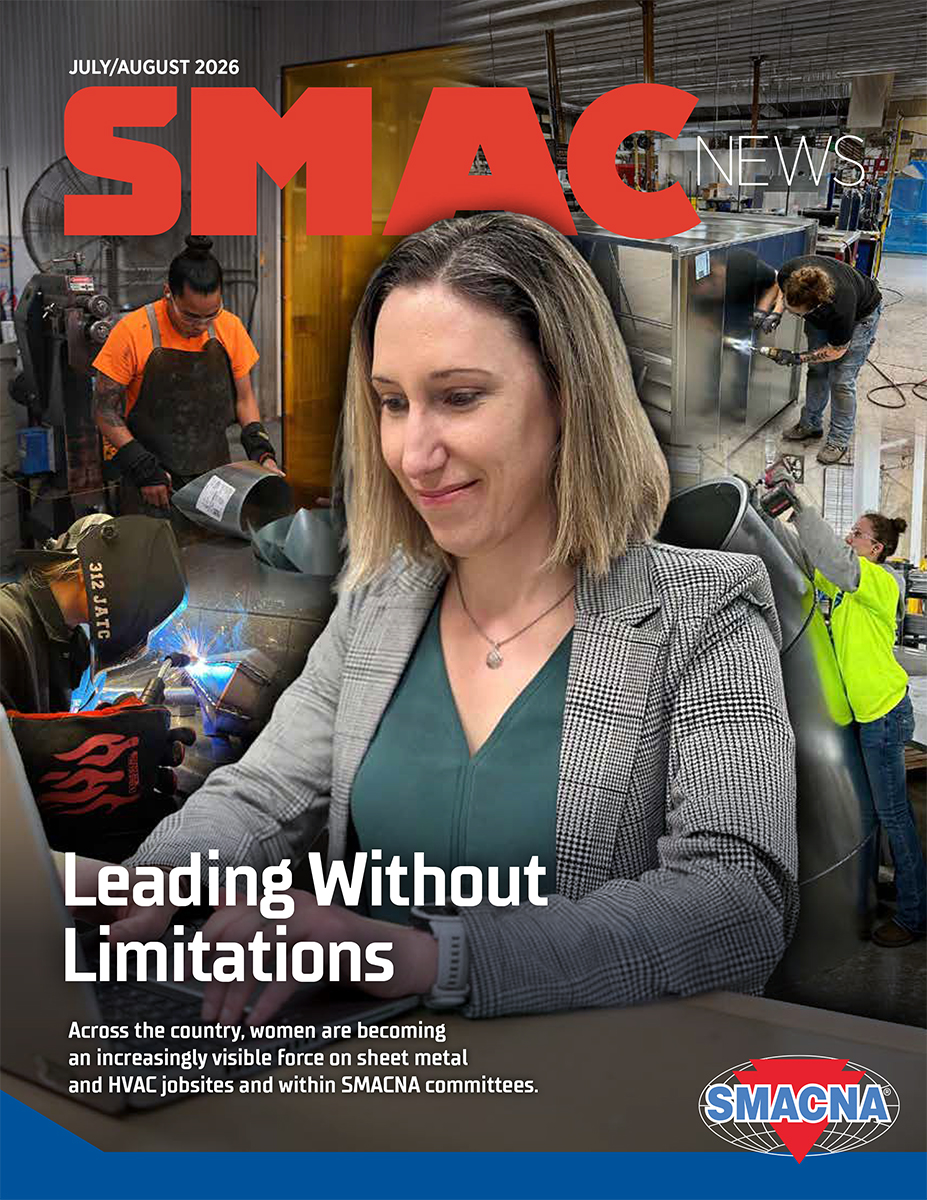
Leading Without Limitations
Across the country, women are becoming an increasingly visible force on sheet metal and HVAC jobsites and within SMACNA committees. These professionals talk about what it took to get in, stay in and start pulling others in behind them.
RESIDENTIAL: How One Illinois Contractor Turned Classic Trucks Into Marketing Machines
Mendel Plumbing & Heating’s themed fleet promotes everything from cancer awareness to local nonprofits, proving that community engagement can double as powerful advertising.
Sonderling Visit Shows the Trades a Path Forward
Acting U.S. Labor Secretary Keith Sonderling visited Pennsylvania’s Luzerne County Community College, where union contractors and educators made the case for apprenticeships, early recruitment and stronger career pathways in HVAC and sheet metal.
TESTING, ADJUSTING AND BALANCING: A Prescription for Healthy IAQ
SMACNA of Oklahoma member McIntosh Corp.’s TAB work helps patients, staff and visitors breathe clean air in a new Tulsa hospital tower.
Why Job Costing Still Breaks Margin Visibility for Construction Firms
Financial pressure in construction rarely appears all at once.
Privacy Policy |
Terms of Use | Contact Us
Phone: 703.803.2980 | Email:
info@smacna.org
© 1998-2026 SMACNA. All rights reserved.
Web Design & Development by Matrix Group
International, Inc.
