Leading Without Limitations
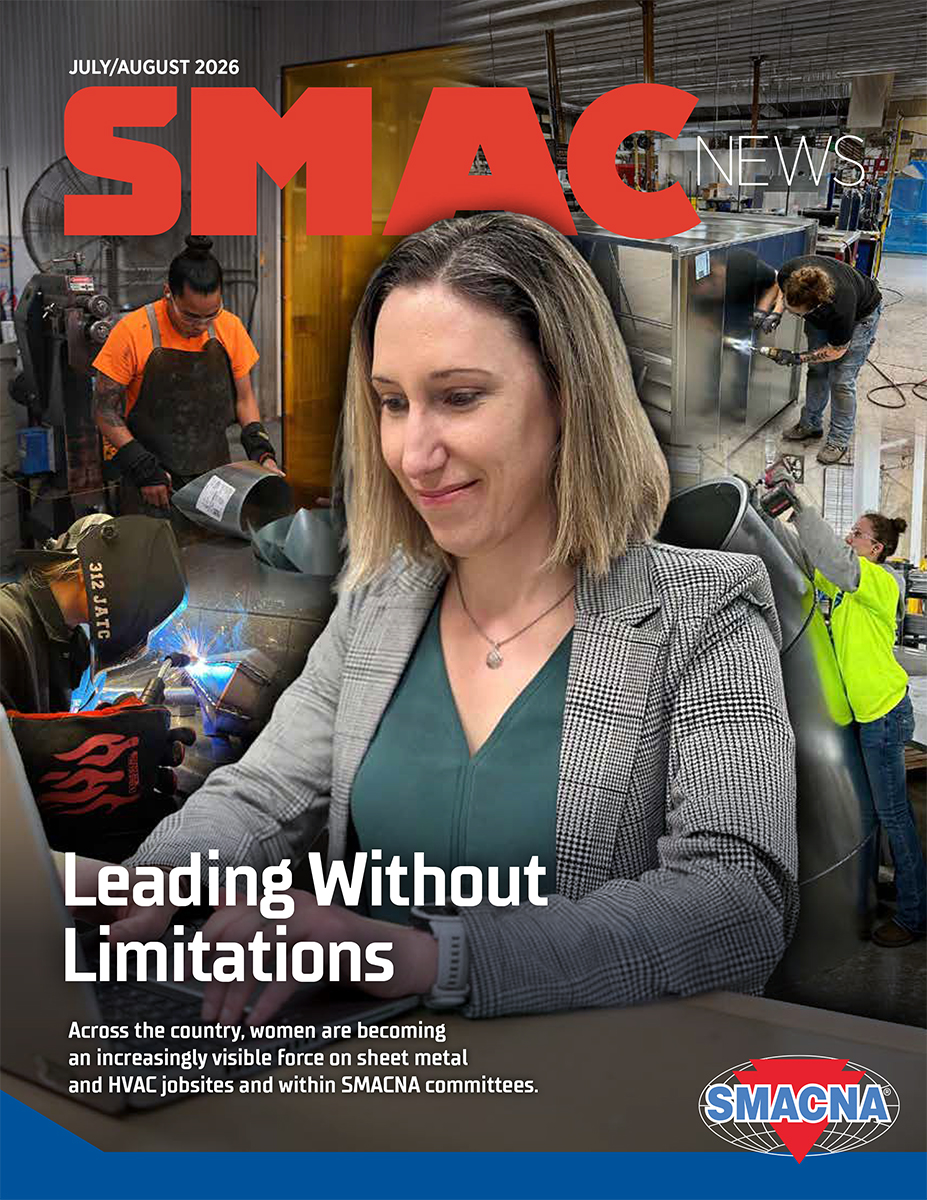
Across the country, women are becoming an increasingly visible force on sheet metal and HVAC jobsites and within SMACNA committees. These professionals talk about what it took to get in, stay in and start pulling others in behind them.
It’s lunchtime, and Michelle Acosta is alone at the will-call counter.
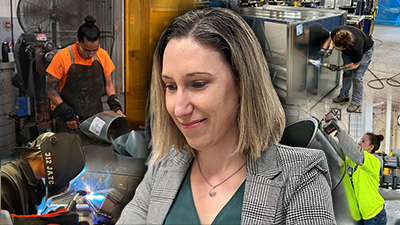 She’s 18, maybe 19, covering the counter by herself while the rest of the crew at her grandfather’s sheet metal manufacturing company is at lunch. A customer walks up needing fittings. “You can’t help me here,” he tells her. “You’re
a girl. ”Acosta doesn’t blink. “I do this all day, every day,” she tells him. “Everybody’s at lunch. You can either sit in your truck and waste 30 minutes, or you can tell me what you need, and I’ll have you out of here in 15 minutes. Your call.” He stays. She fills the order.
It’s a small showdown, over almost before it starts. But it captures something Acosta, now Vice President of Business Development at ATS Mechanical in San Jose, California, has lived through in one form or another for two decades. She started at Acosta Sheet Metal Manufacturing at 15, answering phones. By 17, she was teaching herself to write orders by watching over the shoulders of the men in inside sales, because, as she puts it, “nobody wanted to give me a chance.” By the 2008 recession, with the company short-staffed, she’d talked her way onto the shop floor doing shipping and receiving, carrying spiral duct, loading trucks and filling in wherever the business needed her.
There was one problem nobody had planned for: none of the company’s protective equipment came in her size. “I was swimming in them,” she says. “I was maybe 115 pounds soaking wet, and the shirts were hanging off me, so I did my best to tuck them in as much as I could.”
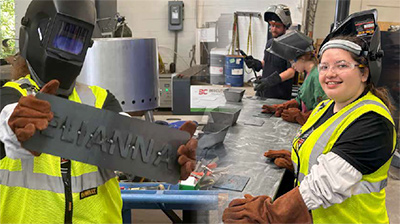
A teenage girl in men’s-large shirts, doing a job nobody thought she’d want is, in miniature, the story of women in sheet metal and HVAC right now. More are in the building than ever before, and national data backs that up. But the equipment, the culture and the paths into the industry were mostly built without women in mind. Closing that gap is the work SMACNA and its members are now visibly, deliberately taking on.
WHAT THE NUMBERS SAY
Women made up 11.2% of the U.S. construction workforce in 2024 — the highest share in 20 years and up from just 9.1% in 2017, according to the National Association of Home Builders’ analysis of federal labor data. That’s 1.34 million women, a number that has finally climbed back past pre-2008-recession levels after bottoming out at 802,000 in 2012. Growth has continued. Industry analysis of Bureau of Labor Statistics figures compiled by Fixr.com found women added roughly 22,000 net construction jobs between 2024 and 2025, pushing their share to 11.3%. A regional analysis by Associated Builders and Contractors’ Carolinas chapter found women’s participation in construction grew 45% between 2016 and 2025. And in 2025, women filled 12,000 of the 14,000 net new construction jobs added nationally, even as overall hiring slowed.
Acosta, who dug into the same data while thinking through her own story, put a finer point on it. “Women represent approximately 11% to 14% of the U.S. construction workforce,” she says, citing California’s Labor & Workforce Development Agency, “marking a historic high driven by a 45% increase in female participation over the past decade. This figure lines up with the Institute for Women’s Policy Research, which found women held just 4.3% of construction trade jobs nationally in 2024, even after a 77.3% increase in the number of tradeswomen since 2015. In three of the industry’s five largest trades, women’s share is smaller still: 3.5% of laborers; 3.2% of plumbers, pipefitters and steamfitters; and 2.9% of electricians.
Acosta’s read on why the gap persists tracks closely with an analysis published in March 2026 by Bluebeam’s Built blog, which found retention, not recruitment, is now the industry’s real bottleneck. “Retention is the issue,” Acosta says, “or as I describe it, a symptom. The underlying problems are everything from culture fit on the jobsite to the literal lack of fit of necessary PPE and everything in between.” The Bluebeam analysis backs her up, pointing out that women enter construction training and apprenticeship programs at higher rates than a decade ago, but leave the trades at higher rates than men, particularly in the first year. This is driven by isolation, thin mentorship and jobsite conditions like PPE that were never designed with them in mind. A 2025 industrial safety survey found more than one in five women linked a workplace injury directly to equipment that didn’t fit — the same problem, in a different decade, that had a teenage Acosta tucking men’s work uniform shirts into her waistband because there was no alternative.
Athena Chiera, Vice President of Athena Engineering in San Dimas, California, gives the honest, unsentimental version of that same trajectory from inside a company her parents founded in 1984. “It’s better, but don’t pop the champagne,” she says of where the industry stands now versus when she started. “There are more of us, more contractors who want us there, and more clients who genuinely expect it. But the numbers at the top and in the field are still thin, and too many women get in and then quietly leave because the culture treats them like guests. We’ve moved the needle. Now we have not finished the job.”
NO SINGLE FORMULA
Ask how these women arrived in sheet metal and HVAC, and the honest answer is almost none of them planned to and almost no two of them arrived the same way. There’s an engineer who didn’t know what sheet metal was until she was 28, a grandfather’s receptionist who taught herself the business from the back of a cubicle, a bank employee who took over her father’s fabrication shop, a CFO who backed in through an accounts-receivable job, a Ph.D. in Shakespeare who found herself drawn into estimating, and a union ironworker’s spouse who volunteered for a finance job she wasn’t trained for.
Chiera says her path had two separate beginnings.
“The first is that I was born into it,” Chiera says. “My mom, Jannie, started Athena Engineering in 1984 and had the guts to do it. My dad, Richard, was the technical one, but my mom was, and still is, the heart and the brains of this company. She blazed the trail I get to walk. I grew up on jobsites with my own toolbox, keying invoices at six and calling vendors to bid jobs at 11.”
The second beginning, she says, was the one she chose: coming in as a sales and business development professional during the 2008 financial collapse. Her goal was simple: to help the family business survive. “I thought I was just pitching in,” she says. “It turned out to be a natural fit, and I never left. So, the path found me first, and then I chose it right back.”
Jen Clark, Project Integration Manager at General Sheet Metal in Portland, Oregon, thinks that range of paths is an important
part of the industry’s story, but that the underlying imbalance is still very real.
Chiera goes one step further, arguing that the framing itself does specific damage before a girl ever gets near a jobsite. “By the time we recruit at the apprenticeship or college level, most girls have already crossed us off [the list],” she says, “not because a door slammed, but because we spent their childhood calling this industry ‘male-dominated.’ That phrase is well-meaning and it’s poison; it tells a 10-year-old the seats are taken before she ever considers one. An industry has no gender. Stop giving it one.”
WHAT SMACNA IS BUILDING
The industry isn’t just tracking this shift from the sidelines. SMACNA is actively building infrastructure around it. The association’s National Women in Leadership Committee, chaired by Kathy Kerber, President and COO of KSM Metal Fabrication in Troy, Ohio, has spent the past several months rebuilding momentum after a quieter stretch, and the growth has been fast. The committee’s private LinkedIn community, “Trailblazing Women in Sheet Metal and HVAC — Connected by SMACNA,” has grown from zero members to more than 70 since its launch, giving women across the industry — in the office, in the field and in leadership — a place to connect with peers and mentors that didn’t exist in this form before.
The committee meets twice a year, with a stated goal of making sure every avenue available to SMACNA members is genuinely open to the women working in the industry, whether they know those doors exist yet or not. Acosta has felt that outreach firsthand. She serves on the Bay Area SMACNA board, a seat she also didn’t wait to be invited into. “I just simply started going,” she says of her early involvement. “I wanted more of that. I just charged my credit card and went.”
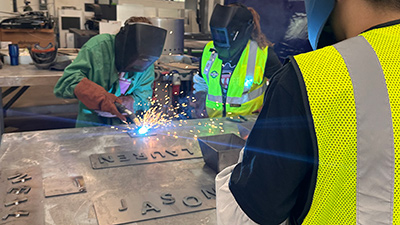
That kind of direct, on-the-ground exposure is also happening at the shop level. Devon Madon, Co-owner of Madon Sheet Metal near Chicago, recently hosted a Heavy Metal Summer Experience event at her shop, bringing students in to see what a career in the trade could look like up close. “One of the highlights of the day was connecting with several young women who were excited to explore opportunities in manufacturing,” she says. “Their curiosity, confidence and eagerness to learn were inspiring.”
Clark points to the same program in Portland. “That’s the importance of things like Heavy Metal Summer Experience — trying to reach out to younger people ... it’s just making the trades a valid option.”
Gina Medel, Chief Financial Officer of The Penn Air Group in Cypress, California, has taken a similarly hands-on approach in Southern California, giving tours of the local Joint Apprenticeship and Training Committee facility to friends’ sons and daughters alike. “I try to do my best because the industry is so great, and we just don’t market it enough,” she says. Her advice to anyone weighing the industry: “Take a chance. If you love what you do, the money will follow.”
Alongside the Women in Leadership Committee, SMACNA runs a second, broader effort aimed at the same underlying concern: making sure people in the industry are representative of the greater population. The Representation, Integrity, Support, and Empowerment Committee (RISE), a joint effort between SMACNA and the sheet metal workers’ union SMART, is barely two years old, and Renee Hoffman, Business Manager at Miller Sheetmetal in Bremerton, Washington, is one of its newer members. She joined, she says, after realizing she wanted a more direct hand in the conversation than the hallway small talk she’d been having on her own. “It’s just including everybody and helping those who are underrepresented,” she says of the committee’s focus, which extends well beyond gender. “I wanted to be able to do more.”
RISE also administers, alongside SMACNA’s Safety and Health Committee, an annual Safety Sponsorship — up to $5,000 toward attending the National Safety Council’s Safety Congress & Expo — in partnership with SMACNA’s BE4ALL initiative. Hoffman won the award in 2025, recognized for a safety program built on the same instincts that got her into finance: showing up, asking questions and refusing to let anything stop her. “Safety is more than just following rules; it’s about planning, communicating clearly and looking out for each other on every job,” she says. “As our company grows, we want to make sure our systems, training and leadership grow with it.”
Chiera won the same sponsorship in 2025. She built Athena Engineering’s safety program essentially from scratch after joining full time in 2008 — work later recognized separately by the company’s insurer, the ICW Group. “I’ve spent 18 years running our safety program while sending everyone else to the conferences,” Chiera says. “This scholarship is the first time it’s been my turn.” She’s using the recognition to push further, including expanding mental-health awareness at her company; improving near-miss reporting; and pressing on three concrete, practical fixes for women in the field: PPE that actually fits, reliable bathroom access on jobsites and stronger channels for reporting harassment.
Chiera’s involvement with SMACNA goes back further than the award. Athena Engineering has been a member “for a long time,” she says, and the company made a deliberate bet on training when it went union in 2005, “because we needed access to better training and more skilled people.” She’s since joined the National Association of Women in Construction, sits on an advisory board for the Air Conditioning, Refrigeration and Controls program at Mt. San Antonio College, and counts some of her closest professional friendships among tradeswomen nearing retirement who spent entire careers on the tools without ever being asked for their story. “Their stories deserve to be told before they walk off the job for the last time,” she says.
But several of the women make the same larger point: fixing safety protocols isn’t accommodation for women; it’s a safer jobsite for everyone. Clark makes the case from the field. “I can’t go out and lift 200 pounds over my head, so I’m probably going to be safer because I’m not trying to out-macho anybody,” she says. Bringing in people of different sizes, strengths and backgrounds, she argues, pushes crews to use the lifts and equipment they’re supposed to “because we all want to go home at night.”
PROVING IT TWICE
Ask several of these HVAC and sheet metal professionals what got in their way as they explored industry careers and a specific pattern shows up. There was a quiet assumption that the woman in the room isn’t the one in charge.
Chiera describes it as a fact of life on the sales side of the business, even now. “Men who were perfectly friendly with each other would see a woman walk up and assume she was a stand-in for the real decision-maker,” she says. Two moments from her career have become the stories she tells to explain what that assumption costs and what refusing it looks like. The first is a job walk where the electrical panel she needed to inspect sat inside the men’s locker room, and she was told she couldn’t go in. “I told them they’d have to cancel the entire RFP because a walk I’m not allowed to complete isn’t a fair bid,” she says. “Then I knocked on the door, told the men inside to put their underwear on because I was coming in, and I walked in and did the walk.” The second, which was smaller but just as telling was when a crew offered to save her the trouble of a roof inspection. “‘Don’t worry about climbing the ladder to the roof. We’ll just tell you what’s up there,’” she remembers being told. “‘No thank you. I’ll climb the ladder and see for myself,’” she said back. Her rule for moments like these hasn’t changed: “I don’t get loud, I don’t get small, and I don’t let it become the story. I refuse the smaller version of the job someone’s trying to hand me.”
Kerber describes a version of the same dynamic that lasted years rather than minutes. “Customers and vendors refused to talk to me and thought I had no idea what I was talking about,” she says of her early years at KSM. “It’s easier not to tell people who you are sometimes and just get a male counterpart to deal with some people.”
Acosta’s counter-scene is the same test. A stranger decided, on sight, that she couldn’t possibly be the person equipped to help him. All three describe handling it the same underlying way: not arguing the point; just doing the job anyway and letting the work settle the argument.
THE DRIVE IT TAKES
Talk to any of these industry professionals long enough, and a theme surfaces that has nothing to do with gender: none of them waited around.
Acosta calls it resourcefulness and traces it back to her first months in inside sales, teaching herself to type orders by watching coworkers when nobody would train her directly. “I think resourcefulness — essentially not waiting for people to give me an opportunity but rather just simply taking it for myself — is kind of a theme in my life,” she says.
Kerber describes something similar from her own experience building a company culture around it. “I was born somewhat of a leader,” she says. “I also have sought out leadership training, workshops and one-on-one development to help me in my career. I like being a leader, and I like to develop leaders.”
Clark’s version of the same instinct shows up in how she got her current role. She didn’t wait for a job posting.
“I went to the president of
the company with an idea,” she says, “and he said, ‘You know what, that sounds like
a great idea.’”
Hoffman’s came from raising her hand for a job running the company’s finances that she wasn’t trained for yet, then closing the gap on her own time. “I can do this,” she remembers telling herself. “I can do whatever I put my mind to.”
Medel frames it as focus rather than proving a point. “I never looked at it like, ‘Oh, I’m a woman here,’” she says. “I looked at it like, ‘How can I be productive, how can I be effective and what can I contribute?’ I just wanted to do the work.”
All of them describe a genuine, if hard-won, advantage that comes with being one of relatively few women in rooms that used to have none. “When you’re one, if not the only, woman in the room, you’re more easily recognized and remembered,” Acosta says. “When you’re the one who’s not like the others, people are curious, and that’s helped me get an entry point into interactions and groups that let me then show who I am and what I’m about.”
Clark describes it in terms of trust. “I think there’s just less of an ego thing going on,” she says. “People feel comfortable brainstorming with me or being open with me in a way they don’t necessarily feel as comfortable doing with another guy.”
Kerber calls it “a gift where we’re empathetic but strong at the same time ... sometimes we do better at seeing the big picture, and when that happens, we truly can bring unique input.”
Chiera puts the sharpest point on it. “Being the only woman in the room is always an advantage because nobody ever forgets me,” she says. “I’m 5’2”, Cuban, Italian, and definitely not quiet, so I don’t need a gimmick to stand out. For the record, I don’t do the pink hard hat. I like pink fine; it’s just not my color. In a sea of sameness, being different is memorable, and memorable wins work.”
THE PART THAT ISN’T SOLVED YET
None of the professionals who talked to SMACNews oversell the progress of women in the industry.
Kerber is candid that the trend line hasn’t been straight. “For a while, I felt it was getting better, and we were making a difference,” she says. “Now, I am not so sure. It seems like we have taken a back seat again. Hearing some comments from male colleagues feels like we are going back in time.” Asked about the most common misconception outside the industry, she says, “I think they think we are figureheads sometimes, but if you really looked at it, we show up, put in the time and the work, and we contribute a lot.”
Acosta zeroes in on something more structural: an industry-wide instinct to make newcomers (regardless of gender) earn their place through unnecessary hardship rather than real mentorship. “There is such an immense desire to say, ‘This is how I suffered, so you gotta suffer, too,’” she says. “I’m not saying we need to make it easy, but why do people have to suffer and make mistakes that aren’t helping anybody learn? They’re just making people feel bad.” She thinks that pattern, more than any single act of bias, is what actually drives people out. “I think companies forget that it is their obligation to help people grow,” she says. “None of us come out of college, an apprenticeship or a trade already knowing everything. I think once people get far enough in their careers, they forget what it was like to be a beginner.”
Chiera’s version of the same worry centers on visibility, and who the industry lets stand in for “women in construction” in the first place. “Scroll construction TikTok and the vast majority of women you’ll see are young project engineers at big general contractors,” she says. “Great job, nothing against it, but it’s one narrow lane. What you don’t see on the socials are the female welders, pipefitters and electricians. You know why? You can’t film yourself while you’re bending conduit, arc welding or sweating a pipe. Those women have their heads down doing the actual work, and we desperately need their stories out there.” She’s equally blunt about the misconception that follows from that gap. “That we’re the exception that proves the rule — that a woman doing this work must be some rare unicorn who had to be twice as tough to get here. It flattens us into mascots.”
And Chiera doesn’t let the industry off the hook on retention, the same word Acosta and the national data both keep circling back to: “Retention is the real scoreboard, and we’re not winning it yet.”
Hoffman, whose shop hasn’t yet had many women come through the field, says the fix must be ready before the need arrives, not after. “If a woman would need something,” she says, “we would absolutely add that to what we do.”
WHERE IT’S HEADED
Ask all the professionals what they’d tell a young woman weighing this career, and the answers land in roughly the same place, even if the delivery differs.
Madon, who came to Madon Sheet Metal from a Ph.D. in Shakespeare and a decade of teaching, wants the industry to make its intellectual case louder. “I wish more people asked how the humanities and manufacturing complement one another,” she says. “People think they’re opposites; my experience has been the exact opposite.” The same skills — critical thinking and communication — that she taught in a classroom are the ones she now uses to estimate and run a shop, which leads her to how she’d frame the trade’s future. “It’s not just about building better products. It’s about building better thinkers.
“You won’t know until you give it an honest try,” Madon adds. “And one bad apple — a terrible boss, a terrible company culture or one bad situation — doesn’t define the industry. Move on, reassess.”
“Don’t think that you need to be able to lift things that are heavy, or that you can’t do certain things — go out and try it,” adds Hoffman. “If it’s worth having, it’s hard to get.”
When the topic of work-life balance comes up, Chiera doesn’t pretend it’s achievable. “Balance is a lie — there’s no such thing,” she says. “Some weeks it tips all the way toward work, some weeks toward my life. The trick isn’t balance, it’s honesty. I do what I enjoy, I work with people I enjoy, and if I stop enjoying something, I drop it.”
Medel confirms that an office role doesn’t make industry entry any smoother for women despite assumptions that it does. “It’s definitely harder than most people assume,” she says. “People think, ‘Oh, you’re the CFO, you can come in when you want.’ No, it’s a lot and the buck stops with you.” What makes it work, she says, is loving the work itself. “The balance is easier for me because I genuinely enjoy what I do.”
Kerber has similar advice. “[This career] is very rewarding,” she says, “but challenging as hell. It can be tough.” Her hope for the next decade is specific and structural. “Developing more women contractors will require more than recruiting women into the industry — we need to prepare them to lead and own businesses,” she says. “Women need equal access to technical training, estimating, project management, financial education, bonding, capital, industry networks and meaningful mentorship and sponsorship. I would have loved to have had that when I started.”
Acosta’s version of the same hope circles back, fittingly, to the framing question this whole story keeps running into. “In 10 years, I hope that gender doesn’t make the headlines,” she says. “I hope great leaders and great workers are simply recognized for who they are and what they do, not in light of a label. I want to see less about ‘women leaders,’ and see more women in leadership.”
She points to the field leader she admires most in the industry — a man who has told his crew for years, in exactly these words: “I don’t hire women. I hire sheet metal workers.”
Chiera puts almost the same wish in almost the same words, from the other end of a two-decade career. “In 10 years, I want a girl to be able to say ‘I work in HVAC’ or ‘I’m a welder’ and have it land as ordinary,” she says. “It won’t be brave or surprising. It’ll just be her job.”
And when she’s asked what she’s never been asked but wishes someone would, Chiera says she hopes she doesn’t have to reach for anything about being a woman at all. “Ask me about the trickiest mechanical or controls-system problem I’ve untangled or how we kept the company alive through two recessions,” she says. “Ask me the questions you’d ask any seasoned contractor. The day a reporter leads with, ‘What’s the most interesting thing you’ve built?’ instead of ‘How does a woman end up in HVAC?’ that’s the day I’ll know the industry really changed.”
That’s the state of the HVAC and sheet metal industry heading into the back half of 2026: more women in the building than in two decades; a growing, deliberate SMACNA infrastructure working to get more women in the door and keep them there; and career examples that prove there’s no single blueprint for getting in. There is only, as Acosta puts it, a willingness “that I can simply walk in and pull up a chair.” Back at that will-call counter, nobody handed her one. These days, more of the industry is building extra chairs on purpose.
Published: September 14, 2026
IN THIS ISSUE
Leading Without Limitations
Across the country, women are becoming an increasingly visible force on sheet metal and HVAC jobsites and within SMACNA committees. These professionals talk about what it took to get in, stay in and start pulling others in behind them.
Privacy Policy |
Terms of Use | Contact Us
Phone: 703.803.2980 | Email:
info@smacna.org
© 1998-2026 SMACNA. All rights reserved.
Web Design & Development by Matrix Group
International, Inc.
