I’ve Been Collecting All This Data. Now What?
Effective data management is the foundation of any successful data-driven initiative.
Before diving in deep to see what insightful nuggets lie in this goldmine, there are some best practices to ensure that historical data is managed efficiently and utilized effectively in projects
 I used to be a larger proponent of the single source of truth, the centralized platform or cloud-based solution for data storage and management to ensure that all historical data is accessible from a single location, facilitating easy retrieval and analysis. While centralized platforms also provide a unified view of the project, enabling better coordination among different teams and stakeholders, they may not always be feasible, or the infrastructure may not lend itself to this structure. Another option is to leverage APIs and other communication tools to connect systems together provided there are adequate keys in the data to relate the information from one source to another. This allows the data to reside where you created it, but also makes it easily accessible
For intensive data work, there is often a need to pull the data into one pool. Standardizing data formats is crucial for ensuring compatibility and ease of analysis. Without standardization, data from different sources can be inconsistent, making it difficult to draw meaningful insights.
This leads us to quality assurance. Implementing data quality assurance measures, such as regular audits and validation checks, can help maintain data integrity.
Machine learning (ML) and artificial intelligence (AI) can enhance data standardization and quality assurance by automating the processes of identifying, correcting and standardizing data discrepancies. ML algorithms can analyze vast datasets to detect patterns and inconsistencies, ensuring that data conforms to predefined standards. AI-powered tools can continuously monitor data quality, flagging anomalies and suggesting corrections in real-time. This automation reduces the manual effort required for data cleaning and validation, enabling the maintenance of high-quality data consistently.
Once data is collected, the next step is to analyze it to extract valuable insights. This is where data analytics and Business Intelligence tools come into play.
Descriptive analytics involves analyzing historical data to understand past performance and identify trends. This can mean reviewing data on project timelines, labor hours and material costs to determine what went well and what could be improved. Descriptive analytics provides a foundation for making informed decisions.
Predictive analytics uses historical data to forecast future outcomes. Identifying patterns and trends in past projects can help predict potential issues and opportunities in upcoming projects.
Prescriptive analytics goes a step further by not only predicting outcomes but also suggesting actions to achieve desired results. This involves using advanced algorithms and machine learning models to recommend the best courses of action. Prescriptive analytics can provide actionable insights on optimizing resource allocation, scheduling and procurement.
Analyzing data from previous projects develops more accurate project schedules. Understanding how long specific tasks take and identifying potential bottlenecks helps create realistic timelines that minimize delays and ensure timely project completion.
Historical data on material and labor costs can inform more accurate project cost estimates and budgets. Understanding past spending patterns can enable the development of budgets that are more realistic.
Labor productivity and material usage data can optimize resource allocation. Identifying which resources are most effective for specific tasks can ensure the right people and materials are in the right place at the right time, maximizing productivity and minimizing waste.
Historical data can also be used to enhance quality control and risk management efforts.
Published: September 17, 2026
IN THIS ISSUE
Adapt to Remain Competitive
When I started as an apprentice 36 years ago, the sheet metal industry looked very different than it does today.
ARCHITECTURAL: Once in a Lifetime in Copper
Baker Group’s restoration of Iowa’s Webster County Courthouse involved a leaning clock tower, stamped rosettes from overseas and 10,000 hours of field work.
Capitol Hill Update: Housing Bill Could Speed HVAC Work
The bipartisan 21st Century ROAD to Housing Act may be more than a housing policy win.
Chapter Spotlight: How SMACNA St. Louis Built a Union Model That Still Works
Through rebate programs, training partnerships and close coordination with Local 36, the chapter has preserved market share and strengthened its contractor network.
Eli Howard Named SMACNA COO
SMACNA appointed Eli P. Howard, III as the organization’s new Chief Operating Officer.
I’ve Been Collecting All This Data. Now What?
Effective data management is the foundation of any successful data-driven initiative.
INDUSTRIAL: Inside the $100-Billion Micron Megafab Campus
As site work begins on one of the largest private construction projects in U.S. history, central New York’s sheet metal industry braces for an unprecedented test of capacity, timing and labor.
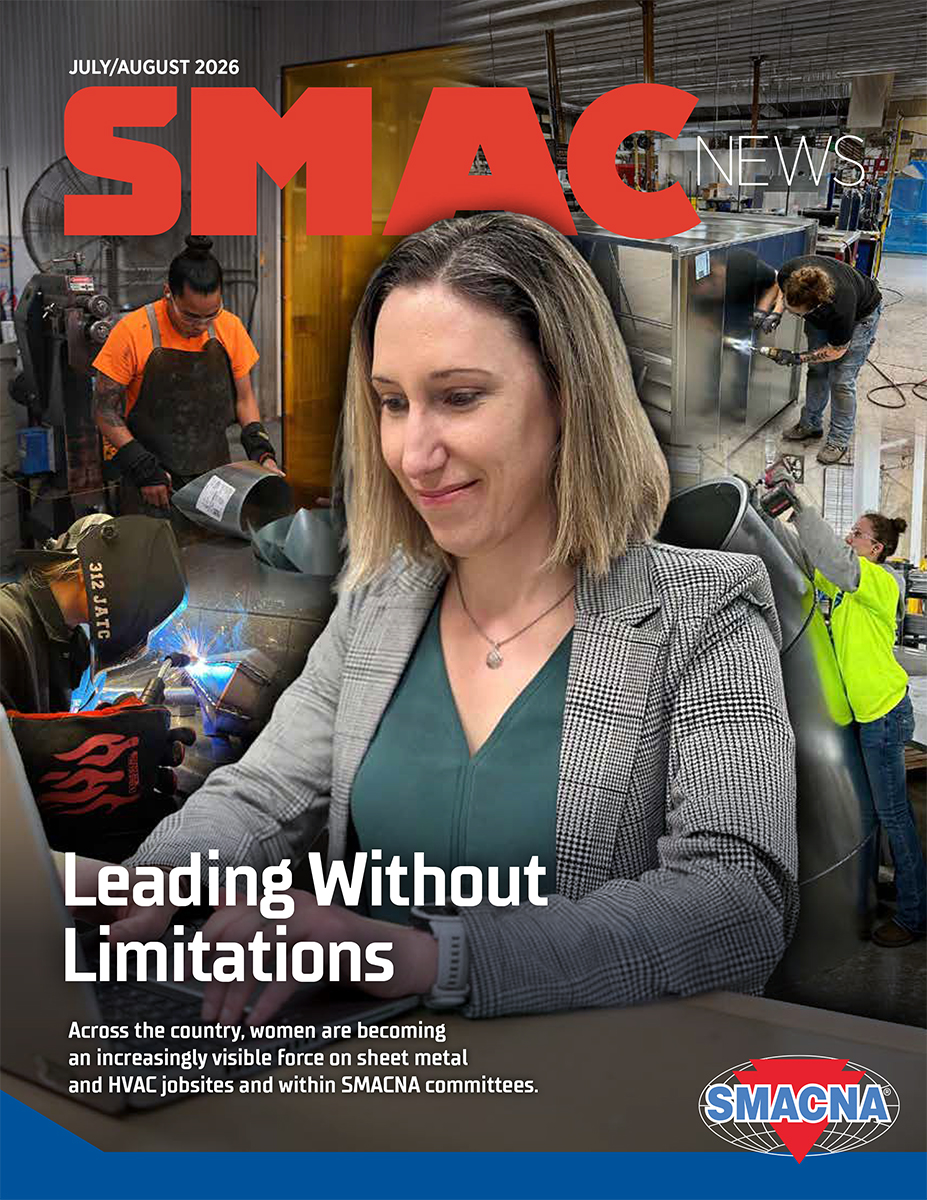
Leading Without Limitations
Across the country, women are becoming an increasingly visible force on sheet metal and HVAC jobsites and within SMACNA committees. These professionals talk about what it took to get in, stay in and start pulling others in behind them.
RESIDENTIAL: How One Illinois Contractor Turned Classic Trucks Into Marketing Machines
Mendel Plumbing & Heating’s themed fleet promotes everything from cancer awareness to local nonprofits, proving that community engagement can double as powerful advertising.
Sonderling Visit Shows the Trades a Path Forward
Acting U.S. Labor Secretary Keith Sonderling visited Pennsylvania’s Luzerne County Community College, where union contractors and educators made the case for apprenticeships, early recruitment and stronger career pathways in HVAC and sheet metal.
TESTING, ADJUSTING AND BALANCING: A Prescription for Healthy IAQ
SMACNA of Oklahoma member McIntosh Corp.’s TAB work helps patients, staff and visitors breathe clean air in a new Tulsa hospital tower.
Why Job Costing Still Breaks Margin Visibility for Construction Firms
Financial pressure in construction rarely appears all at once.
Privacy Policy |
Terms of Use | Contact Us
Phone: 703.803.2980 | Email:
info@smacna.org
© 1998-2026 SMACNA. All rights reserved.
Web Design & Development by Matrix Group
International, Inc.
