ARCHITECTURAL: 173 Feet Up, 130 Years In
Heather & Little brings Cornell University’s McGraw Tower back from the brink.
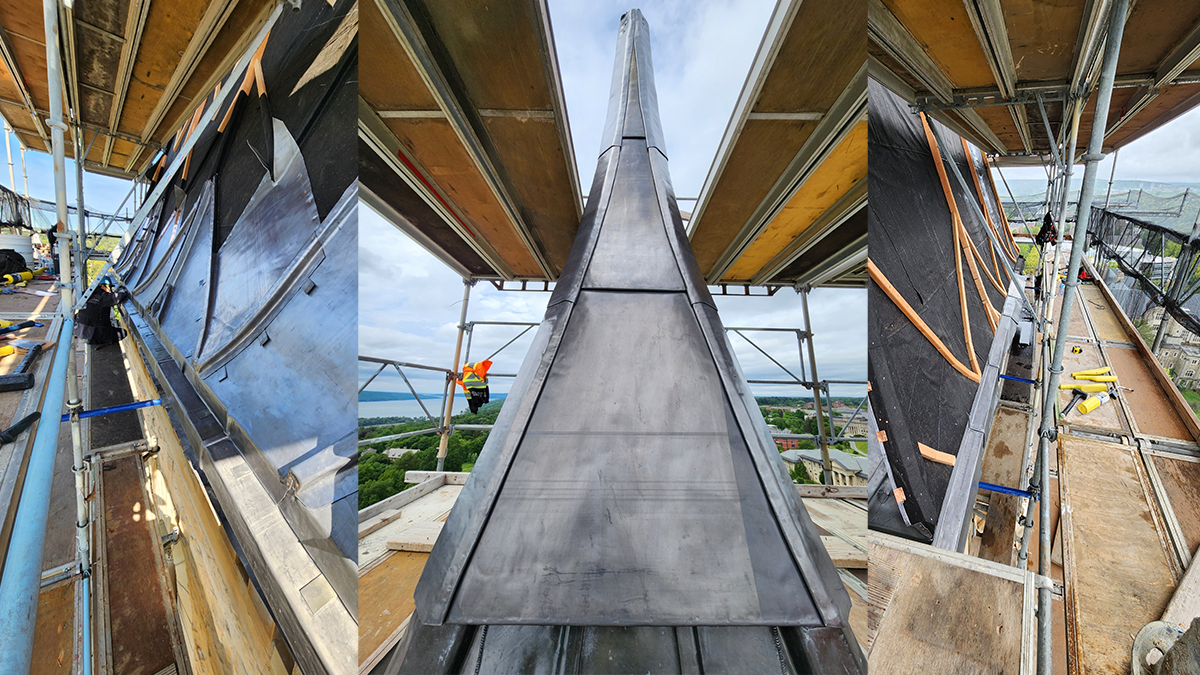 There are restoration projects, and then there are missions. The renewal of McGraw Tower at Cornell University fell squarely into the second category.
Standing 173 feet above the Ithaca, New York campus, McGraw Tower has marked time since its completion in 1891. The clock tower, originally built as part of Cornell’s historic library complex, is one of the university’s most recognized landmarks. Its roof, replaced in 1932 with a lead-coated copper chevron pattern, had become as much a part of the building’s identity as the bells it houses. But after more than 130 years of exposure and decades of patches that slowed but never stopped persistent leaks, the roof had reached the end of its service life.
The design team approved a full replacement, and its members hired Heather & Little to do the work, says Marc Jamieson, Vice President of Sales and Estimating at Heather & Little Limited, the Toronto-area architectural sheet metal firm that got the consulting work, followed by the renovation and construction.
A Rare Material, A Rarer Skill Set
Heather & Little hadn’t come to the project cold. The firm had been consulted early before the job went to bid when the design team was still working through material decisions and wasn’t yet fluent in what working with sheet lead actually requires.
“They weren’t all that familiar with working with sheet lead,” Jamieson says. “So, we helped them come up with some design parameters.”
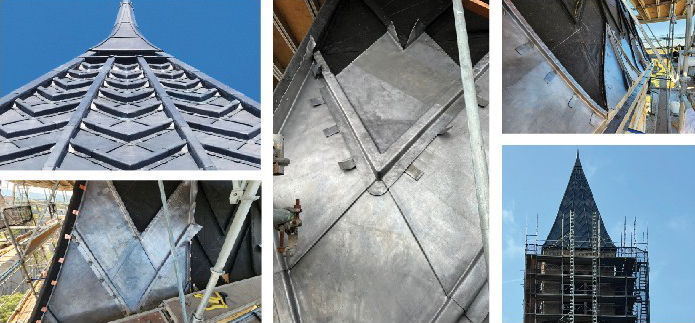
The McGraw Tower has a distinctive chevron pattern made of sheet lead.
That early consultation laid the groundwork for the decision that would define the project. Rather than replicating the original lead-coated copper, the design team chose sheet lead, a material with deep roots in historic preservation work and one that Heather & Little says it knows better than almost anyone in North America.
Lead’s virtues for a project like this are well documented. It is resistant to corrosion, maintaining structural integrity across extreme temperatures, heavy snow loads and decades of freeze-thaw cycles. It develops a natural patina over time that suits historic structures aesthetically. It is fire-resistant. And, critically for McGraw Tower, it is soft enough to conform precisely to irregular substrates, which would prove essential given the tower’s geometry.
But sheet lead is also, as Jamieson puts it plainly, “an unusual material to work with these days.” In the United States, health and safety concerns have made it increasingly rare on active job sites. In Canada, Heather & Little and a small number of peers still use it regularly with rigorous safety protocols, including periodic blood testing for workers handling it, built into standard practice. That institutional knowledge is precisely what Cornell’s design team needed and couldn’t source domestically.
Built by Hand, Panel by Panel
Heather & Little came on as a subcontractor to general contractor Welliver, and their scope was comprehensive: supply and install the full 6-pound sheet lead roofing system, replicating the tower’s distinctive chevron batten-seam design; install lead panels, battens, stainless steel fasteners, copper cleats, synthetic and fabric underlayments, welded connections, and all associated flashing components; and extend the work to the tower’s custom lead spire cap and eave assemblies — each fabricated to heritage specifications with seamless transitions and watertight joints.
What made the execution genuinely unusual, even by restoration standards, was where the fabrication happened, which was not in a shop, but on site.
“Most of it is fabricated in the field,” Jamieson says. “Lead is very soft, and it’s meant to conform very precisely to the substrate. It can’t bridge a gap the way regular sheet metal might. It must match exactly.”
That means if one chevron panel sits at a slightly different angle than the one beside it — a near-certainty on a 130-year-old structure — each piece must be custom-formed to account for it. There is nothing production-oriented about the process. It is slow, deliberate and tactile work, shaped by the building itself rather than by shop drawings alone.
The firm also produced detailed shop drawings, full-scale mock-ups of proposed roofing assemblies and thorough documentation of existing conditions before a single panel was installed — a process that allowed the design team to evaluate appearance, detailing and constructibility before committing to the final approach.
The Logistics of Working Far From Home
Executing this kind of work 500 miles from the firm’s home base added another layer of complexity. Heather & Little’s crew couldn’t pull additional materials from the shop on short notice, couldn’t easily send in support staff and had to operate with the self-sufficiency of a remote expedition.
“Because of the distance and the fact that we were working remotely, we didn’t have access to the shop even if we could have,” Jamieson says. “You can’t just call up and order a couple of pieces of flashing.”
The crew traveled from the Toronto area to Ithaca and worked on location for the duration of the project — a lengthy one, given the nature of the material and the precision required. The result, by all accounts, was worth the effort.
“We’ve been in touch with the architect recently,” Jamieson says, “and they were very pleased with the end result.”
What This Kind of Work Requires
McGraw Tower isn’t an anomaly in Heather & Little’s portfolio. The firm has completed similarly demanding heritage metalwork on the Legislative Assembly of Ontario and other landmark structures across North America. Working in materials and methods that most of the industry has long since set aside keeps the company competitive in this space.
The McGraw Tower “is an iconic, important part of the campus,” Jamieson says of the tower’s chevron roof. “You couldn’t just replace it with something else. It had to be like materials and like design.”
Heather & Little made sure it was.
Published: July 14, 2026

IN THIS ISSUE
3 Benchmarking Metrics Every Contractor Should Track Throughout the Year
Sometimes, success is best measured in relative terms.
ARCHITECTURAL: 173 Feet Up, 130 Years In
Heather & Little brings Cornell University’s McGraw Tower back from the brink.
Caged on Clark Street
When FX’s “The Bear” needed a bear cage for its now-iconic opening scene, they called a sheet metal shop in the Chicago suburbs. It became the biggest show in the city.
Chapter Spotlight: From Tennis Courts to the Corner Office
CHAPTER Spotlight: Tri-County SMACNA: How friendship, tragedy and a family affair reshaped one SMACNA chapter
How Contractors Are Rethinking Fabrication
At SMACNA’s Fab Forum, contractors discussed the future of shop productivity — from prefab and inventory control to automation.
HVAC: Mapping the Work
How shops can use AI to turn messy, real-world operations into clear processes, usable SOPs and repeatable training tools.
INDUSTRIAL: Lee Mechanical’s 250,000-Pound Sheet Metal Answer to the Data Center Boom
When a long-term client needed a massive mechanical infrastructure overhaul at a data center supply chain facility in southeastern Wisconsin, Lee Mechanical brought the solution.
Inside SMACNA’s First Washington, D.C. Leadership Conference
Contractors, policymakers and industry experts convened on Capitol Hill for two days of policy briefings, lobbying and hard conversations about tariffs, pensions and the future of the construction industry.
Learning, Lobbying & Lasting Connections
When I travel, people often ask me why SMACNA membership is important. Networking with peers is a big reason, since it lets us learn from the best in the industry and discover new ideas.
Opportunities for AI in the Sheet Metal and HVAC Industries
At its heart, artificial intelligence differs from traditional software because it uses probability, not instructions, to get work done.
RESIDENTIAL: The 12-month Build
Inside Design Aire’s race to install 259 HVAC systems before Washington University’s fall semester.
Supreme Court Confirms Broad Actuarial Discretion in Withdrawal Liability Calculations
On May 21, the U.S. Supreme Court issued a unanimous decision in M & K Employee Solutions v. Trustees of the IAM National Pension Fund that should be of interest to unionized construction contractors participating in multi-employer pension plans.
TESTING, ADJUSTING AND BALANCING: No More Out of Sight, Out of Mind
Fire and life safety systems hidden inside ductwork have gone unchecked for too long. Industry experts say their moment of focus has arrived.
Two Cities. One Mission.
SMACNA’s spring events made the case that the contractors winning tomorrow are the ones learning, lobbying and connecting today.
Welcome New SMACNA Members
Privacy Policy |
Terms of Use | Contact Us
Phone: 703.803.2980 | Email:
info@smacna.org
© 1998-2026 SMACNA. All rights reserved.
Web Design & Development by Matrix Group
International, Inc.
