Supreme Court Confirms Broad Actuarial Discretion in Withdrawal Liability Calculations
On May 21, the U.S. Supreme Court issued a unanimous decision in M & K Employee Solutions v. Trustees of the IAM National Pension Fund that should be of interest to unionized construction contractors participating in multi-employer pension plans.
 The decision addressed an important issue involving withdrawal liability calculations under ERISA and, more specifically, the discretion pension plan actuaries possess when selecting actuarial assumptions.
While the case focused on a narrow statutory question, the Court’s reasoning reinforces the substantial role actuarial judgment plays in withdrawal liability determinations.
THE ISSUE BEFORE THE SUPREME COURT
Under ERISA, an employer that withdraws from an underfunded multi-employer pension plan may be assessed withdrawal liability representing the employer’s share of the plan’s unfunded vested benefits (“UVBs”).
Calculating those liabilities requires actuaries to make assumptions about future events, including investment returns, mortality and interest rates. One of the most significant assumptions is the “discount rate” used to estimate the present value of future pension obligations.
As a general matter, lower discount rates produce larger projected liabilities, while higher discount rates reduce projected liabilities.
The dispute in M & K Employee Solutions centered on whether a pension fund could use actuarial assumptions that were adopted after the statutory “measurement date” used to calculate withdrawal liability.
The IAM National Pension Fund reduced its discount rate from 7.5% to 6.5% shortly after the applicable measurement date. That change substantially increased the fund’s unfunded vested benefits and the resulting withdrawal liability assessments. According to the Supreme Court, the fund’s UVBs increased from approximately $500 million to more than $3 billion after the assumption change. One employer’s withdrawal liability allegedly increased from approximately $1.8 million to $6.2 million, as a result.
The employers argued that the pension fund should have been required to use the assumptions already “in effect” on the measurement date. The Supreme Court unanimously rejected that argument.
SUPREME COURT: ACTUARIAL ASSUMPTIONS ARE “PREDICTIVE JUDGMENTS”
Justice Ketanji Brown Jackson, writing for the unanimous Court, emphasized that actuarial assumptions are not fixed historical facts. Instead, the Court described them as “predictive judgments about a plan’s anticipated future performance.” That became central to the Court’s analysis.
According to the Court, ERISA requires withdrawal liability to be calculated “as of” the measurement date, but the statute does not require the actuarial assumptions themselves to have been selected by that date.
The Court further explained that actuarial assumptions are “tools actuaries use to calculate the plan’s UVBs” rather than factual inputs that become frozen in time.
The Supreme Court also relied heavily on ERISA’s requirement that actuarial assumptions reflect the actuary’s “best estimate of anticipated experience under the plan.”
In practical terms, the Court reasoned that actuaries may need to rely on the most current market and economic information available in order to make reasonable projections.
BOTTOM LINE
The Supreme Court’s decision in M & K Employee Solutions resolved an important question under ERISA: whether actuarial assumptions used to calculate withdrawal liability must be selected before the statutory measurement date. The Court held that ERISA imposes no such deadline.
Disclaimer: This article is for informational purposes only. If you have questions or need guidance, consult your local labor attorney or labor relations department.
Grant Collins is a specialist in labor and employment law at Felhaber Larson. Reach him at gcollins@felhaber.com.
Published: July 14, 2026
IN THIS ISSUE
3 Benchmarking Metrics Every Contractor Should Track Throughout the Year
Sometimes, success is best measured in relative terms.
ARCHITECTURAL: 173 Feet Up, 130 Years In
Heather & Little brings Cornell University’s McGraw Tower back from the brink.
Caged on Clark Street
When FX’s “The Bear” needed a bear cage for its now-iconic opening scene, they called a sheet metal shop in the Chicago suburbs. It became the biggest show in the city.
Chapter Spotlight: From Tennis Courts to the Corner Office
CHAPTER Spotlight: Tri-County SMACNA: How friendship, tragedy and a family affair reshaped one SMACNA chapter
How Contractors Are Rethinking Fabrication
At SMACNA’s Fab Forum, contractors discussed the future of shop productivity — from prefab and inventory control to automation.
HVAC: Mapping the Work
How shops can use AI to turn messy, real-world operations into clear processes, usable SOPs and repeatable training tools.
INDUSTRIAL: Lee Mechanical’s 250,000-Pound Sheet Metal Answer to the Data Center Boom
When a long-term client needed a massive mechanical infrastructure overhaul at a data center supply chain facility in southeastern Wisconsin, Lee Mechanical brought the solution.
Inside SMACNA’s First Washington, D.C. Leadership Conference
Contractors, policymakers and industry experts convened on Capitol Hill for two days of policy briefings, lobbying and hard conversations about tariffs, pensions and the future of the construction industry.
Learning, Lobbying & Lasting Connections
When I travel, people often ask me why SMACNA membership is important. Networking with peers is a big reason, since it lets us learn from the best in the industry and discover new ideas.
Opportunities for AI in the Sheet Metal and HVAC Industries
At its heart, artificial intelligence differs from traditional software because it uses probability, not instructions, to get work done.
RESIDENTIAL: The 12-month Build
Inside Design Aire’s race to install 259 HVAC systems before Washington University’s fall semester.
Supreme Court Confirms Broad Actuarial Discretion in Withdrawal Liability Calculations
On May 21, the U.S. Supreme Court issued a unanimous decision in M & K Employee Solutions v. Trustees of the IAM National Pension Fund that should be of interest to unionized construction contractors participating in multi-employer pension plans.
TESTING, ADJUSTING AND BALANCING: No More Out of Sight, Out of Mind
Fire and life safety systems hidden inside ductwork have gone unchecked for too long. Industry experts say their moment of focus has arrived.
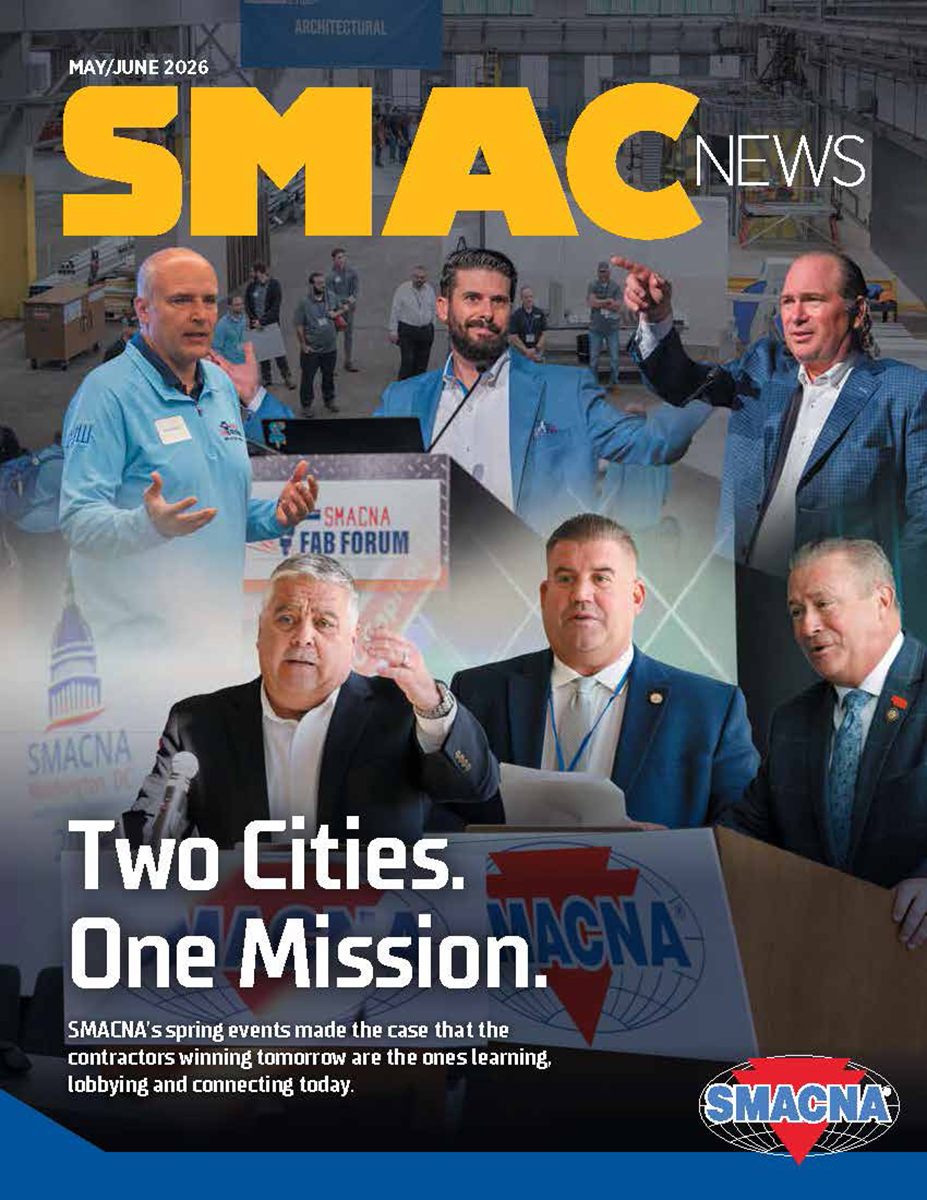
Two Cities. One Mission.
SMACNA’s spring events made the case that the contractors winning tomorrow are the ones learning, lobbying and connecting today.
Welcome New SMACNA Members
Privacy Policy |
Terms of Use | Contact Us
Phone: 703.803.2980 | Email:
info@smacna.org
© 1998-2026 SMACNA. All rights reserved.
Web Design & Development by Matrix Group
International, Inc.
