TESTING, ADJUSTING AND BALANCING: No More Out of Sight, Out of Mind
Fire and life safety systems hidden inside ductwork have gone unchecked for too long. Industry experts say their moment of focus has arrived.
 The morning rush at a major international airport. A hospital pharmacy where patients depend on pressurized isolation rooms. A 9-story office tower in the middle of a downtown financial district. In each of these buildings, behind walls and above ceilings, sits a network of fire dampers and smoke control systems that most people will never see and, until recently, rarely think about. That invisibility, experts say, has been the problem all along.
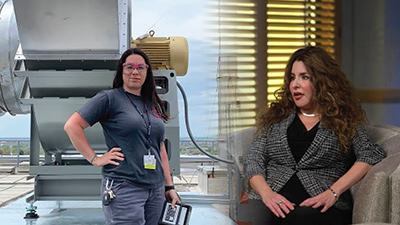
On a recent episode of SMACNA’s Clear the Air podcast, SMACNA Host Seth Lennon was joined by Jennifer Lohr of Fisher Balancing Co. and Gina Medel of the Penn Air Group for a conversation about fire and life safety in the TAB sector. What emerged was a portrait of an industry at a turning point—one where the gap between legislation and enforcement is beginning to close and where SMACNA contractors are positioned to lead.
An Emerging Market With Deep Roots
Fisher Balancing Co., based in Williamstown, New Jersey, holds certifications from both the National Environmental Balancing Bureau (NEBB) and the Testing, Adjusting and Balancing Bureau (TABB). The firm is certified in air and hydronic balancing, fire protection systems commissioning, building systems commissioning, and fire and smoke damper testing. The company has experience in healthcare construction and complex mechanical system troubleshooting.
Penn Air Group, headquartered in Cypress, California, with offices in Las Vegas, Hawaii, San Diego, Virginia and the Pacific Northwest, is an independent testing agency and member of the Associated Air Balance Council (AABC). The firm offers a portfolio spanning HVAC test and balance, smoke removal systems, hospital critical area airflow and pressure testing, clean room certification, and mechanical/life safety control performance verification with a strong focus on government contracts and medical facilities.
Together, Lohr and Medel represent two distinct regional markets facing the same fundamental challenge: a critical building system that has long been undervalued because it cannot be seen.
“Fire dampers and smoke control systems are hidden in duct work. They’re out of sight, out of mind—nobody really thinks about things they can’t see,” Lohr says.
That lack of visibility has real consequences. Lohr and Medel both point to a pattern. Meaningful action on fire and life safety tends to follow tragedy rather than precede it. The 1980 MGM Grand fire in Las Vegas—one of the deadliest hotel fires in U.S. history—remains a reference point for how building systems failures can cascade into mass casualties.
“It’s reaction versus prevention,” says Medel. “Owners and facility managers now see fire and life safety as risk mitigation. NFPA and Joint Commission requirements have become stricter. Mission-critical facilities like hospitals demand documented compliance and digital reporting.”
The Technology Has Caught Up
The mechanical evolution of fire dampers over the past several decades has been substantial. Early designs relied on gravity-operated metal plates that closed when fusible links melted under high heat—passive protection at its most basic. Today’s systems are a different story.
“You’ve gone from basic galvanized steel to high-performance alloys with corrosion-resistant coatings,” Lohr explains. “And when you move from fire dampers to fire/smoke dampers, you’re now integrated into building automation system—electrical actuators, sensors, remote monitoring and control capability.”
That integration is particularly valuable in healthcare settings, where Lohr’s firm has extensive experience and where the stakes of system failure are highest.
For SMACNA contractors, this technology evolution represents both an opportunity and a responsibility. The systems being installed today are sophisticated, code-driven and increasingly tied to building-wide digital infrastructure. That means the TAB professionals who test, inspect and certify them must be equally sophisticated and must operate under clear, enforced standards.
Enforcement is the Missing Link
Philadelphia offers the clearest case study in what enforcement can look like. In 2020, backed by advocacy from Sheet Metal Workers Local 19 and passed unanimously by City Council, Philadelphia enacted legislation requiring licensed technicians to regularly inspect fire dampers and smoke control systems in high-rise buildings. Compliance runs through Philadelphia’s Licensing and Inspection department, and when deficiencies aren’t corrected within 90 days, contractors are required to submit formal deficiency reports to fire code officials. Failure to comply leads to court.
“The enforcement is real in the city of Philadelphia,” Lohr says. “I’m getting calls every week—people saying, ‘L&I is coming after me, I need a TAB contractor.’ That’s what real enforcement looks like.” Fisher Balancing is now preparing for a wave of six-year recertification cycles at major healthcare campuses—a process that for pharmacy spaces alone can require six months of advance scheduling to safely relocate operations.
The challenge, both Lohr and Medel emphasize, is replicating that model nationally. “You can get all the legislation you want, but without enforcement it’s meaningless,” Lohr says. “We need to get that in the faces of legislators and build the simulators that help people understand what they can’t see until they really need it.”
Medel and her team are taking a hands-on approach. Penn Air Group has developed a portable mobile TAB lab, a simulator that physically puts people inside a smoke-controlled environment to feel what a properly or improperly functioning system actually means for egress. The firm recently brought California Assemblywoman Blanca Rubio through the demonstration, and the response was immediate. “She kept saying, ‘Oh my gosh, I’m in 9- and 12-story buildings—how many of those aren’t compliant?’” says Medel. “That’s what opens people’s eyes—not a chart or a code citation but being inside it.”
Where SMACNA Contractors are Seeing Demand
Fire and life safety work is rapidly becoming one of the most consistently active categories across nearly every building type. There are several market segments where SMACNA members should expect continued growth:
Healthcare and medical facilities lead the conversation, driven by Joint Commission (JCAHO) compliance requirements, six-year hospital damper testing cycles under NFPA 80 and the complexity of working inside active clinical environments. Hospitals are, in Lohr’s words, “a lot better” at compliance than most building types, but the volume of work is enormous, and the scheduling demands alone create long-term contractor relationships.
Commercial high-rises and office towers in urban markets are facing increasing code scrutiny, particularly in jurisdictions that have adopted or are moving toward Philadelphia-style enforcement. Transportation infrastructure—airports and train stations where large concentrations of people occupy confined or underground spaces—is also emerging as a significant opportunity. Lohr pointed to Dulles International Airport’s ongoing retrofit program as one example of the scale of work being undertaken. “You need to buy those vital seconds to get people out safely,” she says. “That’s exactly what these systems do.”
Educational facilities, data centers, industrial manufacturing sites and even government buildings round out a demand picture that is, effectively, the entire built environment. As Medel puts it: “Every building you can see—it’s needed there.”
Published: July 14, 2026
IN THIS ISSUE
3 Benchmarking Metrics Every Contractor Should Track Throughout the Year
Sometimes, success is best measured in relative terms.
ARCHITECTURAL: 173 Feet Up, 130 Years In
Heather & Little brings Cornell University’s McGraw Tower back from the brink.
Caged on Clark Street
When FX’s “The Bear” needed a bear cage for its now-iconic opening scene, they called a sheet metal shop in the Chicago suburbs. It became the biggest show in the city.
Chapter Spotlight: From Tennis Courts to the Corner Office
CHAPTER Spotlight: Tri-County SMACNA: How friendship, tragedy and a family affair reshaped one SMACNA chapter
How Contractors Are Rethinking Fabrication
At SMACNA’s Fab Forum, contractors discussed the future of shop productivity — from prefab and inventory control to automation.
HVAC: Mapping the Work
How shops can use AI to turn messy, real-world operations into clear processes, usable SOPs and repeatable training tools.
INDUSTRIAL: Lee Mechanical’s 250,000-Pound Sheet Metal Answer to the Data Center Boom
When a long-term client needed a massive mechanical infrastructure overhaul at a data center supply chain facility in southeastern Wisconsin, Lee Mechanical brought the solution.
Inside SMACNA’s First Washington, D.C. Leadership Conference
Contractors, policymakers and industry experts convened on Capitol Hill for two days of policy briefings, lobbying and hard conversations about tariffs, pensions and the future of the construction industry.
Learning, Lobbying & Lasting Connections
When I travel, people often ask me why SMACNA membership is important. Networking with peers is a big reason, since it lets us learn from the best in the industry and discover new ideas.
Opportunities for AI in the Sheet Metal and HVAC Industries
At its heart, artificial intelligence differs from traditional software because it uses probability, not instructions, to get work done.
RESIDENTIAL: The 12-month Build
Inside Design Aire’s race to install 259 HVAC systems before Washington University’s fall semester.
Supreme Court Confirms Broad Actuarial Discretion in Withdrawal Liability Calculations
On May 21, the U.S. Supreme Court issued a unanimous decision in M & K Employee Solutions v. Trustees of the IAM National Pension Fund that should be of interest to unionized construction contractors participating in multi-employer pension plans.
TESTING, ADJUSTING AND BALANCING: No More Out of Sight, Out of Mind
Fire and life safety systems hidden inside ductwork have gone unchecked for too long. Industry experts say their moment of focus has arrived.
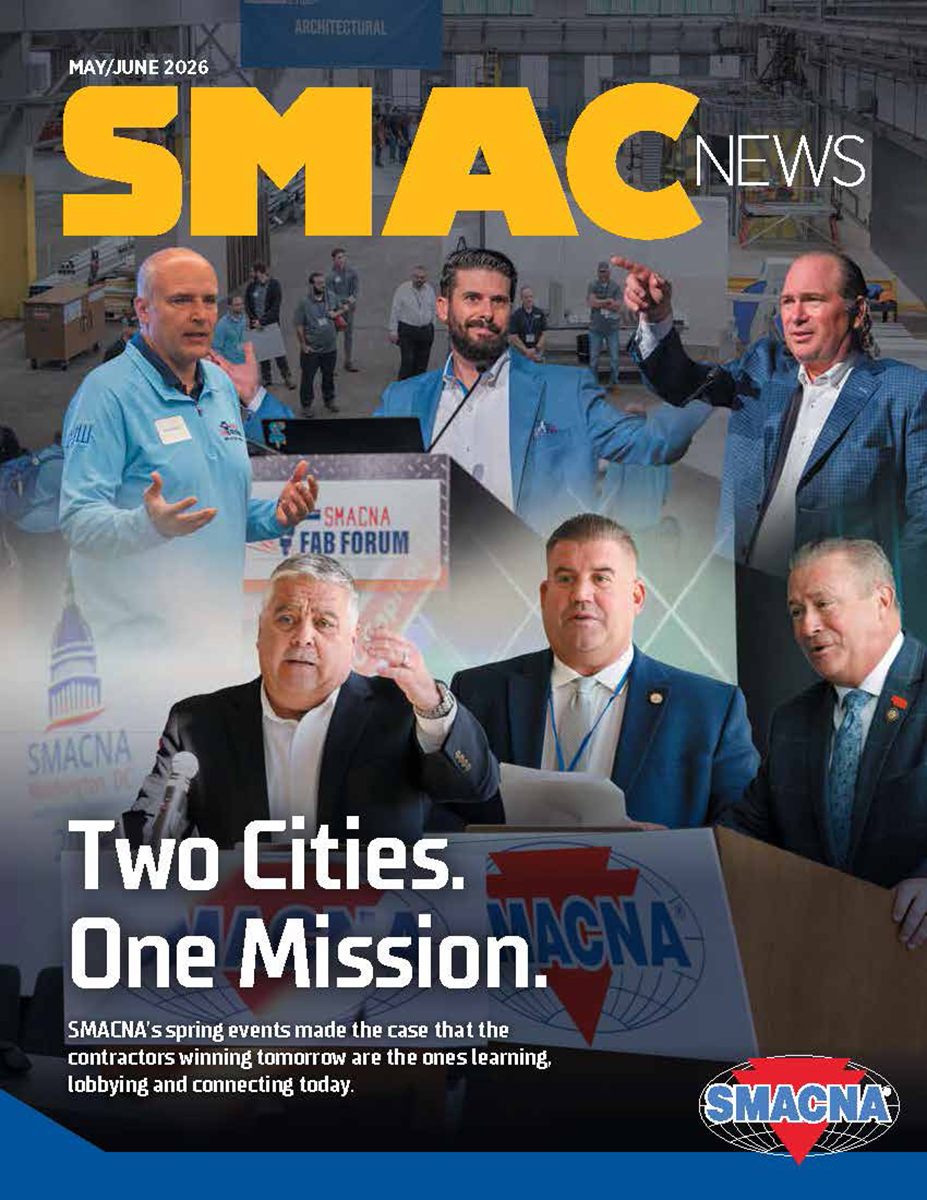
Two Cities. One Mission.
SMACNA’s spring events made the case that the contractors winning tomorrow are the ones learning, lobbying and connecting today.
Welcome New SMACNA Members
Privacy Policy |
Terms of Use | Contact Us
Phone: 703.803.2980 | Email:
info@smacna.org
© 1998-2026 SMACNA. All rights reserved.
Web Design & Development by Matrix Group
International, Inc.
