
RESIDENTIAL: The 12-month Build
Inside Design Aire’s race to install 259 HVAC systems before Washington University’s fall semester.
Design Aire, Inc. has been in the St. Louis, Missouri residential market since 1904. President Jacob Goldkamp represents the fourth generation of ownership, and his son, Otis, is currently employed at Design Aire as summer help through SMART Local 36.
Design Aire started out serving single family homes but has adapted to changing market conditions over time. “We’ve always done some apartments and senior living,” says Goldkamp. “We still do single family homes, like we always have, but it takes a whole lot more land and space and time to get one family in, whereas with multifamily, you can get 250 families or people living in one spot.”
Some years are busier than others, but even in a slow year, Design Aire provides the sheet metal work for at least 1,000 units in multifamily construction. Some of these are senior living and various government apartment projects, but in the last 10 years they’ve averaged about 1,500 new market rate apartment units per year. Typically, these projects are four to six stories high with 160 to 300 units per building.
This summer, Design Aire is finishing a 259-unit, six-story apartment complex that exemplifies the multifamily projects they routinely take on. Anyone can live in these market-rate apartments, but because the location is about 1.5 miles from Washington University in St. Louis, the owner expects to attract students. “The owner builds these nationally, and they target universities,” Goldkamp says. “Due to the timeline, it is a very difficult project. They’re trying to turn that one over the summer, so they can get them leased out for school this fall.”
Goldkamp has a longstanding relationship with the general contractor and bid the job in the summer of 2024. “We started it around eight months later, about the spring of 2025, and it’ll be complete this summer,” Goldkamp says. “This was a super condensed timeline to get 259 units built and installed in basically 12 months.”
Because the owner specializes in these complexes, they provided the blueprints. Each unit has its own HVAC system in a separate mechanical room with a water heater on the floor. “Everybody will have total control over their own living space,” Goldkamp says. “We’ll hang an electric air handler above the water heater.” The apartment air handlers are 1½ to 3 tons each. “It’ll just do that apartment.” Design Aire will run insulated rigid duct work from the air handlers into the space above the ceiling, then branch off with flexible duct to the outlets.
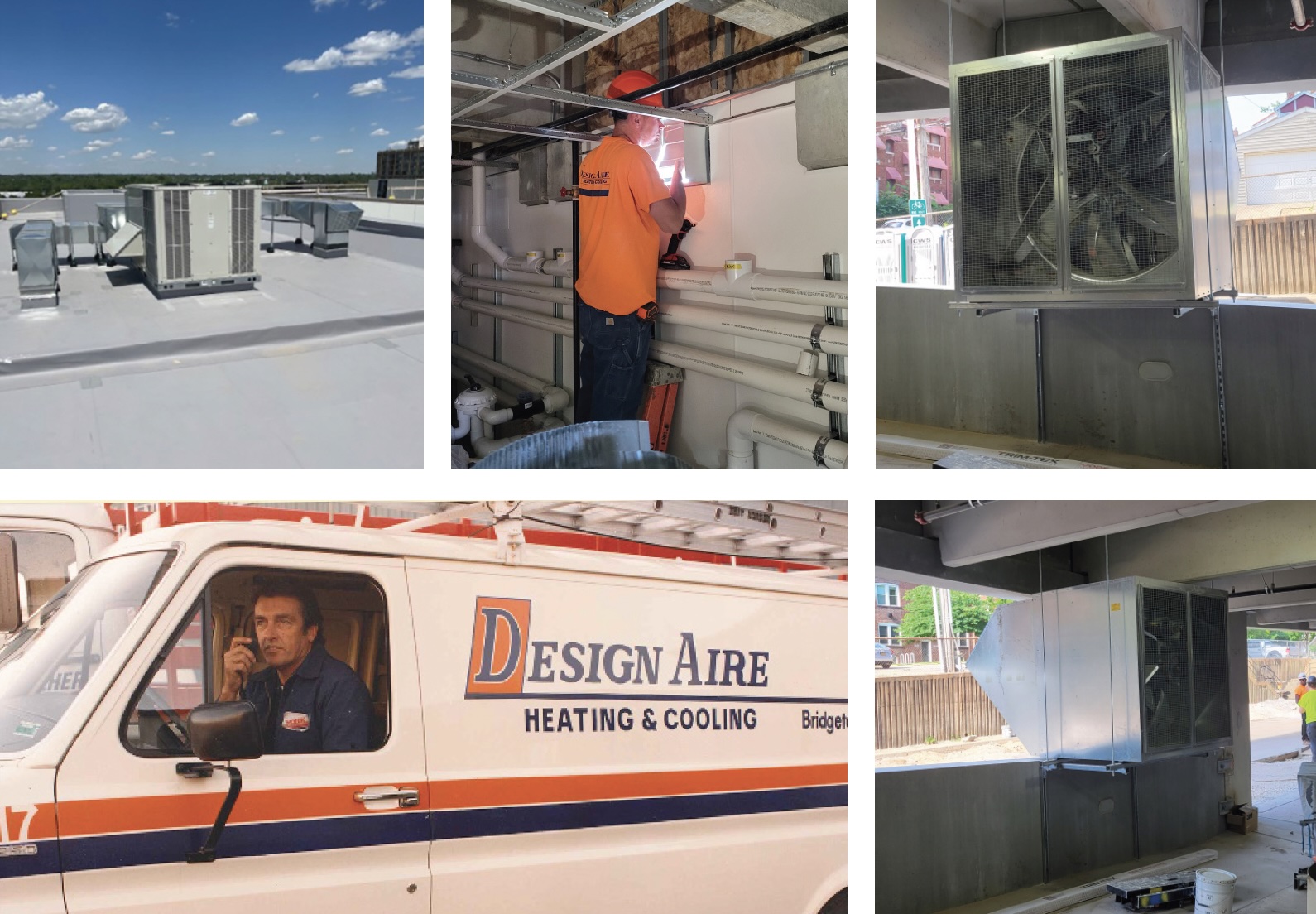
This job took 1,000 hours in the shop, plus 8,500 hours in the field.
The apartments include a kitchen, a living area, a bathroom, a washer and dryer, and one or three bedrooms, so every apartment has kitchen exhaust, bathroom exhaust, dryer exhaust and HVAC exhaust. Outside air ducts bring continuous fresh air to each unit.
Besides the challenges of installing 259 complete HVAC systems in a single building, Design Aire is responsible for features that single family homes usually don’t include, such as large trash chutes. The lowest floor of the complex is dedicated to retail spaces, which require zero-clearance grease duct stacks. “They’re going to have a restaurant and a bank, and there are retail spaces that other businesses will come and occupy,” Goldkamp says. “The finished retail HVAC systems were 5 tons each, but some retail spaces are white-box only, waiting for the future tenants
to finish.”
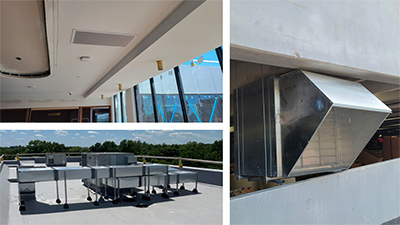
The complex also has an entire floor dedicated to amenities. “On the sixth floor, there’s a workout room, a gathering room with a fancy fireplace and a live workspace with cubbies where students can do their studying,” Goldkamp says. “Those are all controlled by rooftop units that sit on top of the sixth floor.” The rooftop units range in size from 3 tons to a 22-ton unit with giant duct work in the space next to the pool. “The walls there are all glass, and then that walks out to a rooftop pool.”
Between the 259 individual HVAC units for the apartments, the retail space and the common areas, Design Aire is installing 4,300 linear feet of galvanized steel ductwork for this project. They source various fittings and parts from supply houses but fabricate the rectangular duct in their shop.
This project is bringing 8,500 work hours in the field, plus another 1,000 hours in the shop. Six professionals from Local 36 are handling the sheet metal aspects of the work, but finding enough skilled craftspersons to handle this work, plus Design Aire’s other projects, has been a challenge. “Our local understands,” Goldkamp says. “We’ve met with them, so they’re well aware.”
Price increases have been another unexpected complication. “Early on it was steel prices,” Goldkamp says. “Lately, we’re getting hammered with price increases, mainly based on the price of gas.” Copper prices also impact Design Aire’s costs because of the need for copper refrigerant lines.
The compressed schedule and changing prices are challenging for the general contractor and for everyone involved, but Goldkamp is used to the ups and downs of the multifamily construction market.
“We’re able to get it done,” he says.
Published: July 14, 2026
IN THIS ISSUE
3 Benchmarking Metrics Every Contractor Should Track Throughout the Year
Sometimes, success is best measured in relative terms.
ARCHITECTURAL: 173 Feet Up, 130 Years In
Heather & Little brings Cornell University’s McGraw Tower back from the brink.
Caged on Clark Street
When FX’s “The Bear” needed a bear cage for its now-iconic opening scene, they called a sheet metal shop in the Chicago suburbs. It became the biggest show in the city.
Chapter Spotlight: From Tennis Courts to the Corner Office
CHAPTER Spotlight: Tri-County SMACNA: How friendship, tragedy and a family affair reshaped one SMACNA chapter
How Contractors Are Rethinking Fabrication
At SMACNA’s Fab Forum, contractors discussed the future of shop productivity — from prefab and inventory control to automation.
HVAC: Mapping the Work
How shops can use AI to turn messy, real-world operations into clear processes, usable SOPs and repeatable training tools.
INDUSTRIAL: Lee Mechanical’s 250,000-Pound Sheet Metal Answer to the Data Center Boom
When a long-term client needed a massive mechanical infrastructure overhaul at a data center supply chain facility in southeastern Wisconsin, Lee Mechanical brought the solution.
Inside SMACNA’s First Washington, D.C. Leadership Conference
Contractors, policymakers and industry experts convened on Capitol Hill for two days of policy briefings, lobbying and hard conversations about tariffs, pensions and the future of the construction industry.
Learning, Lobbying & Lasting Connections
When I travel, people often ask me why SMACNA membership is important. Networking with peers is a big reason, since it lets us learn from the best in the industry and discover new ideas.
Opportunities for AI in the Sheet Metal and HVAC Industries
At its heart, artificial intelligence differs from traditional software because it uses probability, not instructions, to get work done.
RESIDENTIAL: The 12-month Build
Inside Design Aire’s race to install 259 HVAC systems before Washington University’s fall semester.
Supreme Court Confirms Broad Actuarial Discretion in Withdrawal Liability Calculations
On May 21, the U.S. Supreme Court issued a unanimous decision in M & K Employee Solutions v. Trustees of the IAM National Pension Fund that should be of interest to unionized construction contractors participating in multi-employer pension plans.
TESTING, ADJUSTING AND BALANCING: No More Out of Sight, Out of Mind
Fire and life safety systems hidden inside ductwork have gone unchecked for too long. Industry experts say their moment of focus has arrived.
Two Cities. One Mission.
SMACNA’s spring events made the case that the contractors winning tomorrow are the ones learning, lobbying and connecting today.
Welcome New SMACNA Members
Privacy Policy |
Terms of Use | Contact Us
Phone: 703.803.2980 | Email:
info@smacna.org
© 1998-2026 SMACNA. All rights reserved.
Web Design & Development by Matrix Group
International, Inc.
