Inside SMACNA’s First Washington, D.C. Leadership Conference
Contractors, policymakers and industry experts convened on Capitol Hill for two days of policy briefings, lobbying and hard conversations about tariffs, pensions and the future of the construction industry.
When Stan Kolbe, SMACNA’s Executive Director of Government and Political Affairs, stepped to the podium on the morning of May 7 to welcome a room full of contractors, chapter executives and labor allies to Washington, D.C., he opened with optimism.
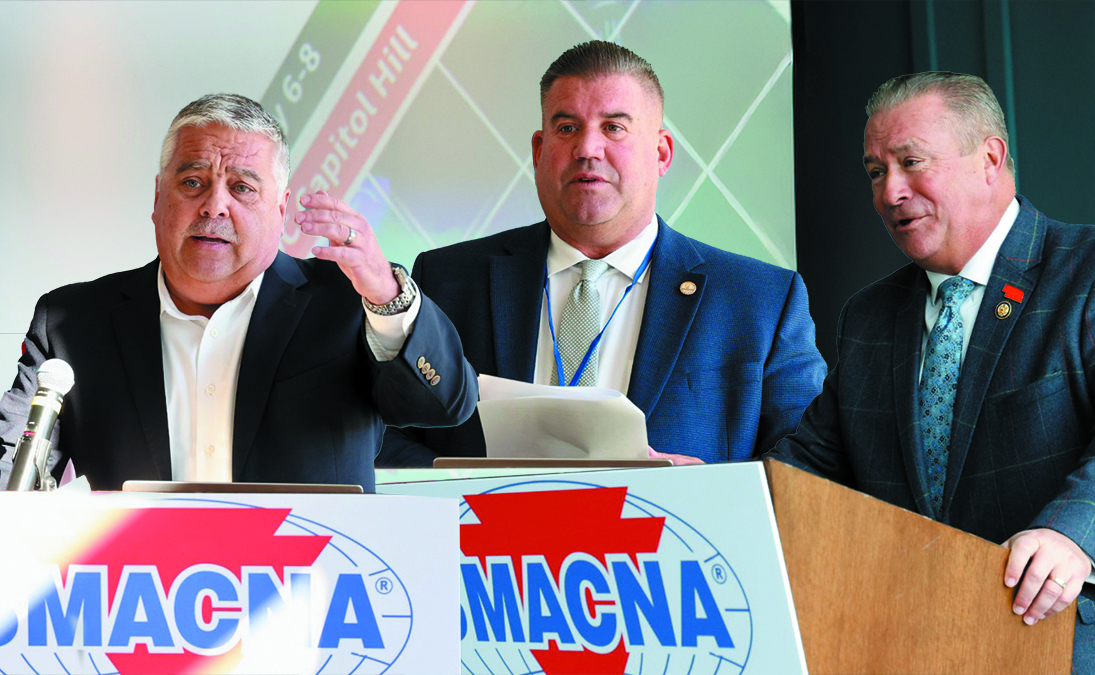
Mike Coleman, General President of SMART (left); Todd Hill, SMACNA President (center); Rep. Don Bacon (R-Neb.) (right).
“The political environment is still challenging,” Kolbe told the group, “but there are also reasons to be optimistic.”
That measured confidence set the tone for the first-ever SMACNA Washington, D.C. Leadership Conference, a two-day immersion into the legislative realities shaping the sheet metal and HVAC contracting industry. Held May 7–8, the conference brought together SMACNA members, sitting members of Congress, agency officials, labor partners and policy experts for a look at the issues that keep contractors up at night: tariffs, pension security, workforce development, tax incentives, global trade and geopolitical conflicts.
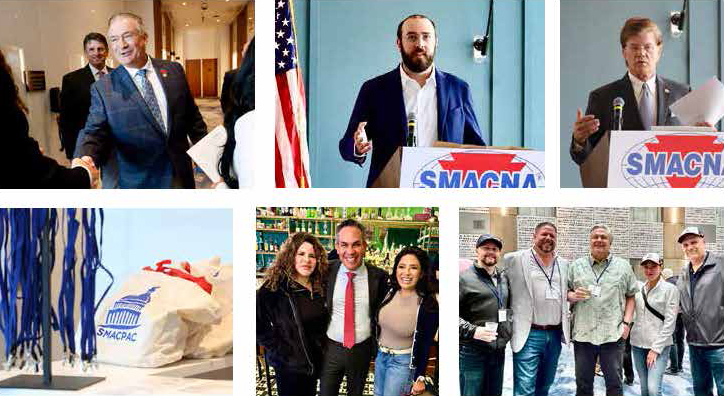
Rep. Don Bacon (R-Neb.) (top left); Brendan Larkin, Chief Policy Staff for Rep. Paul Tonko (D-N.Y.), sponsor of indoor air quality in a SMACNA-endorsed bill; Stan Kolbe, SMACNA’s Executive Director of Government and Political Affairs (top right); CA-based SMACNA members Gina Medel and Carmen Koo with Rep. Pete Aguilar (D-Calif.) (bottom center); SMACNA members at the opening reception before the Washington Nationals Game vs. Minnesota Twins at Nats Park (bottom right).
The conference also welcomed SMART General President Michael Coleman, whose presence underscored the depth of the labor-management partnership that is central to SMACNA’s advocacy strategy.
LOBBYING 101: THE ART OF THE MEETING
Before attendees set foot in congressional offices, SMACNA’s own team made sure they were ready. Seth Lennon, Director of Content Development and Media Relations Policy, and Denise Murphy McGraw, Special Assistant for Political and Government Affairs, kicked off the Thursday morning program with a session designed to demystify the lobbying process and arm members with the confidence to walk into a congressional office and be heard.
“Nobody can tell the story of what our contractors do better than our contractors,” Murphy McGraw says, explaining why face-to-face advocacy is important. “That one-on-one experience with legislators and their staff — nothing compares to it.”
Both Lennon and Murphy McGraw are veterans of Capitol Hill, and they were quick to share lessons from their time as congressional staffers. The most important: don’t underestimate a meeting with staff.
“Never undersell the meeting with the staff person,” Murphy McGraw says. “You’ll get more of their time. You’re probably going to get somebody who’s really focused on these issues. And, if you do your job right, you get an advocate in the office who will then be able to go tell your story as well as you have.”
They stressed that members’ stories can make big impacts. “You don’t need to be an expert on congressional rulemaking. Murphy McGraw explains. “Be an expert on yourself and on your business and convey what indoor air quality reform legislation would mean to your business and what it would mean to schools in your community.”
Equally important, Lennon adds, is the power of being a voter. “Not only are you an advocate for our issues, but you’re also a constituent,” he says.
PROCUREMENT, INFRASTRUCTURE & IAQ
The conference’s first substantive policy session brought Rep. Don Beyer (D-VA-8) and Brendan Larkin, Deputy Chief of Staff for Rep. Paul Tonko (D-NY-20), to the table for a discussion on procurement reform, infrastructure investment and indoor air quality legislation.
Beyer serves on the House Committee on Ways and Means and the Joint Economic Committee. Tonko, through Larkin, has been a consistent ally and policy champion for school construction, energy efficiency grants for schools and environmental legislation, including introducing IAQ tax incentives for commercial buildings and related measures tied to IAQ standards in public buildings.
A WORLD ECONOMY UNDER PRESSURE
John G. Murphy, Senior Vice President and Head of International at the U.S. Chamber of Commerce, delivered the mid-morning briefing. He is one of the authorities on international trade and tariff policy.
The session, titled “Hot Wars and Trade Wars: How Conflict, Tariffs and Geopolitical Competition are Transforming the World Economy,” traced the cascading effects of U.S. tariff policy alongside the disruptions from the Iran War.
On tariffs, Murphy laid out a complex, multi-wave landscape. The first wave, enacted under the International Emergency Economic Powers Act (IEEPA), had generated $166 billion in payments across 53 million import entries before being invalidated by the U.S. Supreme Court on Feb. 20, with refunds beginning April 20. A second wave — a 10% across-the-board tariff invoked under Section 122 of the Trade Act of 1974 — was set to run 150 days starting Feb. 24, limited in scope to about one-third of U.S. imports. A third wave was being pursued under Section 301, targeting unfair trade practices, with the administration seeking what Murphy describes as “continuity” and “durability” in any resulting orders. And Section 232 tariffs — the ones SMACNA members know intimately — remained in force on steel and aluminum, with additional tariffs on autos already enacted and rumors swirling about possible new duties on power grid components and chemicals, with semiconductors and pharmaceuticals pending.
The Federal Reserve affirmed that tariffs boosted core goods PCE by 3.1% in 2025. Consumer sentiment dropped sharply in April. U.S. manufacturing was under pressure on all fronts: profits down, jobs down and input prices up. The Tax Foundation concluded that the tariff regime was actively undermining the economic growth that the administration’s tax legislation was designed to produce.
Then there was the Iran War — a conflict that began Feb. 28 with escalations sending commodity prices into sharp relief. Jet fuel was up 70%. Heating oil and Brent crude had risen more than 50%. Diesel was up 45%. Even iron ore had climbed 8%. The disruption to shipping through the Strait of Hormuz was rippling far beyond the conflict zone.
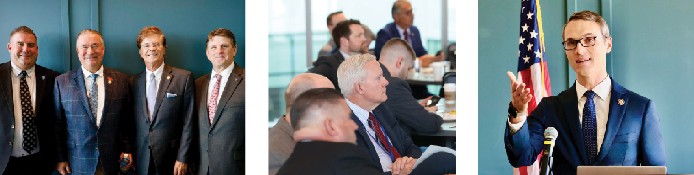
Todd Hill, Don Bacon, Stan Kolbe and Todd Byxbe (SMACPAC committee member and Vice President of Miller Engineering Co.) (left); contractors absorbing information at the SMACNA Washington, D.C. Leadership Conference (center); Rep. James Walkinshaw (D-Va.), one of the new voices for indoor air quality in Congress (right).
Murphy also addressed the upcoming review of the United States-Mexico-Canada Agreement (USMCA), which requires a joint decision by July 1 on whether to extend the agreement through 2042 or allow it to wind down by 2036. More than 13 million American jobs depend on trade with Canada and Mexico, Murphy notes, and manufacturers export more to those two countries than to their next 12 largest export markets combined. The Chamber’s objectives for the review: hold fast to tariff-free North American trade, secure compliance from all three parties and keep it a trilateral agreement.
PENSIONS UPDATE
Thursday’s fireside chat covered how close America’s union pension system came to collapse, and what it took to pull it back.
The panel was moderated by Jared Karbowsky, SMACNA’s Director of Legislative Affairs, and featured two knowledgeable voices in the multiemployer pension space: Mariah Becker, Director of Research and Education at the National Coordinating Committee for Multiemployer Plans (NCCMP), and Kendra Kosko Isaacson, now a Principal at Mindset and formerly the Senate’s top Pension and Tax Policy Expert for Senator Patty Murray and the Health, Education, Labor and Pensions (HELP) Committee.
The conversation traced the years of dysfunction that preceded the American Rescue Plan Act’s pension rescue provisions — a story of enormous funds like Central States and the United Mine Workers’ plan teetering toward insolvency while Congress cycled through proposals that never quite came together.
Becker put the stakes into human terms, saying, “People came to the Hill and made sure lawmakers understood these weren’t just statistics — these were real lives.”
The panel walked through a legislative graveyard of failed fixes. The negotiations stretched on for years: “We were talking loans, partitions and 12,000 different ways of trying to fix this problem, and none of it was coming together,” Becker says.
The turning point came after the 2020 elections delivered Senate control to Democrats, enabling a pivot to budget reconciliation and the inclusion of pension rescue in ARPA. The final provisions were negotiated in roughly six weeks.
Critics of the rescue approach have argued that simply injecting federal dollars into fundamentally broken systems doesn’t address underlying problems — declining union membership, flawed funding rules and structurally unsustainable promises. Becker acknowledges those concerns directly, noting that while major structural reforms didn’t make it into the final bill, the rescue funds came with significant guardrails. “It doesn’t mean they are certain to be OK, but a lot of those plans have a good chance. They’re in much better shape than they were before.”
ADVOCACY IN ACTION
Friday morning’s legislative labor overview, featuring SMACNA President Todd Hill and SMART’s Coleman, served as a status report and rallying call. Together, they reviewed the key issues. Kolbe’s remarks laid out the scope of SMACNA’s advocacy agenda, covering wins, ongoing fights and the infrastructure of the political operation itself.
On the defensive side, Kolbe cited a notable series of victories: blocking efforts to remove municipal bond tax preferences, preserving state and local tax deductions for businesses, preventing new taxes on employee fringe benefits, and protecting key equipment expensing provisions and CHIPS plant credits. “We play aggressive defense,” Kolbe says. “That means keeping important laws and programs in place, not just passing new ones.”
On offense, SMACNA has championed the Small Business Payment for Performance Act (H.R. 4615), which would address the persistent problem of delayed payments on contract change orders — a chronic pressure point for sheet metal contractors on complex projects. Bipartisan tax bills H.R. 8744 and H.R. 5862 are also on the active docket, both seeking to restore energy efficiency tax incentives, including the 179D deduction, that were left on the cutting room floor in last summer’s tax package.
SMACNA’s work with the Treasury Department and Congress to secure economic price adjustment provisions for contracts bid before the current round of tariffs was announced was another front in the fight.
On workforce, the association has continued to press Congress on apprenticeship funding, Davis-Bacon protections and project labor agreements, while collaborating with SMART on what Kolbe described as “debt-free workforce pipelines” — pathways into the trade that don’t saddle young workers with student loan burdens.
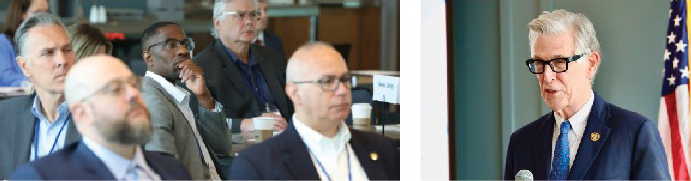
Attendees received briefings from representatives of both parties’ congressional operations (left), Rep. Don Beyer (D-Va.) (right).
SMACPAC, the association’s political action committee, had a record-breaking 2026 fundraising year, with 2026 projections even stronger if participation broadens. The recently launched SMAC Administrative Fund (SMAC AF) program, which supports political education and engagement activities, got off to a strong early start and is drawing increasing participation from associate and premier partners.
THE HILL & THE PARTIES
The conference’s programming extended beyond expert panels to direct access to the political machinery shaping SMACNA’s operating environment. Attendees received briefings from representatives of both parties’ congressional operations, including political insights from the RNCC and an appearance by Roger Lau, Executive Director of the DNC. Industry champion and close friend of SMACNA, Rep. Don Bacon (R-NE-2) addressed attendees on the state of defense and DOD procurement on Capitol Hill, and Rep. James Walkinshaw (D-VA-11), one of the new voices for indoor air quality (IAQ) in Congress, who serves on the House Oversight and Government Reform Committee and the Homeland Security Committee, also spoke.
A FOUNDATION FOR FUTURE ENGAGEMENT
Published: July 14, 2026
IN THIS ISSUE
3 Benchmarking Metrics Every Contractor Should Track Throughout the Year
Sometimes, success is best measured in relative terms.
ARCHITECTURAL: 173 Feet Up, 130 Years In
Heather & Little brings Cornell University’s McGraw Tower back from the brink.
Caged on Clark Street
When FX’s “The Bear” needed a bear cage for its now-iconic opening scene, they called a sheet metal shop in the Chicago suburbs. It became the biggest show in the city.
Chapter Spotlight: From Tennis Courts to the Corner Office
CHAPTER Spotlight: Tri-County SMACNA: How friendship, tragedy and a family affair reshaped one SMACNA chapter
How Contractors Are Rethinking Fabrication
At SMACNA’s Fab Forum, contractors discussed the future of shop productivity — from prefab and inventory control to automation.
HVAC: Mapping the Work
How shops can use AI to turn messy, real-world operations into clear processes, usable SOPs and repeatable training tools.
INDUSTRIAL: Lee Mechanical’s 250,000-Pound Sheet Metal Answer to the Data Center Boom
When a long-term client needed a massive mechanical infrastructure overhaul at a data center supply chain facility in southeastern Wisconsin, Lee Mechanical brought the solution.
Inside SMACNA’s First Washington, D.C. Leadership Conference
Contractors, policymakers and industry experts convened on Capitol Hill for two days of policy briefings, lobbying and hard conversations about tariffs, pensions and the future of the construction industry.
Learning, Lobbying & Lasting Connections
When I travel, people often ask me why SMACNA membership is important. Networking with peers is a big reason, since it lets us learn from the best in the industry and discover new ideas.
Opportunities for AI in the Sheet Metal and HVAC Industries
At its heart, artificial intelligence differs from traditional software because it uses probability, not instructions, to get work done.
RESIDENTIAL: The 12-month Build
Inside Design Aire’s race to install 259 HVAC systems before Washington University’s fall semester.
Supreme Court Confirms Broad Actuarial Discretion in Withdrawal Liability Calculations
On May 21, the U.S. Supreme Court issued a unanimous decision in M & K Employee Solutions v. Trustees of the IAM National Pension Fund that should be of interest to unionized construction contractors participating in multi-employer pension plans.
TESTING, ADJUSTING AND BALANCING: No More Out of Sight, Out of Mind
Fire and life safety systems hidden inside ductwork have gone unchecked for too long. Industry experts say their moment of focus has arrived.
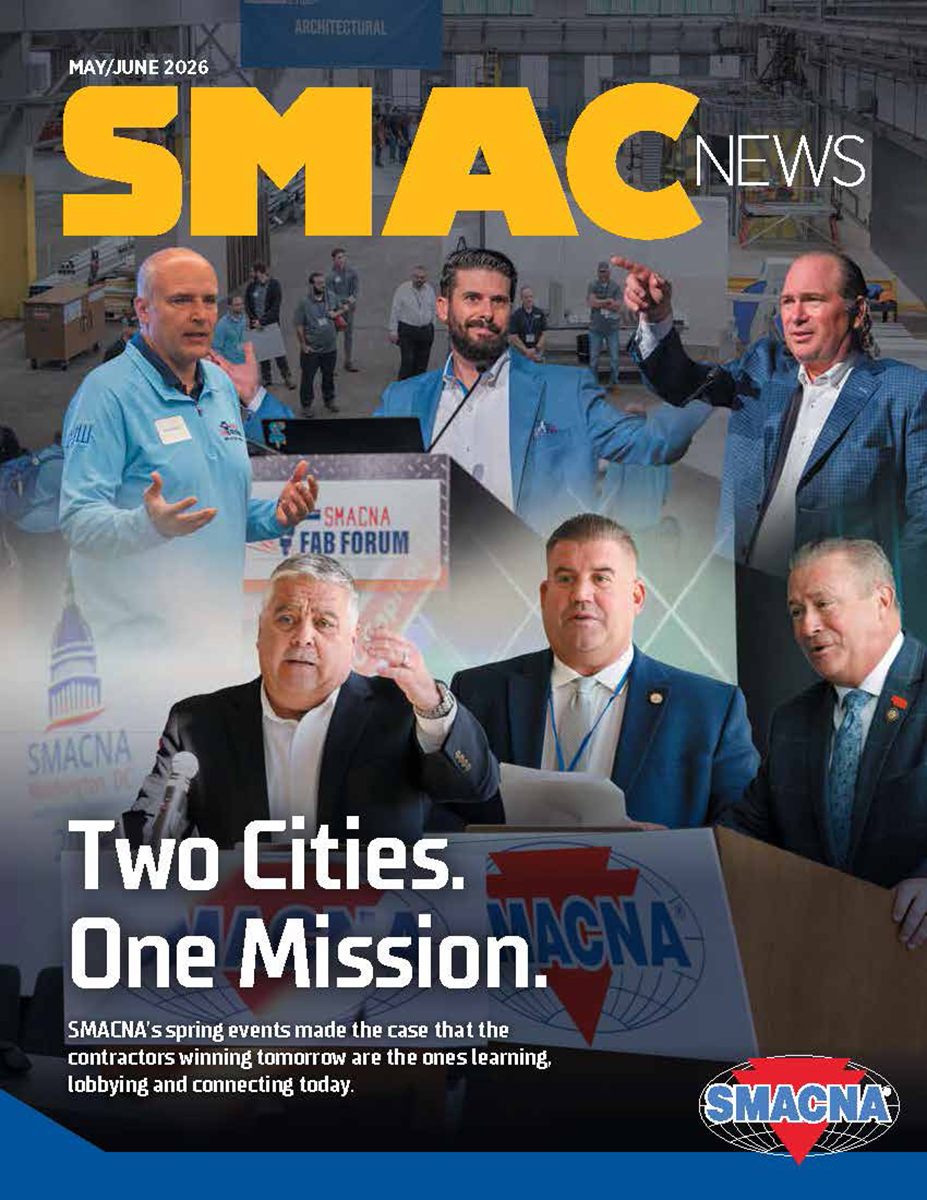
Two Cities. One Mission.
SMACNA’s spring events made the case that the contractors winning tomorrow are the ones learning, lobbying and connecting today.
Welcome New SMACNA Members
Privacy Policy |
Terms of Use | Contact Us
Phone: 703.803.2980 | Email:
info@smacna.org
© 1998-2026 SMACNA. All rights reserved.
Web Design & Development by Matrix Group
International, Inc.
