INDUSTRIAL: Lee Mechanical’s 250,000-Pound Sheet Metal Answer to the Data Center Boom
When a long-term client needed a massive mechanical infrastructure overhaul at a data center supply chain facility in southeastern Wisconsin, Lee Mechanical brought the solution.
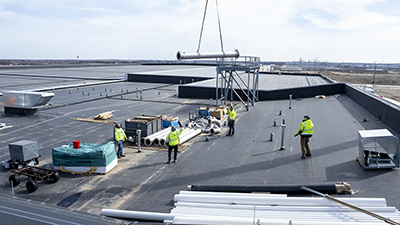 The data center market doesn’t wait. Facilities feeding the infrastructure behind America’s explosive demand for computing power operate on relentless timelines, and when one of Lee Mechanical’s long-standing clients needed a major mechanical expansion at its southeastern Wisconsin facility, the Franklin-based contractor was ready.
This project took 250,000 pounds of sheet metal and 48,000 total work hours.
“This has been a client of ours for quite a while,” says Ken Ahler, President of Lee Mechanical. That established trust mattered on a project of this scale and sensitivity. This was a 200,000-square-foot mechanical infrastructure expansion within an existing one-million-square-foot facility that was completed over roughly 10 months in 2024 for a company that sits upstream in the data center supply chain, providing products and systems that feed directly into the data centers being built across the country. [Per the client’s requirements, the facility and its operator remain unnamed.]
The Scope
Lee Mechanical was brought in as the design/build contractor working directly for the client, handling mechanical, plumbing, fire protection, controls, startup and commissioning, as well as general conditions management across the expansion. At the center of the project was a new chiller plant built to support 16 custom air handling units that modulate temperatures for 80 server test racks—systems where precise environmental control is a requirement.
The chiller installation alone illustrated the scale of what the team was up against. Getting 52,000-pound chillers into position inside an existing facility isn’t a standard logistics problem. Lee’s team engineered a custom-fabricated equipment dolly specifically designed for the task. 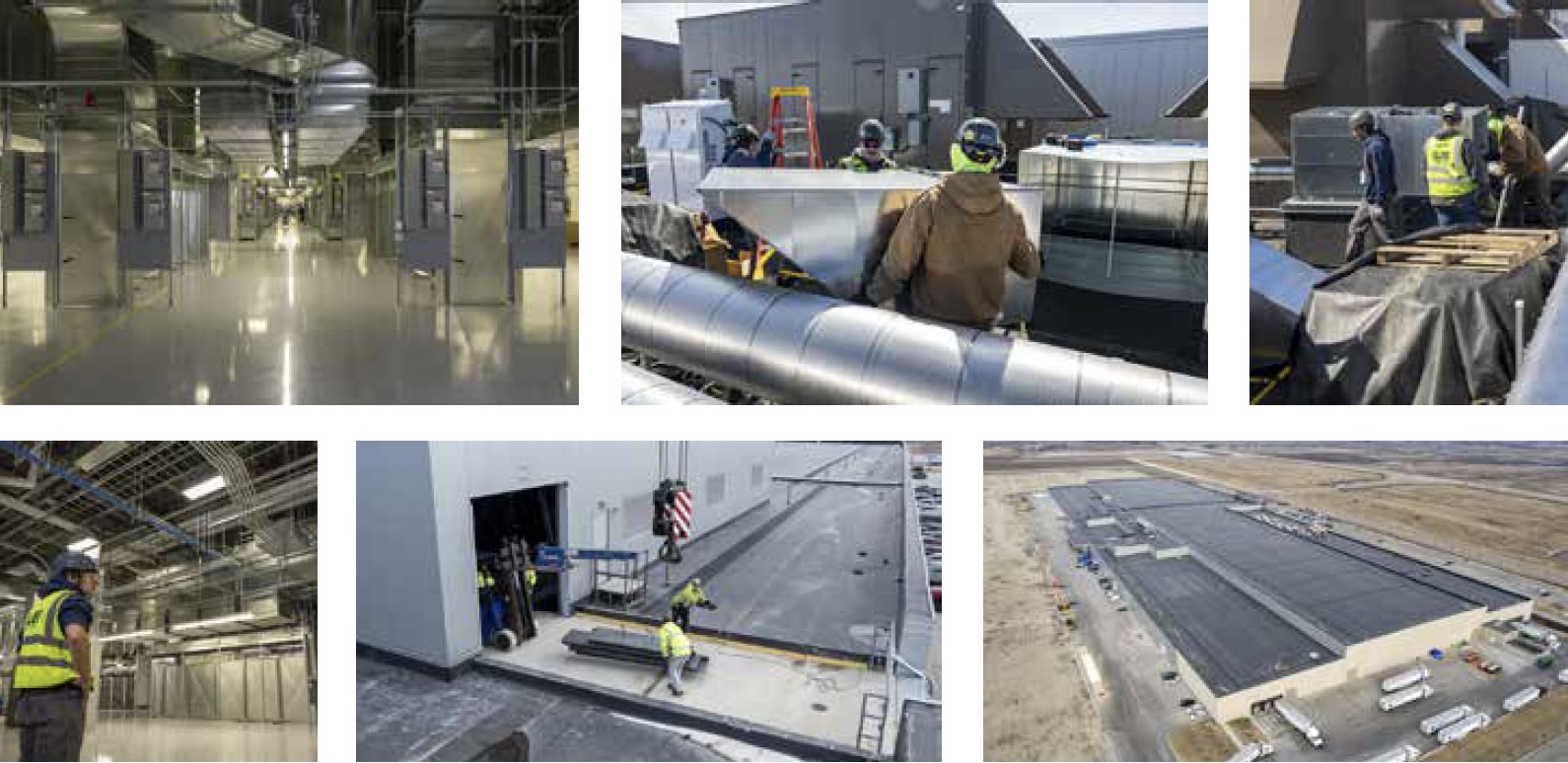
This mechanical infrastructure expansion project involved 52,000-pound chillers. Lee Mechanical custom-fabricated an equipment dolly to use to get each of them into place.
By the time the job was complete, Lee’s team had installed approximately 250,000 pounds of sheet metal and logged 48,000 total work hours over the course of the project. More than 35 skilled tradespeople were on the job at peak, including sheet metal workers, steamfitters, plumbers, HVAC control technicians, sprinkler fitters and service technicians.
“That’s a large project,” Ahler says when asked how 250,000 pounds of sheet metal compares to a typical industrial job in the region.
Air Over Liquid
What made this particular project distinctive within the data center world was its heavy reliance on air-cooled systems and, correspondingly, the sheer volume of sheet metal involved.
Ahler is candid that the technology landscape is already shifting beneath the industry’s feet. “The data center market is shifting more to liquid-cooled technology,” he says. “At the time this project was done, air-cooled technology was still the predominant approach, but now we’re seeing a shift toward more piping-heavy projects.”
For sheet metal contractors, that evolution is worth watching. Projects like this one where the cooling architecture drives a massive ductwork and air handling scope are becoming less common as liquid cooling gains ground. That makes this particular build something of a high-water mark for air-cooled data center infrastructure work.
Working in Someone Else’s House
The technical scope was matched by a logistical one. The expansion took place inside a fully occupied, actively operating production facility, which meant every phase of the work had to be choreographed around the client’s own employees, schedules and daily operations.
“Navigating major construction like this in an occupied building poses challenges,” Ahler says. “Whether that’s coordinating shutdowns or managing employee traffic within the building, it required constant communication.”
Lee’s project manager and on-site foreman held weekly planning meetings with the client; projecting two to three weeks ahead to identify which areas of the building required access; arrange for staff to be temporarily relocated; and ensure that egress throughout the facility to restrooms, cafeterias and work areas was never compromised.
But the coordination went beyond schedules. It required a shift in jobsite culture. “We had to communicate to our team to keep in mind that we’re working in someone else’s house right now,” Ahler says. “We wanted to make sure they knew we weren’t just passing through. This meant reminding everyone to clean up after themselves and be professional. We’re guests.”
A Market Reshaping Southeast Wisconsin
For Lee Mechanical, the data center supply chain sector is a market that has meaningfully changed the company’s trajectory. Ahler says the segment has driven roughly 30% revenue growth over the past two years.
“This particular market has definitely impacted us,” he says. “Something we’ve seen in the past two years—jumps in revenue and in size—impacted by this industry.”
It’s a trend that shows no signs of slowing in Wisconsin. Microsoft began building data center infrastructure in the state three years ago, with projections that construction activity will continue through at least 2033. Multiple additional data center sites are currently under development across the region, and contractors with the workforce, relationships and technical depth to serve that market are well-positioned—provided they can adapt as the technology evolves.
Published: July 14, 2026
IN THIS ISSUE
3 Benchmarking Metrics Every Contractor Should Track Throughout the Year
Sometimes, success is best measured in relative terms.
ARCHITECTURAL: 173 Feet Up, 130 Years In
Heather & Little brings Cornell University’s McGraw Tower back from the brink.
Caged on Clark Street
When FX’s “The Bear” needed a bear cage for its now-iconic opening scene, they called a sheet metal shop in the Chicago suburbs. It became the biggest show in the city.
Chapter Spotlight: From Tennis Courts to the Corner Office
CHAPTER Spotlight: Tri-County SMACNA: How friendship, tragedy and a family affair reshaped one SMACNA chapter
How Contractors Are Rethinking Fabrication
At SMACNA’s Fab Forum, contractors discussed the future of shop productivity — from prefab and inventory control to automation.
HVAC: Mapping the Work
How shops can use AI to turn messy, real-world operations into clear processes, usable SOPs and repeatable training tools.
INDUSTRIAL: Lee Mechanical’s 250,000-Pound Sheet Metal Answer to the Data Center Boom
When a long-term client needed a massive mechanical infrastructure overhaul at a data center supply chain facility in southeastern Wisconsin, Lee Mechanical brought the solution.
Inside SMACNA’s First Washington, D.C. Leadership Conference
Contractors, policymakers and industry experts convened on Capitol Hill for two days of policy briefings, lobbying and hard conversations about tariffs, pensions and the future of the construction industry.
Learning, Lobbying & Lasting Connections
When I travel, people often ask me why SMACNA membership is important. Networking with peers is a big reason, since it lets us learn from the best in the industry and discover new ideas.
Opportunities for AI in the Sheet Metal and HVAC Industries
At its heart, artificial intelligence differs from traditional software because it uses probability, not instructions, to get work done.
RESIDENTIAL: The 12-month Build
Inside Design Aire’s race to install 259 HVAC systems before Washington University’s fall semester.
Supreme Court Confirms Broad Actuarial Discretion in Withdrawal Liability Calculations
On May 21, the U.S. Supreme Court issued a unanimous decision in M & K Employee Solutions v. Trustees of the IAM National Pension Fund that should be of interest to unionized construction contractors participating in multi-employer pension plans.
TESTING, ADJUSTING AND BALANCING: No More Out of Sight, Out of Mind
Fire and life safety systems hidden inside ductwork have gone unchecked for too long. Industry experts say their moment of focus has arrived.
Two Cities. One Mission.
SMACNA’s spring events made the case that the contractors winning tomorrow are the ones learning, lobbying and connecting today.
Welcome New SMACNA Members
Privacy Policy |
Terms of Use | Contact Us
Phone: 703.803.2980 | Email:
info@smacna.org
© 1998-2026 SMACNA. All rights reserved.
Web Design & Development by Matrix Group
International, Inc.
