How Contractors Are Rethinking Fabrication
At SMACNA’s Fab Forum, contractors discussed the future of shop productivity — from prefab and inventory control to automation.
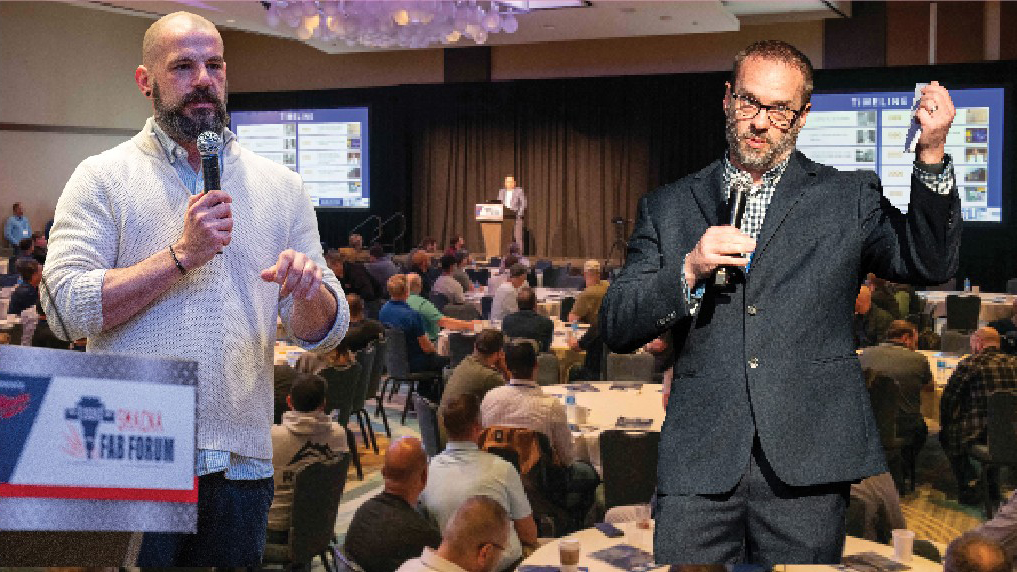 At a time when fabrication shops are being asked to do more with less, the 2026 SMACNA Fab Forum offered a clear snapshot of where the industry is heading.
attendees (right).
Held in Chicago, Illinois, and anchored by a tour of The Hill Group’s expansive campus, the sold-out event brought together contractors, technologists and industry leaders for two and a half days of practical learning focused on the systems behind stronger shops.
From workflow and VDC to analytics, machine learning and materials management, the sessions reflected an industry looking hard at efficiency, visibility and the tools that make modern fabrication work.
THE HILL GROUP TOUR
The Hill Group, a third-generation, family-owned firm, has been in the construction industry for more than 80 years. With a full-service mechanical, plumbing and fire protection firm, they have completed over 100,000 construction projects.
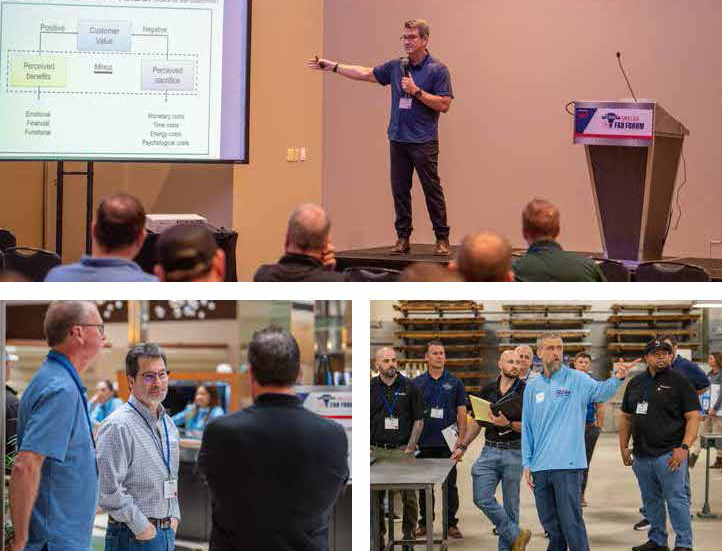
Tom Santos speaks about how to optimize the VDC process (top); SMACNA Fab Forum attendees networking and interacting during a tour of The Hill Group’s 104,000-square-foot prefabrication shop and 80,000-square-foot modular construction space (bottom left and right).
Hill comprises five companies, each with its own office location across three states, and is headquartered in Franklin Park, Illinois. The company employs 1,200 people and has worked three million hours, fabricating 4 million pounds of ductwork.
The tour of its 104,000-square-foot prefabrication shop and the 80,000-square-foot modular construction space emphasized on-site collaboration and problem-solving to improve project efficiency and safety. The company showcased its commitment to technology, innovation and industry best practices.
As Harry Humyak, Hill’s Supply Chain Director, explains, “90% of what we do is just-in-time delivery, so we’re trying to coordinate deliveries with what is happening in the shop to what we’re delivering in the field because there is not a lot of room on jobsites in Chicagoland.”
Adding a preconstruction team five years ago helped, according to Bob Hill, the company’s Preconstruction Manager. “This group houses the data and metrics where all the estimating for bigger jobs resides,” he says.
After all, “the success or failure of a job comes down to how everyone communicates. How does BIM communicate with the shop? How does the field communicate with the shop?” explains Anthony Camasta, Hill Group’s Operations Manager. “And we use technology as a tool to get us there.”
Metrics not only help improve estimating efficiency, but they also improve scheduling, Camasta adds. “If we know what we have in terms of work and how much time it takes us to do it, we now know what the throughput is going to be for the shop, and we can schedule more efficiently,” he says.
HOW TO IMPROVE FUTURE OUTCOMES WITH VDC AND PREFAB
Thomas Santos, Director of Maxim Consulting Group, Englewood, Colorado, led a presentation that showcased the pressures SMACNA contractors are facing, why virtual design and construction (VDC) and prefab are becoming operational necessities and how firms can move from ad hoc efforts to more standardized, scalable models.
 The current market is defined by labor shortages, coordination problems, compressed schedules, cost overruns, quality issues, technology adoption and supply chain disruptions.
SMACNA members listen to opening remarks from The Hill Group at the association’s Fab Forum, including Operations Manager Anthony Camasta (top right).
This means “ the old way of relying on field heroics and loose coordination is getting more expensive and less reliable,” Santos explains, adding that VDC optimization matters now because “operational excellence is essential for survival and growth.
“The future belongs to companies that use process, training and feedback to turn complexity into repeatable execution,” he says.
SMACNA contractors should start by building a process-driven system that exposes problems early, Santos recommends.
He also emphasizes using a “human system” where people are trained and empowered to identify and solve issues, while keeping customer value at the center. The expected payoff is broad: better communication, less rework, more predictable delivery, lower costs and stronger profitability.
Getting there means focusing on customer value, standardization, DFMI, clear roles and responsibilities, KPIs and feedback loops as the levers that make VDC and prefab work at scale. He points out that standard work can apply across the entire construction process — from mobilization and underground work to overhead rough-in and final trim.
Santos says leaders need to create and communicate this vision, provide tools and resources and stay engaged enough to support teams and remove barriers. He also notes that “productivity is a measure of management effectiveness,” which shifts the conversation from blaming the field to improving the system. That is important for SMACNA contractors who are trying to build consistency across design, shop and field teams.
 Change is difficult, Santos admits. “Many organizations fail after year one because of frustration, impatience, mistrust and weak accountability, so change has to be paced with quick wins and coaching,” he explains.
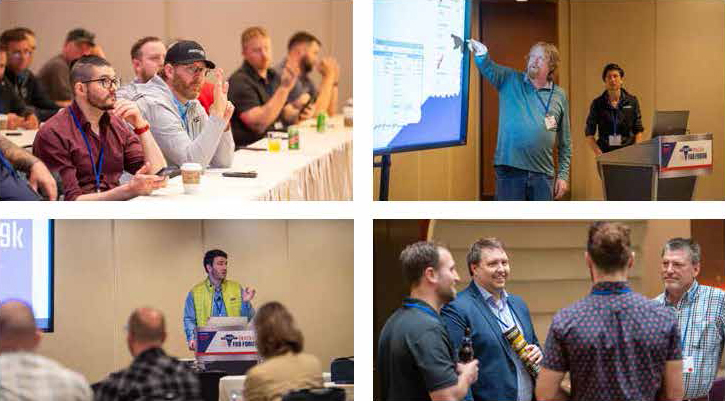
SMACNA Fab Forum attendees asking questions of speakers (top left); Darren Young, Director of Construction Technology at UMC (top right); Micah Rodman, CEO and Co-founder of Kojo (bottom left); and SMACNA Fab Forum attendees networking (bottom right).
Winning means tying your efforts back to measurable results: higher on-time delivery, better safety and quality, better first-pass yield and a more scalable operation.
STREAMLINE MATERIAL RECEIVING TO IMPROVE INVENTORY CONTROL
Material receiving is not a clerical chore, but a control point that can shape inventory accuracy, job costs and day-to-day efficiency, explained Micah Rodman, CEO and Co-founder of Kojo, a technology company that provides a construction procurement platform aimed at digitizing and streamlining materials management for contractors.
 He argues that the biggest problems often start when deliveries are handled manually with paper tickets, verbal confirmations and delayed data entry that leave the office, warehouse and field working from different versions of the truth.
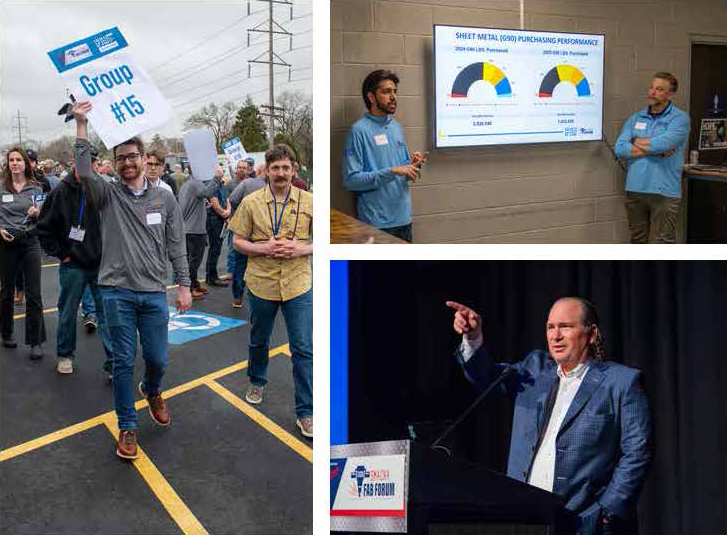
SMACNA members on The Hill Group tour (left), Hill Group employees going over sheet metal purchasing performance on the tour (top right).Jim Hill, President of The Hill Group (bottom right)
Rodman says one of the first fixes is to stop relying on disconnected receiving habits and instead create a process that records deliveries in real time. He points to simple but essential steps, such as snapping a photo at the jobsite, matching the delivery to the correct purchase order immediately and alerting the office as soon as materials arrive. In his view, that kind of workflow helps catch short shipments, backorders and damages before they turn into costly disputes.
Receiving data must flow back into purchasing and accounting without delay, he adds. “When it doesn’t,” he explains, “buyers can’t close out purchase orders accurately, accounting risks paying for items that never arrived and warehouse teams may reorder materials that are already sitting on hand.” He also warns that projects suffer when missing materials are not flagged early enough to prevent schedule delays.
SMACNA contractors should treat the warehouse as part of the material management system, not a separate island, Rodman emphasizes. Clear bin and shelf locations, inventory minimum alerts and consistent inventory tracking can reduce wasted time and help crews use what they already own instead of buying more. Returns should be easy to process, since unused materials sent back into inventory can improve both waste reduction and job costing accuracy, he says.
Better process design can replace guesswork with visibility. Rodman encourages teams to build standard operating procedures, forecast demand using historical patterns and collaborate more closely with the field so materials spend less time in limbo. For him, the goal is not technology for its own sake, but a cleaner, faster receiving system that gives contractors a clearer picture of what they have, what they need and what each job is really costing.
TIPS TO AVOID SHOP EQUIPMENT ISSUES
When shops buy new equipment, the real problems usually appear after the purchase, when machines must connect, communicate and integrate with existing systems. Darren Young, Director of Construction Technology at UMC, told SMACNA Fab Forum attendees that key questions often go unasked until “the pain shows up after commissioning.”
Equipment buying is a technology decision as much as a production one. “Everyone asks about cost, capabilities and throughput,” he says, but far fewer people ask “How does it connect? How does it communicate? How does it integrate How does it work?”
There are common ways machines receive files — manual programming, USB, serial, Ethernet or Wi-Fi — and shops need to understand how that choice affects IT requirements, downtime and support, Young advises, adding that domain joining, antivirus policies, isolated networks and static IP addresses can all shape whether a machine is practical in a real shop environment.
He then turned to CAD/CAM integration, explaining that many machines rely on G-code, but not all do. Young warns that specialty equipment may use proprietary or undocumented formats, and says post processors become essential when CAM software must translate design files into machine instructions. His advice: Ask for a programming guide, request sample files and be cautious when a vendor offers only vague guidance such as “use DXF files.”
Look closely at machine features beyond the sales demo, Young advises. Test automation claims against real production behavior, including whether the system can run hands-off, load and unload materials automatically or require manual intervention that slows work and increases error risk. “Ask to see a full production run, not just a demo,” he says, especially if the machine is being shown with someone else’s data.
Finally, Young urges shops to evaluate controllers, software lifespan, compliance issues and vendors. Buyers should ask whether parts, repairs, licensing and updates will still be available down the road and whether the equipment can integrate with broader production systems such as Stratus or M-Suite.
Published: July 14, 2026
IN THIS ISSUE
3 Benchmarking Metrics Every Contractor Should Track Throughout the Year
Sometimes, success is best measured in relative terms.
ARCHITECTURAL: 173 Feet Up, 130 Years In
Heather & Little brings Cornell University’s McGraw Tower back from the brink.
Caged on Clark Street
When FX’s “The Bear” needed a bear cage for its now-iconic opening scene, they called a sheet metal shop in the Chicago suburbs. It became the biggest show in the city.
Chapter Spotlight: From Tennis Courts to the Corner Office
CHAPTER Spotlight: Tri-County SMACNA: How friendship, tragedy and a family affair reshaped one SMACNA chapter
How Contractors Are Rethinking Fabrication
At SMACNA’s Fab Forum, contractors discussed the future of shop productivity — from prefab and inventory control to automation.
HVAC: Mapping the Work
How shops can use AI to turn messy, real-world operations into clear processes, usable SOPs and repeatable training tools.
INDUSTRIAL: Lee Mechanical’s 250,000-Pound Sheet Metal Answer to the Data Center Boom
When a long-term client needed a massive mechanical infrastructure overhaul at a data center supply chain facility in southeastern Wisconsin, Lee Mechanical brought the solution.
Inside SMACNA’s First Washington, D.C. Leadership Conference
Contractors, policymakers and industry experts convened on Capitol Hill for two days of policy briefings, lobbying and hard conversations about tariffs, pensions and the future of the construction industry.
Learning, Lobbying & Lasting Connections
When I travel, people often ask me why SMACNA membership is important. Networking with peers is a big reason, since it lets us learn from the best in the industry and discover new ideas.
Opportunities for AI in the Sheet Metal and HVAC Industries
At its heart, artificial intelligence differs from traditional software because it uses probability, not instructions, to get work done.
RESIDENTIAL: The 12-month Build
Inside Design Aire’s race to install 259 HVAC systems before Washington University’s fall semester.
Supreme Court Confirms Broad Actuarial Discretion in Withdrawal Liability Calculations
On May 21, the U.S. Supreme Court issued a unanimous decision in M & K Employee Solutions v. Trustees of the IAM National Pension Fund that should be of interest to unionized construction contractors participating in multi-employer pension plans.
TESTING, ADJUSTING AND BALANCING: No More Out of Sight, Out of Mind
Fire and life safety systems hidden inside ductwork have gone unchecked for too long. Industry experts say their moment of focus has arrived.
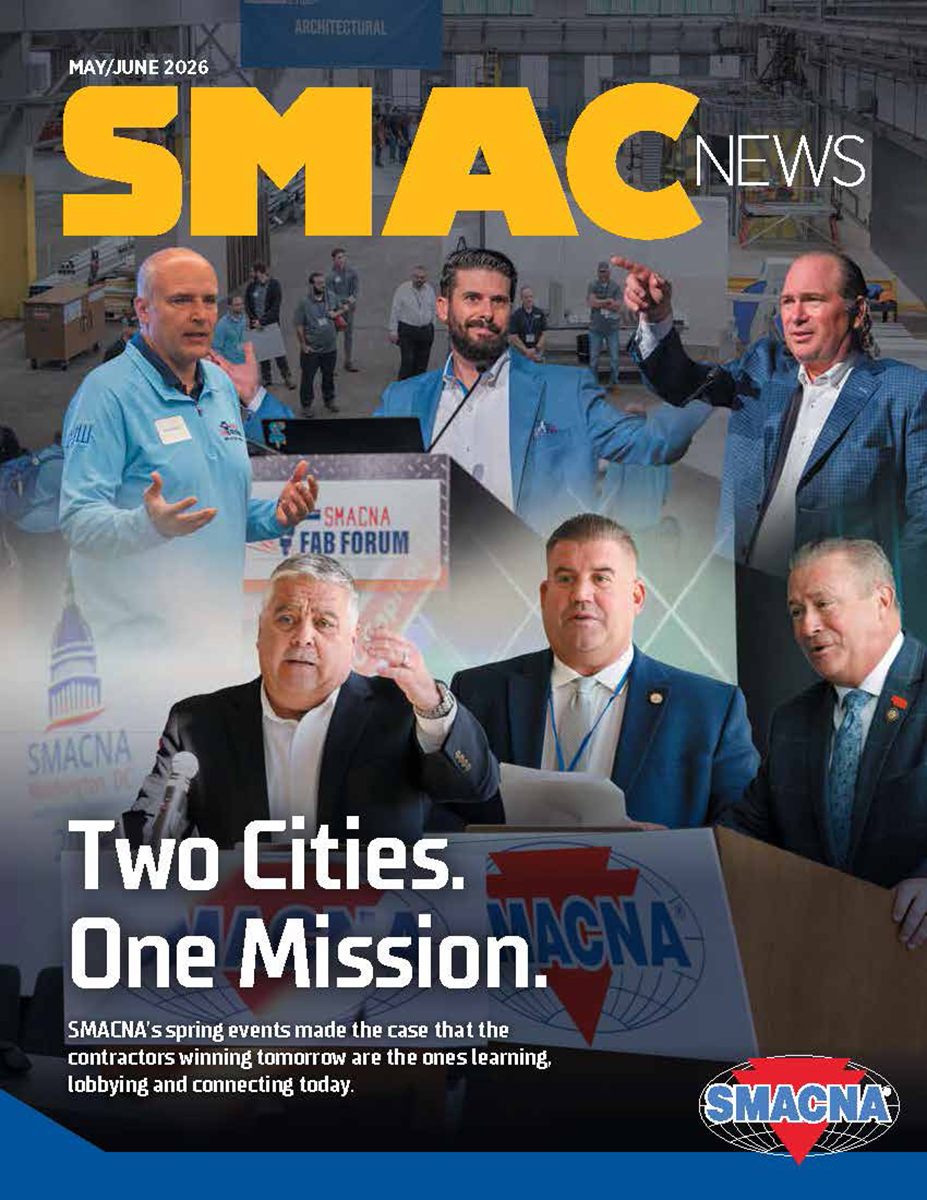
Two Cities. One Mission.
SMACNA’s spring events made the case that the contractors winning tomorrow are the ones learning, lobbying and connecting today.
Welcome New SMACNA Members
Privacy Policy |
Terms of Use | Contact Us
Phone: 703.803.2980 | Email:
info@smacna.org
© 1998-2026 SMACNA. All rights reserved.
Web Design & Development by Matrix Group
International, Inc.
