AI Is Your New Apprentice: Why Contractors Need Training, Guardrails and an AI Game Plan in 2026
Unlike some technologies, AI is not just something firms adopt; it has a strong individual-level adoption, which presents a problem familiar to leaders who dealt with the introduction of smartphones 15 years ago.

AI TECHNOLOGY
At its heart, artificial intelligence differs from traditional software because it uses probability, not instructions, to get work done. This gives it enormous power to handle real world inputs, without requiring expensive reformatting and collection. But it also means that outputs are not automatically reliable.
We address this by engineering AI systems that surround the core AI models with guardrails. Think of AI like a smart but inexperienced worker. It can read fast, write fast and find things fast, but it needs supervision and clear direction, just like a green apprentice.
AI RISKS
Leaders should consider six main risks as they assess AI strategy and implementation:
- Security: AI systems are not inherently prone to cybersecurity risk than other cloud software. An AI model will not remember what it has worked on, contrary to popular misconception. However, AI has unique risks, because we are exposing our software to more of the real world than traditional software. The biggest concern amongst cybersecurity specialists is “prompt injection,” which means the AI is exposed to malicious instructions because of a document, website or other source that tells it to do unwanted things.
- Mitigation: Ensure the IT department is trained and aware of AI-specific risks and recommends and enforces policies to avoid them. This should not be a heavy lift but needs to be ongoing as new risks evolve.
- Agentic control: The power of AI agents is that they develop their own plans and execute them. But, just like a human, they can go off track. This can become problematic because it wastes time and resources. Also, whenever you give an agent access to tools and resources, it can do things you’d prefer it not, like delete or alter files.
- Mitigation: Ensure extensive testing, strict permissioning and periodic testing.
- Easy Button: Workers trust AI because it sounds confident and looks polished, but it can lead to over-reliance on a tool that still makes mistakes..
- Mitigation: Treat AI training the same way you’d treat safety training. Essential, non-negotiable and ongoing. Basic training on how to use AI well is not expensive and does not need to be extensive. Part of this training should be in-person groups, where coworkers learn from each other.
- Overwhelm: In an industry with long hours and stressful days, AI presents another challenge: burying people in information faster than they can process it.
- Mitigation: Train workers how to think about integrating AI into their work and how to effectively instruct AI. Long, overdone answers are not inevitable, and brief training can make them both aware of the problem and how to get the right number of inputs.
- Overautomation: More than one AI vendor is promising automation of key workflows. This sounds attractive, but there is a reason experienced workers do certain things. Good AI solutions maximize context and opportunity for workers to apply judgment and creativity where needed, while automating the supporting functions that make judgment possible.
EDITOR’S NOTE: For March/April and May/June, I am honored to cede my article space to SMACNA’s AI Leadership consultant, Hugh Seaton. Hugh has been providing valuable insights, webinars and thought leadership to our members over the last two years. Visit SMACNA’s Construction Technology & AI site (www.smacna.org/business-resources/business-management/construction-technology-ai) to learn more about the topic. This is part one of two.
Published: May 18, 2026
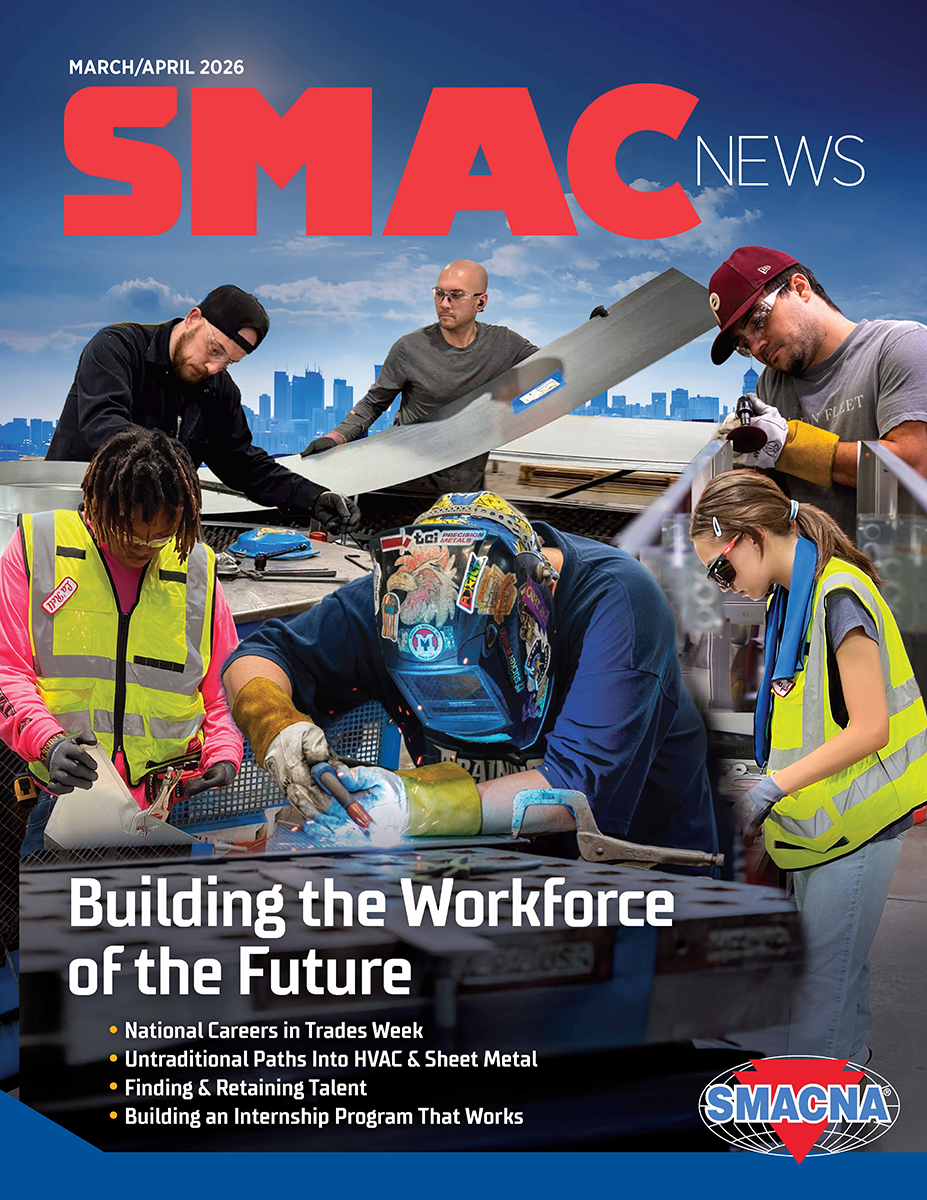
IN THIS ISSUE
AI Is Your New Apprentice: Why Contractors Need Training, Guardrails and an AI Game Plan in 2026
Unlike some technologies, AI is not just something firms adopt; it has a strong individual-level adoption, which presents a problem familiar to leaders who dealt with the introduction of smartphones 15 years ago.
ARCHITECTURAL: Where Metal Meets the Landscape
California Sheet Metal’s award-winning work at Bioterra proves that architectural precision and environmental harmony are not mutually exclusive.
Chapter Spotlight: SMACNA Detroit - America’s Comeback City
The Motor City’s SMACNA chapter works to capture new opportunities in this resurgent community.
Clean Air, Efficient Buildings: SMACNA Pushes Three Bills That Could Transform the Industry
The construction slowdown that began in early 2025 only worsened in 2026 due to increased metal and equipment tariffs,spiking energy costs and stubborn interest rates.
How a Father’s Advice Built a Career
SMACNA's President discusses his story of how he entered the trades and provides advice for those looking to join our industry.
HVAC: 75 Years and Still Ahead of the Curve
Geauga Mechanical’s three-generation bet on innovation pays off in an historic Cleveland renovation.
INDUSTRIAL: Metal and Microclimates
How HVAC is powering America’s next industrial boom.
Powering the Trades
Learn more about the enormous potential of a career in the trades and why it is important for SMACNA to do its part to build a sustainable and dynamic workforce.
RESIDENTIAL: Breathing Life Into Burnaby’s New Skyline
At Gilmore Place, Evergreen Sheet Metal navigated one of the most complex HVAC installations in British Columbia’s history.
TESTING, ADJUSTING AND BALANCING: Tuning the Invisible TAB Orchestra
HVAC systems hum silently when balanced right, delivering comfort, safety and efficiency. But when done wrong, the noise of wasted energy and failed inspections can drown out everything.
Welcome New SMACNA Members
What Contractors Should Know About “No Tax on Overtime”
To keep projects moving and crews in the field, overtime has long been a reality in the construction industry.
Workforce Strategies: A Trade Without Walls
How three professionals from academia, marketing and tech left their careers behind and found their futures in sheet metal and HVAC.
Workforce Strategies: Building the Workforce of the Future
National Careers in Trades Week returns with new partners, new research and a new generation ready to work.
Workforce Strategies: Finding and Retaining Talent in a Shifting Workforce
How to recruit with authenticity, retain through empathy and develop through opportunity.
Workforce Strategies: How to Build an Internship Program That Works
Sheet metal and HVAC leaders reveal proven strategies that turn college talent into industry lifelines, even for small firms.
Privacy Policy |
Terms of Use | Contact Us
Phone: 703.803.2980 | Email:
info@smacna.org
© 1998-2026 SMACNA. All rights reserved.
Web Design & Development by Matrix Group
International, Inc.
