
INDUSTRIAL: Metal and Microclimates
How HVAC is powering America’s next industrial boom.
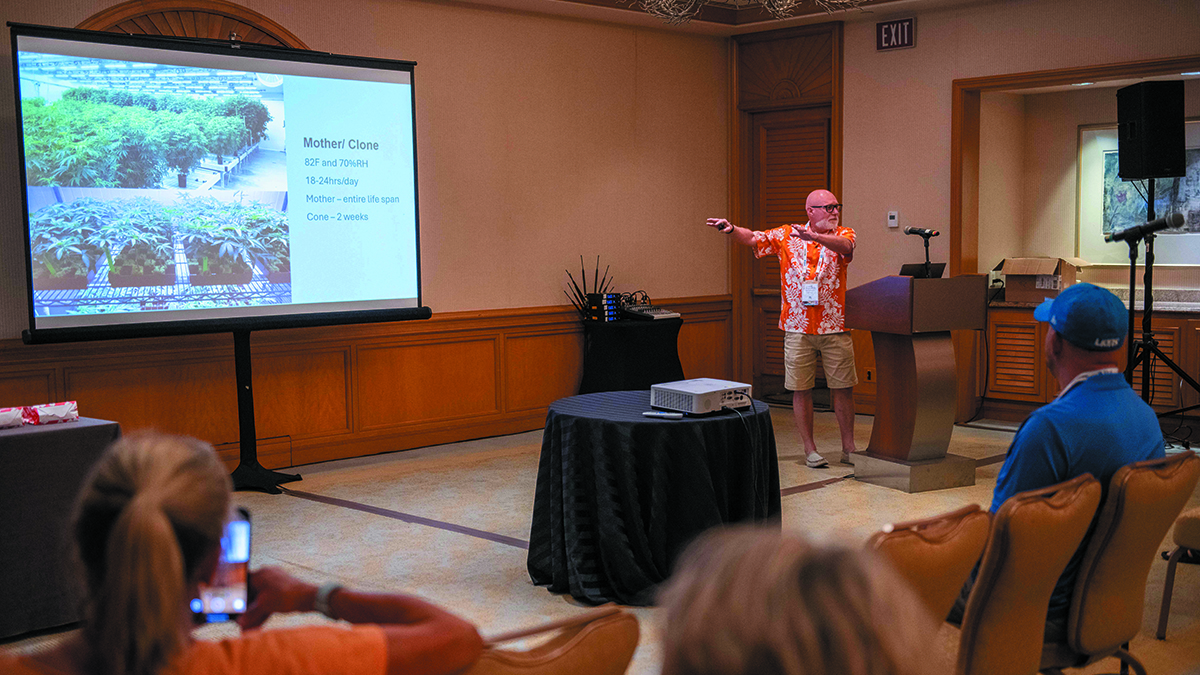 In the race to build the factories of the future, from cannabis grow operations to lithium battery plants, success often depends not on software or robotics, but on something far more elemental: air.
Behind every sealed grow room or dust-free battery line lies a world of engineered airflow, humidity control and HVAC precision.
At the 2025 SMACNA Annual Convention, mechanical engineers James E. Megerson, Vice President of Design Mechanical, and Andy Phelps, Vice President of Barnes and Dodge Sheetmetal, unpacked what it takes to design these specialized systems. Their session, “Sheet Metal for Specialty Hi-Tech Facilities,” explored how airflow, pressure and temperature management have become critical tools in two surging industries shaping American manufacturing.
“These environments push HVAC and sheet metal design to their limits,” Megerson says. “Every degree and every cubic foot of air directly affects performance and product quality.”
For most people, the term “grow room” conjures images of plants under bright lights. But for Megerson and Phelps, these rooms are engineered ecosystems that rely on meticulous airflow, humidity and temperature control to produce consistent yields.

“Every stage of a plant’s life has its own microclimate,” Phelps says. “In the cloning stage, for example, you’re looking at roughly 82 degrees Fahrenheit and 70% humidity with long light cycles — nearly all day. But by the time you reach flowering, humidity drops, lights dim earlier and moisture from transpiration can completely change your load balance.”
That variability is where HVAC design becomes both art and science. Megerson describes what he calls “the load conundrum,” which is a challenge unique to indoor agriculture. “When plants are small, heat rules the day. As they grow, latent loads rise because of moisture release. Your system must flex with that evolution.”
Typical commercial buildings base their cooling load calculations on human occupancy, including body heat, computers and sunlight from windows. But in a 24-hour agricultural grow cycle, humans are replaced by photosynthetic workers: plants. Lighting intensity surges up to 50 watts per square foot, water content constantly shifts and fresh air is minimized to maintain internal stability and CO₂ enrichment.
“You don’t just design for steady-state conditions,” Phelps says. “You design for a living, breathing supply chain inside your building.”
THE AERODYNAMICS OF GROWTH
Air movement in these environments is tied to the biology of the crop itself. As Megerson explains, transpiration, which is the release of vapor through plant stomata, is how nutrients move through the plant. Temperature and humidity “don’t just make a plant comfortable,” he says, “they drive its entire nutrient delivery mechanism.”

Maintaining this balance requires incredibly tight control. Grow rooms often achieve air change rates of 30 to 50 times per hour, with supply air temperatures finely tuned just above dew point to prevent condensation or mold. Even the direction of airflow — whether air is pushed or drawn through the canopy — can determine whether a crop thrives or fails.
“You can’t just blow cold air at plants; it’ll bounce right off,” Megerson says. “You want to pull air through the canopy, where it can move moisture away and maintain a uniform temperature. Velocity at the plant level should sit around 100 to 200 feet per minute — any higher and you risk damaging the plant.”
Every variable connects to another: air pressure, duct insulation and even the materials used inside these sealed rooms. “We see a lot of misconceptions about materials,” Phelps notes. “People think you need exotic metals, but galvanized sheet, properly installed and insulated, performs just fine in most areas. The key is keeping ductwork out of the grow space and minimizing leakage.”
To achieve that, grow rooms undergo meticulous pressurization tests to ensure air leaks stay below 0.2 air changes per hour. “These rooms have to be more airtight than a spacecraft,” Megerson says.
If precision defines cannabis facilities, scale defines lithium battery plants. As the U.S. rushes to expand electric vehicle production, hundreds of new gigafactories and specialty manufacturing facilities are emerging across the country.
“Battery plants are the industrial equivalent of orchestras,” Phelps points out. “They have thousands of instruments, including duct systems, cleanrooms and slurry coating lines, all playing together in sequence.”
Megerson cites “Project Kansas,” a facility producing more than one million battery cells annually, with a capacity exceeding 32 gigawatt-hours a year. Within these vast facilities, every ounce of air is managed. “Just one dry room may span tens of thousands of square feet,” he says. “You’re talking about massive, continuous filtration and dehumidification to protect raw materials.”
Unlike general manufacturing, lithium battery production demands both temperature stability and humidity often below 1% relative. “These are environments where the wrong air leak can ruin an entire batch of cells,” Phelps says.
Duct systems for these spaces mix galvanized and stainless steel, often welded in dry rooms or clean areas. Specialty exhausts handle everything from particulates to electrolyte vapors. “Air movement is literally part of the manufacturing process,” Megerson says. “Every cubic inch of this air has to be controlled, filtered and verified.”
Designing and building such facilities is a logistical challenge.
“Battery plants are massive,” Phelps says. “You might have 10 or more mechanical contractors, national and local, sharing the same site. Add travelers, safety protocols and nonstop scheduling pressure, and every day becomes a coordination puzzle.”
Despite the difficulties, both engineers see immense opportunities with these types of projects. “Mechanical scope can stretch into hundreds of millions,” Megerson says. “These projects take time, care and patience. But they also showcase the best of what our field can deliver.”
He laughs when asked what defines success on jobs this complex. “It takes more than a village,” he says. “It takes an entire industry moving in sync.”
Top photo: Airflow and humidity control are key aspects of building cannabis facilities and lithium battery plants.
Andy Phelps, Vice President of Barnes and Dodge Sheetmetal (left) and James E. Megerson, Vice President of Design Mechanical (right).
Published: May 18, 2026
IN THIS ISSUE
AI Is Your New Apprentice: Why Contractors Need Training, Guardrails and an AI Game Plan in 2026
Unlike some technologies, AI is not just something firms adopt; it has a strong individual-level adoption, which presents a problem familiar to leaders who dealt with the introduction of smartphones 15 years ago.
ARCHITECTURAL: Where Metal Meets the Landscape
California Sheet Metal’s award-winning work at Bioterra proves that architectural precision and environmental harmony are not mutually exclusive.
Chapter Spotlight: SMACNA Detroit - America’s Comeback City
The Motor City’s SMACNA chapter works to capture new opportunities in this resurgent community.
Clean Air, Efficient Buildings: SMACNA Pushes Three Bills That Could Transform the Industry
The construction slowdown that began in early 2025 only worsened in 2026 due to increased metal and equipment tariffs,spiking energy costs and stubborn interest rates.
How a Father’s Advice Built a Career
SMACNA's President discusses his story of how he entered the trades and provides advice for those looking to join our industry.
HVAC: 75 Years and Still Ahead of the Curve
Geauga Mechanical’s three-generation bet on innovation pays off in an historic Cleveland renovation.
INDUSTRIAL: Metal and Microclimates
How HVAC is powering America’s next industrial boom.
Powering the Trades
Learn more about the enormous potential of a career in the trades and why it is important for SMACNA to do its part to build a sustainable and dynamic workforce.
RESIDENTIAL: Breathing Life Into Burnaby’s New Skyline
At Gilmore Place, Evergreen Sheet Metal navigated one of the most complex HVAC installations in British Columbia’s history.
TESTING, ADJUSTING AND BALANCING: Tuning the Invisible TAB Orchestra
HVAC systems hum silently when balanced right, delivering comfort, safety and efficiency. But when done wrong, the noise of wasted energy and failed inspections can drown out everything.
Welcome New SMACNA Members
What Contractors Should Know About “No Tax on Overtime”
To keep projects moving and crews in the field, overtime has long been a reality in the construction industry.
Workforce Strategies: A Trade Without Walls
How three professionals from academia, marketing and tech left their careers behind and found their futures in sheet metal and HVAC.
Workforce Strategies: Building the Workforce of the Future
National Careers in Trades Week returns with new partners, new research and a new generation ready to work.
Workforce Strategies: Finding and Retaining Talent in a Shifting Workforce
How to recruit with authenticity, retain through empathy and develop through opportunity.
Workforce Strategies: How to Build an Internship Program That Works
Sheet metal and HVAC leaders reveal proven strategies that turn college talent into industry lifelines, even for small firms.
Privacy Policy |
Terms of Use | Contact Us
Phone: 703.803.2980 | Email:
info@smacna.org
© 1998-2026 SMACNA. All rights reserved.
Web Design & Development by Matrix Group
International, Inc.
