Clean Air, Efficient Buildings: SMACNA Pushes Three Bills That Could Transform the Industry
The construction slowdown that began in early 2025 only worsened in 2026 due to increased metal and equipment tariffs,spiking energy costs and stubborn interest rates.
This new economic reality for construction has a significant policy dimension, and SMACNA is working on Capitol Hill to address it by offering legislative solutions with bipartisan appeal and cosponsors motivated for results.
Residential and commercial retrofit and equipment markets are experiencing a slump following federal tax and spending reversals impacting existing projects. A significant impact was the elimination of key energy-efficiency tax incentives from the budget reconciliation package signed into law on July 4, 2025. SMACNA is actively advocating for three pieces of legislation. These would restore those incentives, improve indoor air quality in schools and drive IAQ assessments leading to HVAC upgrades in commercial buildings nationwide.
The centerpiece of SMACNA’s legislative push is the American Energy Independence and Affordability Act (H.R. 5862), introduced in direct response to the gutting of energy efficiency provisions in the final version of H.R. 1. Those provisions — many carrying vocal bipartisan support — were stripped in the final days of negotiations before the deadline. Their loss was felt immediately in residential and commercial construction and equipment sales markets that have now seen more than eight months of declining activity.
H.R. 5862 would restore and extend the tax incentive framework that was making energy efficient retrofits financially viable for homeowners, building owners and businesses. The bill extends incentives for efficient homes and commercial buildings; restores clean electricity production and investment tax credits for wind, solar and other zero-emission sources; reinstates clean-vehicle tax credits for businesses; supports domestic manufacturing of clean energy components; and extends the clean hydrogen production credit.
The practical effect of reinstating these incentives would be significant and fast-moving, injecting immediate stimulus into residential, industrial and transportation construction sectors with a growing number of contractors now sitting on the sidelines. The policy change would help in generating skilled construction jobs; supporting small businesses and equipment suppliers; and reducing pressure on the overburdened and strained electric grid by accelerating efficient retrofits across the country. With data center electricity demands now a front-page policy issue, this increased grid efficiency measure should be a simple choice for Congress to make before the election season ends Capitol Hill activity.
The Indoor Air Quality and Healthy Schools Act (H.R. 5123), co-sponsored by Representatives Paul Tonko (D-NY) and Brian Fitzpatrick (R-PA) is pending in the Energy and Commerce Committee. The bill takes direct aim at one of the nation’s top public health challenges: poor indoor air quality in schools and public buildings.
SMACNA contractors are on the front lines advocating for addressing this issue every day. SMACNA’s leading firms are deeply engaged in designing and installing the mechanical systems that determine whether a school’s air is protecting its occupants or quietly harming them. The bill would strengthen the EPA’s Indoor Environments Division, require the agency to establish and regularly update a list of significant indoor contaminants along with voluntary health-based guidelines, create voluntary building certifications for properties designed to minimize IAQ risks, and establish a national assessment of air quality conditions in schools and childcare facilities.
Sponsored by Representative Don Beyer (D-VA) and pending in the Ways and Means Committee, the AIRBORNE Act would add incentives to the tax code to move commercial property owners to respond, assess and address problems with their building indoor air quality. The bill offers a $1-per-square-foot tax credit for IAQ assessments, a $5-per-square-foot credit for air filter upgrades meeting ASHRAE Standard 62.1-2022 and MERV-13 or better, and a $50-per-square-foot credit for full HVAC system upgrades — each capped at 50% of total project cost. A voluntary DOE/EPA certification program would allow property owners to demonstrate compliance with the standards outlined in the bill.
SMACNA has enthusiastically endorsed the AIRBORNE Act and is actively working with SMART and industry allies and House members to build cosponsors and broaden support.
Published: May 18, 2026
IN THIS ISSUE
AI Is Your New Apprentice: Why Contractors Need Training, Guardrails and an AI Game Plan in 2026
Unlike some technologies, AI is not just something firms adopt; it has a strong individual-level adoption, which presents a problem familiar to leaders who dealt with the introduction of smartphones 15 years ago.
ARCHITECTURAL: Where Metal Meets the Landscape
California Sheet Metal’s award-winning work at Bioterra proves that architectural precision and environmental harmony are not mutually exclusive.
Chapter Spotlight: SMACNA Detroit - America’s Comeback City
The Motor City’s SMACNA chapter works to capture new opportunities in this resurgent community.
Clean Air, Efficient Buildings: SMACNA Pushes Three Bills That Could Transform the Industry
The construction slowdown that began in early 2025 only worsened in 2026 due to increased metal and equipment tariffs,spiking energy costs and stubborn interest rates.
How a Father’s Advice Built a Career
SMACNA's President discusses his story of how he entered the trades and provides advice for those looking to join our industry.
HVAC: 75 Years and Still Ahead of the Curve
Geauga Mechanical’s three-generation bet on innovation pays off in an historic Cleveland renovation.
INDUSTRIAL: Metal and Microclimates
How HVAC is powering America’s next industrial boom.
Powering the Trades
Learn more about the enormous potential of a career in the trades and why it is important for SMACNA to do its part to build a sustainable and dynamic workforce.
RESIDENTIAL: Breathing Life Into Burnaby’s New Skyline
At Gilmore Place, Evergreen Sheet Metal navigated one of the most complex HVAC installations in British Columbia’s history.
TESTING, ADJUSTING AND BALANCING: Tuning the Invisible TAB Orchestra
HVAC systems hum silently when balanced right, delivering comfort, safety and efficiency. But when done wrong, the noise of wasted energy and failed inspections can drown out everything.
Welcome New SMACNA Members
What Contractors Should Know About “No Tax on Overtime”
To keep projects moving and crews in the field, overtime has long been a reality in the construction industry.
Workforce Strategies: A Trade Without Walls
How three professionals from academia, marketing and tech left their careers behind and found their futures in sheet metal and HVAC.
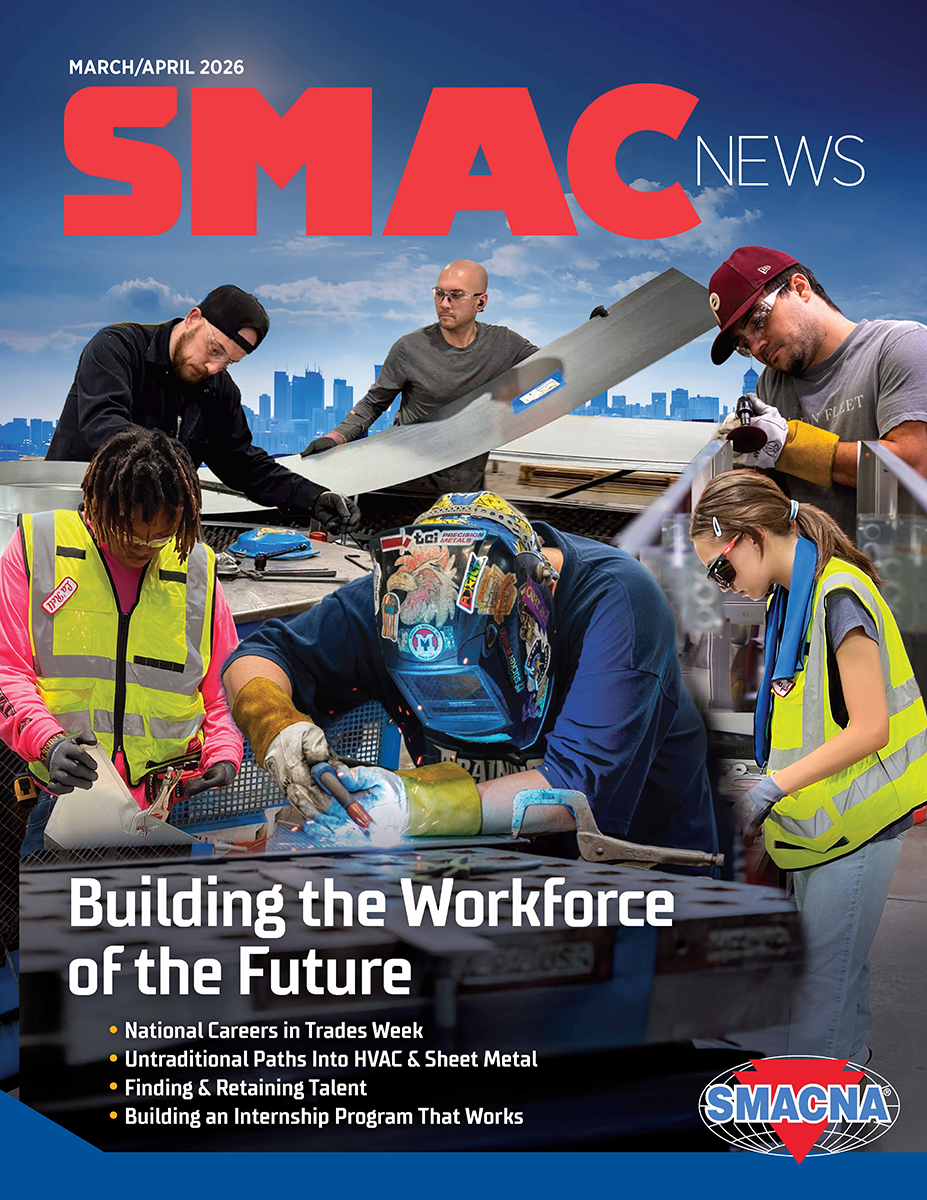
Workforce Strategies: Building the Workforce of the Future
National Careers in Trades Week returns with new partners, new research and a new generation ready to work.
Workforce Strategies: Finding and Retaining Talent in a Shifting Workforce
How to recruit with authenticity, retain through empathy and develop through opportunity.
Workforce Strategies: How to Build an Internship Program That Works
Sheet metal and HVAC leaders reveal proven strategies that turn college talent into industry lifelines, even for small firms.
Privacy Policy |
Terms of Use | Contact Us
Phone: 703.803.2980 | Email:
info@smacna.org
© 1998-2026 SMACNA. All rights reserved.
Web Design & Development by Matrix Group
International, Inc.
