TESTING, ADJUSTING AND BALANCING: Tuning the Invisible TAB Orchestra
HVAC systems hum silently when balanced right, delivering comfort, safety and efficiency. But when done wrong, the noise of wasted energy and failed inspections can drown out everything.
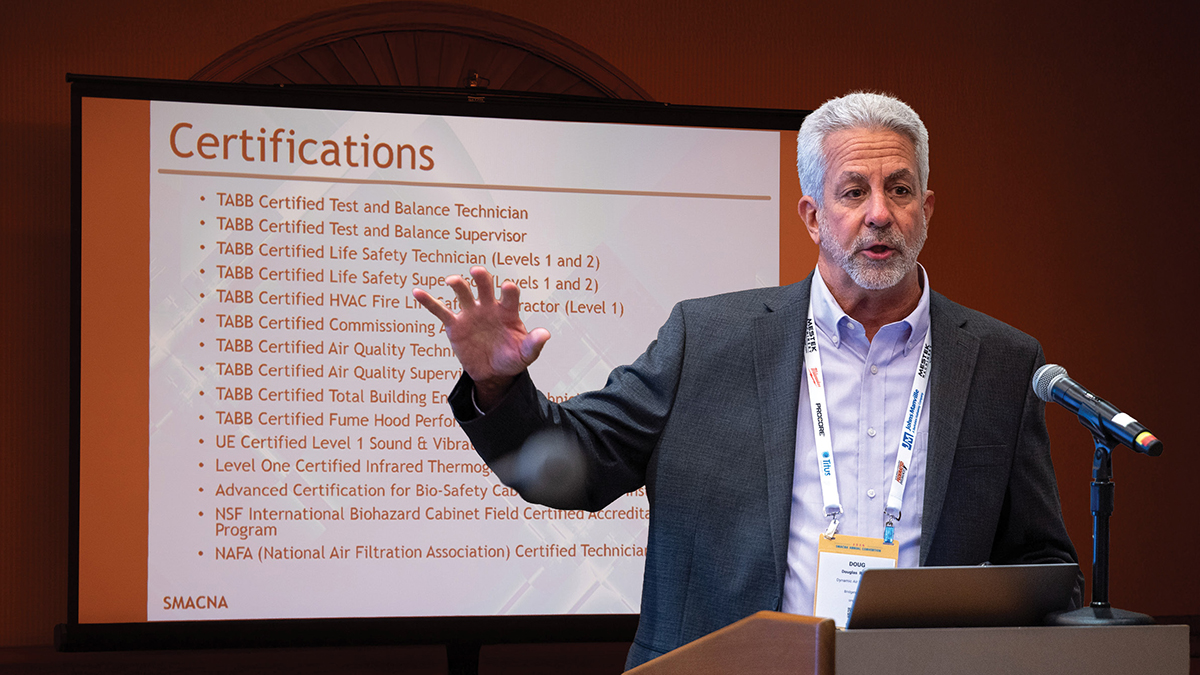 The first thing Doug Ratley wants his audience to understand about testing, adjusting and balancing (TAB) is that it’s like music.
When an HVAC system is tuned and coordinated, a building feels almost invisible to the people inside it: temperatures are steady, critical rooms hold pressure, noise fades into the background and air quietly does its job. But “what happens when one or more of the instruments are not tuned properly?” asks Ratley, President, Dynamic Air Solutions, St. Louis, Missouri. The answer: noise.
In Ratley’s analogy, every major component of a modern HVAC system is an instrument. Air-handling units and rooftop units move conditioned air through floors. Exhaust fans and recovery units pull stale or contaminated air out. Variable air-volume boxes and Venturi valves fine-tune the flow into individual rooms. Pumps, chillers and boilers push heating and cooling water across a campus, while cooling towers reject unwanted heat outside.
Individually, each piece can be installed correctly and still fail to produce the “song” the designer intends. That is where testing, adjusting and balancing (TAB) comes in. The American Society of Heating, Refrigerating and Air Conditioning Engineers (ASHRAE) defines TAB as “the process of checking and adjusting all environmental systems in a building to produce the design objectives.” Technicians measure airflow, water flow, pressure, temperature and humidity. Then they make systematic adjustments until the real world system matches the engineer’s drawings as closely as conditions allow.
SMACNA describes TAB contractors as specialists whose measurements and reports “assure the HVAC systems are operating at the highest standards of energy efficiency, ventilation effectiveness, indoor air quality and comfort in a healthy indoor environment.” The work often exposes pre-existing problems.
TAB: FRIEND OR FOE?
TAB contractors tend to arrive late in the project schedule after years of design and months of installation. They are also, as Ratley notes, usually subcontractors “with no authority to push anyone to make any corrections whatsoever.” When they publish a deficiency list documenting missing components, miswired fans, leaky ducts or rooms that will not hold pressure, it can feel like an attack on everyone who came before.
Ratley pushes back on that perception. TAB, he argues, is an owner’s ally and a quality control backstop. When done properly, it lowers utility costs by trimming wasted air and water flow, increases occupant comfort and safety, and reduces wear on equipment and extends operational life.
SMACNA makes a similar case in its public materials, emphasizing that balanced systems are essential to both energy performance and indoor air quality, and that formal TAB reports create an actionable roadmap for corrective work.
WHO MAKES TAB WORK?
Ratley poses a simple question: “Who are the critical players for TAB?” Then he answers it by walking through the project chain, role by role.
The owner, he says, must “communicate the requirements to the design team so they can develop a well-defined scope” and then hold everyone accountable. Without clear expectations for air changes, pressures and comfort, there is nothing solid to balance to.
The architect must provide adequate space around equipment and ducts, separate noisy mechanical rooms from sensitive areas and design tight room envelopes where pressure relationships matter.
The mechanical engineer develops written specifications and detailed drawings with control strategies and sequences of operation. “There is no substitute for a well-written specification and set of drawings,” he says.
The general contractor or construction manager controls time. Ratley says they must carve out a real window for TAB “before the equipment/furniture is installed.”
Mechanical, sheet metal, plumbing and electrical contractors have straightforward but critical assignments: install equipment so it is accessible, start and prove it out, purge air from hydronic systems, open and verify dampers, and check fan and pump rotation. Some fans, Ratley says, will appear to be moving air even when they are wired backwards, but only at half the expected volume.
The controls contractor must deliver a functioning building automation system, then “provide TAB with access to controls and make changes to the system as needed.”
TAB technicians stand at the end of that line. They review drawings and specifications, flag missing balancing valves or dampers, and then, once systems run, measure and adjust until the flows in the field align with the engineer’s numbers.
- Review design drawings and specifications.
- Identify overlooked balancing components.
- Create project specific TAB documentation.
- After startup, perform an onsite evaluation.
- Measure and balance air and water flows to the engineer’s specifications and monitor system response.
Technicians rely on instruments such as flow hoods, digital meters and pressure sensors to collect data at diffusers, grilles, coils and pumps. SMACNA has recently updated its own TAB Procedural Guide, an 118-page standard that outlines detailed methods for air and water systems and provides sample report forms.
But the neatness of the procedure often collides with job site realities. Projects have fixed completion windows. Components arrive late. Hydronic systems trap air. Fire alarm testing shuts down air handlers. Floors get sealed before diffusers can be accessed. Each of these, Ratley warns, restricts what TAB can accomplish within the allotted time.
Some TAB projects Ratley showcased were healthcare facilities, where air changes and pressure relationships can be matters of life and safety. Agencies, including the Centers for Medicare and Medicaid Services, the National Fire Protection Association, the Facility Guidelines Institute and The Joint Commission, exert pressure on hospitals to meet stringent HVAC standards.
In sterile processing departments, for example, guidelines spell out minimum air changes per hour, temperature and humidity ranges, and whether decontamination rooms must be positively or negatively pressurized relative to adjacent spaces.
When those requirements are not met, TAB teams are often the first to see why. Ratley documents holes above ceilings in supposedly tight rooms, security grilles punched into “pressure sensitive” spaces, clogged measurement devices, years of dirt compacted into coils, blocked duct sensors, and flex duct connections that have worked loose. In one image, a damper actuator spins freely on a loose mount instead of turning the blade it is supposed to control. In another, biological growth creeps across drain pans and duct liners, undermining both cleanliness and humidity control.
- Life safety verification, including fire and smoke damper testing and smoke zone conformance.
- Stairwell pressurization tests.
- Duct and air handler leakage testing.
- Envelope “blower door” testing.
- Pharmacy and laboratory performance validation, including work to USP 797 and 800 standards and fume hood testing.
- HEPA filter integrity checks, particle counts and sound and vibration analysis.
When owners, designers and contractors treat TAB as an integral part of the project — rather than a last minute hurdle — it is a friend. It becomes a system where every instrument plays in tune, and the people inside never hear the noise that might have been.
Doug Ratley, President, Dynamic Air Solutions, St. Louis, Missouri.
Published: May 18, 2026
IN THIS ISSUE
AI Is Your New Apprentice: Why Contractors Need Training, Guardrails and an AI Game Plan in 2026
Unlike some technologies, AI is not just something firms adopt; it has a strong individual-level adoption, which presents a problem familiar to leaders who dealt with the introduction of smartphones 15 years ago.
ARCHITECTURAL: Where Metal Meets the Landscape
California Sheet Metal’s award-winning work at Bioterra proves that architectural precision and environmental harmony are not mutually exclusive.
Chapter Spotlight: SMACNA Detroit - America’s Comeback City
The Motor City’s SMACNA chapter works to capture new opportunities in this resurgent community.
Clean Air, Efficient Buildings: SMACNA Pushes Three Bills That Could Transform the Industry
The construction slowdown that began in early 2025 only worsened in 2026 due to increased metal and equipment tariffs,spiking energy costs and stubborn interest rates.
How a Father’s Advice Built a Career
SMACNA's President discusses his story of how he entered the trades and provides advice for those looking to join our industry.
HVAC: 75 Years and Still Ahead of the Curve
Geauga Mechanical’s three-generation bet on innovation pays off in an historic Cleveland renovation.
INDUSTRIAL: Metal and Microclimates
How HVAC is powering America’s next industrial boom.
Powering the Trades
Learn more about the enormous potential of a career in the trades and why it is important for SMACNA to do its part to build a sustainable and dynamic workforce.
RESIDENTIAL: Breathing Life Into Burnaby’s New Skyline
At Gilmore Place, Evergreen Sheet Metal navigated one of the most complex HVAC installations in British Columbia’s history.
TESTING, ADJUSTING AND BALANCING: Tuning the Invisible TAB Orchestra
HVAC systems hum silently when balanced right, delivering comfort, safety and efficiency. But when done wrong, the noise of wasted energy and failed inspections can drown out everything.
Welcome New SMACNA Members
What Contractors Should Know About “No Tax on Overtime”
To keep projects moving and crews in the field, overtime has long been a reality in the construction industry.
Workforce Strategies: A Trade Without Walls
How three professionals from academia, marketing and tech left their careers behind and found their futures in sheet metal and HVAC.
Workforce Strategies: Building the Workforce of the Future
National Careers in Trades Week returns with new partners, new research and a new generation ready to work.
Workforce Strategies: Finding and Retaining Talent in a Shifting Workforce
How to recruit with authenticity, retain through empathy and develop through opportunity.
Workforce Strategies: How to Build an Internship Program That Works
Sheet metal and HVAC leaders reveal proven strategies that turn college talent into industry lifelines, even for small firms.
Privacy Policy |
Terms of Use | Contact Us
Phone: 703.803.2980 | Email:
info@smacna.org
© 1998-2026 SMACNA. All rights reserved.
Web Design & Development by Matrix Group
International, Inc.
