
RESIDENTIAL: Breathing Life Into Burnaby’s New Skyline
At Gilmore Place, Evergreen Sheet Metal navigated one of the most complex HVAC installations in British Columbia’s history.
-1200x675.jpg?sfvrsn=150e80a5_1 "Gilmore (1) 1200x675")
The contract, secured by Evergreen in late 2020, put the firm at the center of one of the most technically demanding sheet metal installations the region had seen. Justin Nguyen, Project Manager at Evergreen, says the scope left no room for anything less than complete precision.
“The complexity of Gilmore Place’s HVAC system set it apart,” Nguyen says. “The buildings’ design required a deep understanding of HVAC systems and building codes to ensure seamless execution and functionality. Every component had to be meticulously planned to integrate with the structure, ensuring efficient operation for years to come.”
At the heart of the project were the luxury amenities on levels four and five of each tower — the spaces Onni intended as the development’s centerpiece. Heating and cooling for those areas are delivered through a 15,000 CFM make-up air unit and heat pump systems, while the pool area is served by its own dedicated air handling unit. Both units are housed in a mechanical room with severely limited space.
“The AHU is located in a restricted crawlspace, posing significant challenges for installation and logistics,” Nguyen says. “Early-stage coordination between our field and BIM teams was key. By resolving potential conflicts and finalizing layouts well in advance, we ensured the installation could proceed smoothly despite the tight mechanical room constraints.”
The solution was to prefabricate the ductwork off-site entirely and deliver it to the project before the surrounding walls were formed. Nguyen estimates that roughly 60% of under-slab ductwork and approximately 90% of in-slab ductwork was prefabricated directly from BIM models, a strategy that allowed the team to move efficiently through one of the tightest mechanical rooms on the project without having to maneuver large duct sections through confined spaces after the fact.
With a project of this density and scale, coordination with other trades was the defining operational challenge. Ceiling space in the amenity areas was extremely limited. In-slab duct routing required millimeter-level precision. A conflict discovered in the field, rather than the model, could cost days and significant rework dollars.
“The biggest hurdle was aligning our work with other trades to preventing clashes during installation,” Nguyen says. “This is a massive project with a complex mechanical system, and a significant amount of planning took place during the design phase. With so many moving parts, even a minor misalignment could lead to costly rework.”
Evergreen used Revit and Revizto to build highly detailed 3D models of the mechanical systems before a single piece of ductwork was installed. The payoff showed up early. During BIM coordination for the Level 4 make-up air distribution system, the team identified that the original duct routing would create conflicts with structural elements and other building services. The system was redesigned in the model before construction reached that level.
“Resolving the issue in the BIM model allowed the team to avoid significant field modifications, saving both installation time and potential rework costs once construction was underway,” Nguyen says.
Evergreen entered full on-site operations in mid-2021, but the project’s procurement strategy had already been shaped by decisions made a year earlier. In early 2020, as the scope of COVID-19’s supply chain disruption was becoming clear, the team held internal discussions and moved decisively.
“Preloading materials and equipment helped us stay on track, particularly with rising costs across various materials,” Nguyen says. “By planning ahead, we minimized delays and prevented budget overruns.”
The majority of critical equipment was purchased and delivered to the site before the worst of the global shortages hit. It was a lesson in risk management that Nguyen says applies to any large-scale project going forward: identify the exposure early and act before the window closes.
Gilmore Place was designed to meet ASHRAE 90.1 2010 standards, but as construction progressed, the City of Burnaby adopted the BC Energy Step Code, a stricter framework that required the project’s mechanical systems to be re-evaluated for compliance.
“We needed to source ‘green’ equipment with low energy consumption to align with LEED requirements while maintaining system performance,” Nguyen says.
The answer was an ambient loop system powered by air-source heat pumps. A central make-up air unit working in conjunction with the heat pump system delivers heating and cooling to approximately 60,000 square feet of amenity space. All air-moving equipment was specified with energy efficiency as a primary criterion. This meant securing direct-drive fans with ECM motors and belt-driven fans specified below the designed motor horsepower to reduce overall energy consumption while meeting airflow requirements. Acoustic performance was held to a maximum Noise Criteria rating of NC-15 in sensitive spaces, including the lobby and amenities, with all ductwork sized in accordance with SMACNA standards to maintain controlled velocity and minimize turbulence.
Gilmore Place is also, Nguyen says, exactly the kind of project that develops a workforce. Apprentices worked alongside senior staff through advanced BIM coordination, detailed field installation and the particular demands of working adjacent to an active transit station. SMACNA standards served throughout as the technical backbone for fabrication and installation practices.
“Like the evergreens in our name, we believe in continuously learning and strengthening our trade,” Nguyen says. “Projects like Gilmore Place push us to evolve, from coordinating across multiple trades to optimizing designs for efficiency. It takes commitment and dependability from our team to ensure that every piece of ductwork and ventilation system meets the highest standard.”
For a 28-year-old family-owned firm out of Maple Ridge, Gilmore Place is more than a completed contract. It is a demonstration of what the sheet metal trade looks like when precision engineering, digital coordination and proactive planning converge on a project worthy of the effort.
Burnaby’s skyline is changing. Evergreen helped make sure it breathes right.
Heating and cooling for the luxury amenities of the three residential towers at Gilmore Place included 15,000 CFM
Published: May 18, 2026
IN THIS ISSUE
AI Is Your New Apprentice: Why Contractors Need Training, Guardrails and an AI Game Plan in 2026
Unlike some technologies, AI is not just something firms adopt; it has a strong individual-level adoption, which presents a problem familiar to leaders who dealt with the introduction of smartphones 15 years ago.
ARCHITECTURAL: Where Metal Meets the Landscape
California Sheet Metal’s award-winning work at Bioterra proves that architectural precision and environmental harmony are not mutually exclusive.
Chapter Spotlight: SMACNA Detroit - America’s Comeback City
The Motor City’s SMACNA chapter works to capture new opportunities in this resurgent community.
Clean Air, Efficient Buildings: SMACNA Pushes Three Bills That Could Transform the Industry
The construction slowdown that began in early 2025 only worsened in 2026 due to increased metal and equipment tariffs,spiking energy costs and stubborn interest rates.
How a Father’s Advice Built a Career
SMACNA's President discusses his story of how he entered the trades and provides advice for those looking to join our industry.
HVAC: 75 Years and Still Ahead of the Curve
Geauga Mechanical’s three-generation bet on innovation pays off in an historic Cleveland renovation.
INDUSTRIAL: Metal and Microclimates
How HVAC is powering America’s next industrial boom.
Powering the Trades
Learn more about the enormous potential of a career in the trades and why it is important for SMACNA to do its part to build a sustainable and dynamic workforce.
RESIDENTIAL: Breathing Life Into Burnaby’s New Skyline
At Gilmore Place, Evergreen Sheet Metal navigated one of the most complex HVAC installations in British Columbia’s history.
TESTING, ADJUSTING AND BALANCING: Tuning the Invisible TAB Orchestra
HVAC systems hum silently when balanced right, delivering comfort, safety and efficiency. But when done wrong, the noise of wasted energy and failed inspections can drown out everything.
Welcome New SMACNA Members
What Contractors Should Know About “No Tax on Overtime”
To keep projects moving and crews in the field, overtime has long been a reality in the construction industry.
Workforce Strategies: A Trade Without Walls
How three professionals from academia, marketing and tech left their careers behind and found their futures in sheet metal and HVAC.
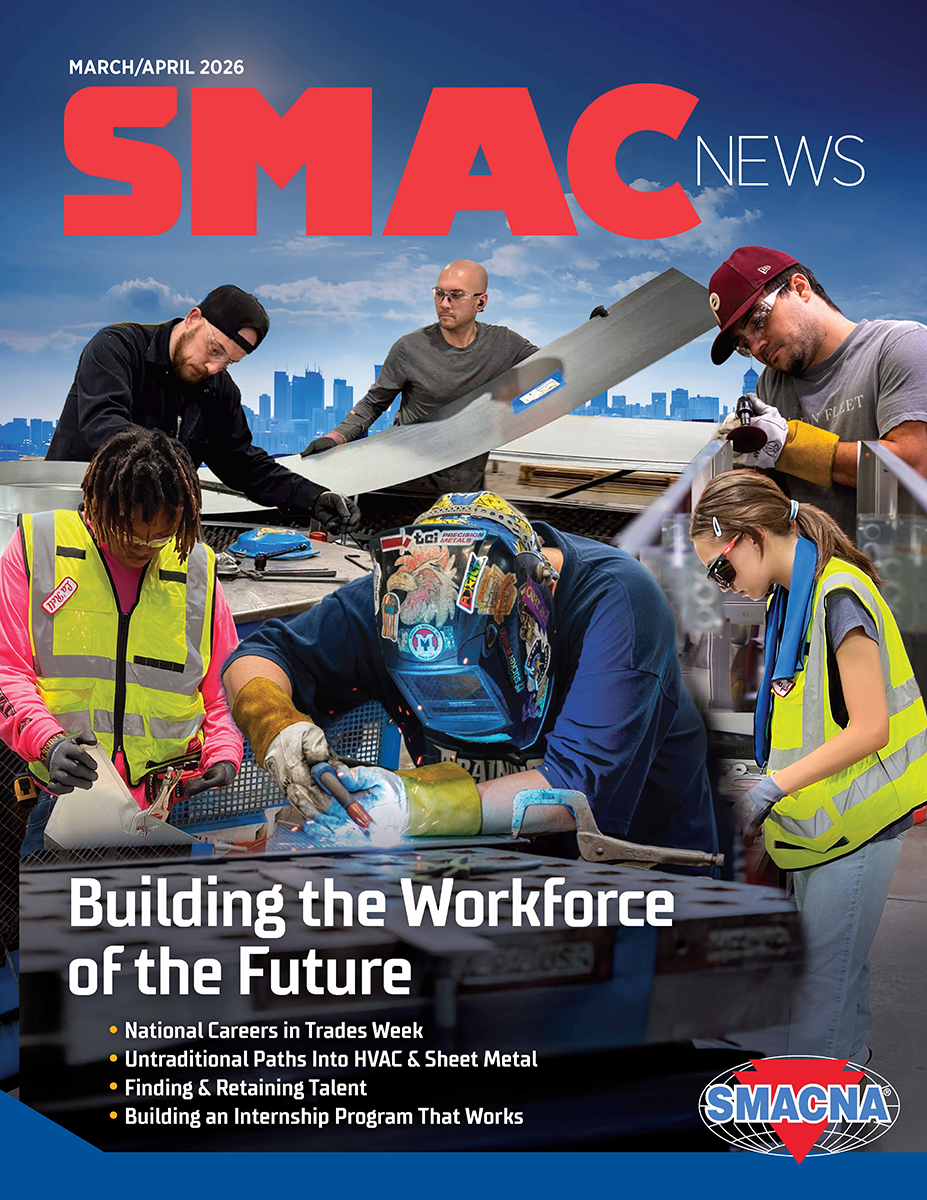
Workforce Strategies: Building the Workforce of the Future
National Careers in Trades Week returns with new partners, new research and a new generation ready to work.
Workforce Strategies: Finding and Retaining Talent in a Shifting Workforce
How to recruit with authenticity, retain through empathy and develop through opportunity.
Workforce Strategies: How to Build an Internship Program That Works
Sheet metal and HVAC leaders reveal proven strategies that turn college talent into industry lifelines, even for small firms.
Privacy Policy |
Terms of Use | Contact Us
Phone: 703.803.2980 | Email:
info@smacna.org
© 1998-2026 SMACNA. All rights reserved.
Web Design & Development by Matrix Group
International, Inc.
