
ARCHITECTURAL: Where Metal Meets the Landscape
California Sheet Metal’s award-winning work at Bioterra proves that architectural precision and environmental harmony are not mutually exclusive.

In the Sorrento Mesa neighborhood of San Diego, where the Torrey Pine clings to coastal bluffs and the biotech industry has built one of its most productive clusters in the world, a new building is doing something unusual by trying to look like it belongs.
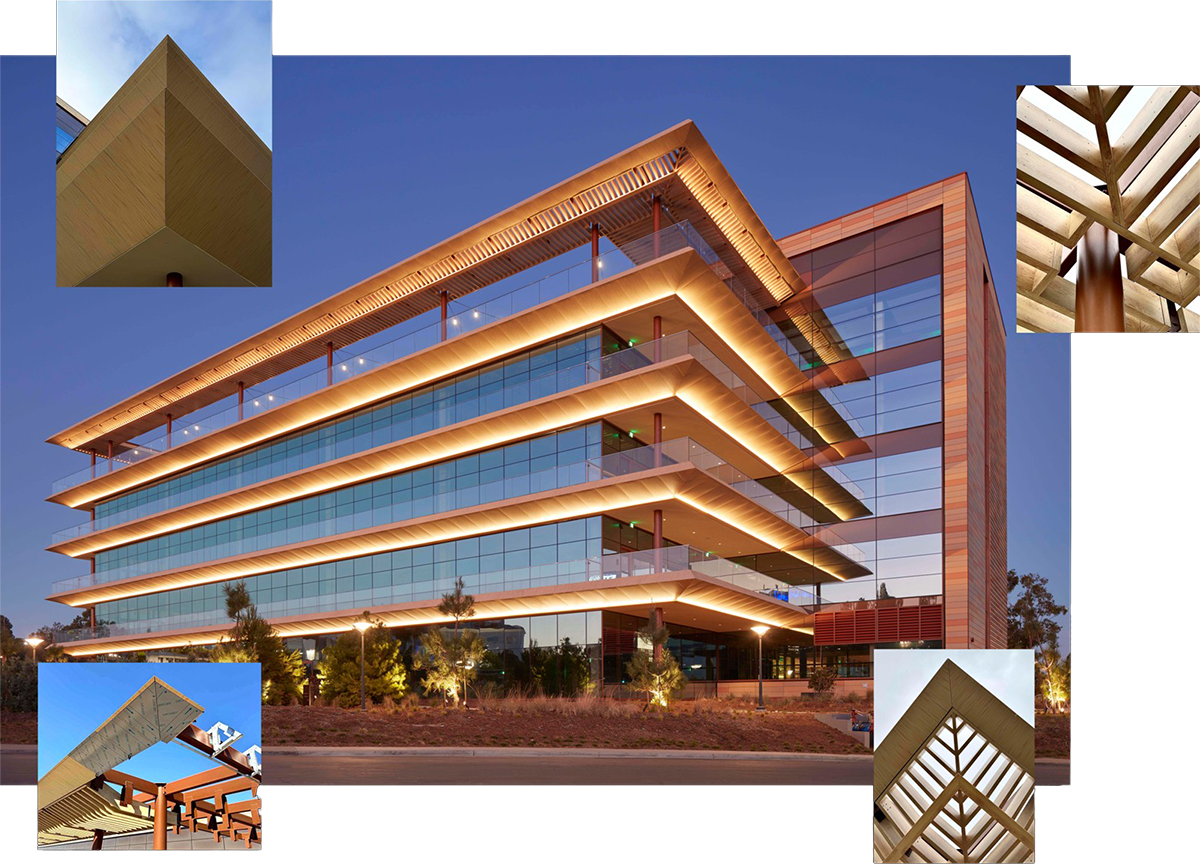
Bioterra, a 323,000-square-foot, five-story life science facility developed by Longfellow Real Estate Partners, was designed by HOK with a clear mandate. The building’s facade, terraces, colors and textures were all meant to echo the arroyos, pines and coastline of its immediate surroundings rather than announce themselves against it. The building’s two pairs of slender parallel wings slip past one another on a northeast axis on a tight, triangular 4.14-acre site, a massing strategy that creates self-shading across projecting terraces designed to shade the floors below. Floor-to-ceiling glass runs throughout. The first floor carries 18-foot ceilings. Integrating structural and mechanical systems maximized the 15-foot typical floor-to-floor height. This meant every trade, including sheet metal, had to work in sync with very little margin for error.
Turning that architectural intention into fabricated metal was the job of California Sheet Metal, a San Diego-based, employee-owned union contractor and charter member of San Diego SMACNA. The result earned the company the 2025 Tom Guilfoy Memorial Craftsmanship Award in the Architectural category from CAL SMACNA — the firm’s sixth Guilfoy win since 2014. It took 21,577 work-hours to get there.
The central fabrication challenge at Bioterra was a facade panel system whose geometry was anything but forgiving. The panels’ unique angular profiles required precise notching and CNC-located bend lines before any forming could begin, a sequencing that demanded exacting dimensional control at every stage. Flange dimensions had to meet tight tolerances to ensure that tabs and slots aligned properly and that panel faces sat flush across the building’s exterior. Any deviation in the shop would compound in the field.
To manage that risk, California Sheet Metal built a quality control rhythm directly into the production workflow. A three-person forming team worked through the panels systematically, producing up to 70 fully formed panels per day and stopping every 10 parts to assemble a control panel and verify consistency before moving forward. It was a disciplined, iterative approach that kept quality from becoming a field problem.
The angular aluminum trellis that crowns sections of the facade presented its own coordination challenge: it had to mirror the same angular profile as the panels below it, maintaining visual continuity across different structural elements. Getting that alignment right required not just precision fabrication but close collaboration with the project team throughout design and installation.
The scope extended beyond the exterior skin. California Sheet Metal also installed a high-performance aluminum soffit finished in a warm, weathered Parisian Rust tone that carries from the exterior into the building’s entryway, where it defines the reception desk, interior millwork and elevator surrounds — a material continuity that required the same dimensional precision indoors as well as out.
The ecological dimension of the project pushed beyond geometry into something less common in sheet metal work: biomimicry. The design called for panels finished to replicate the natural colors and textures of the Torrey Pine, the rare, gnarled conifer native to this exact stretch of San Diego coastline. To achieve that, California Sheet Metal’s team had to develop a working knowledge of the local flora, then translate it into color matching and texturing processes precise enough to hold up against the real thing at close range.
The result blends so seamlessly with the surrounding landscape that the building reads less as an intrusion on the mesa than as an extension of it.
California Sheet Metal has been fabricating and installing architectural metal in Southern California for more than 100 years and has been a fixture on the region’s most demanding projects for decades — from the San Diego Central Library to Horton Plaza’s perforated stainless steel luminaries to the multifaceted aluminum facade at The Grand LA, which earned a Guilfoy in 2023. The Bioterra win marks the company’s sixth time taking the architectural category since the award was established in 1996.
What makes that run possible is consistency. The average tenure across California Sheet Metal’s employee-owner workforce is 13 years, a depth of institutional knowledge that shows up directly in the shop’s ability to execute complex, tolerance-sensitive work reliably and at scale.
For Bioterra, that meant delivering 21,577 work-hours of fabrication and installation in service of a building designed for LEED Gold and Fitwel certification, equipped with San Diego’s first all-electric life science HVAC system, and built to serve the next generation of research on one of the city’s most ecologically distinctive sites. The building doesn’t just breathe clean air. Its skin looks like it grew there.
Top photo: The Bioterra project earned California Sheet Metal the 2025 Tom Guilfoy Memorial Craftsmanship Award in the Architectural category.
California Sheet Metal’s fabrication and installation work on this project took 21,577 work-hours.
Published: May 18, 2026
IN THIS ISSUE
AI Is Your New Apprentice: Why Contractors Need Training, Guardrails and an AI Game Plan in 2026
Unlike some technologies, AI is not just something firms adopt; it has a strong individual-level adoption, which presents a problem familiar to leaders who dealt with the introduction of smartphones 15 years ago.
ARCHITECTURAL: Where Metal Meets the Landscape
California Sheet Metal’s award-winning work at Bioterra proves that architectural precision and environmental harmony are not mutually exclusive.
Chapter Spotlight: SMACNA Detroit - America’s Comeback City
The Motor City’s SMACNA chapter works to capture new opportunities in this resurgent community.
Clean Air, Efficient Buildings: SMACNA Pushes Three Bills That Could Transform the Industry
The construction slowdown that began in early 2025 only worsened in 2026 due to increased metal and equipment tariffs,spiking energy costs and stubborn interest rates.
How a Father’s Advice Built a Career
SMACNA's President discusses his story of how he entered the trades and provides advice for those looking to join our industry.
HVAC: 75 Years and Still Ahead of the Curve
Geauga Mechanical’s three-generation bet on innovation pays off in an historic Cleveland renovation.
INDUSTRIAL: Metal and Microclimates
How HVAC is powering America’s next industrial boom.
Powering the Trades
Learn more about the enormous potential of a career in the trades and why it is important for SMACNA to do its part to build a sustainable and dynamic workforce.
RESIDENTIAL: Breathing Life Into Burnaby’s New Skyline
At Gilmore Place, Evergreen Sheet Metal navigated one of the most complex HVAC installations in British Columbia’s history.
TESTING, ADJUSTING AND BALANCING: Tuning the Invisible TAB Orchestra
HVAC systems hum silently when balanced right, delivering comfort, safety and efficiency. But when done wrong, the noise of wasted energy and failed inspections can drown out everything.
Welcome New SMACNA Members
What Contractors Should Know About “No Tax on Overtime”
To keep projects moving and crews in the field, overtime has long been a reality in the construction industry.
Workforce Strategies: A Trade Without Walls
How three professionals from academia, marketing and tech left their careers behind and found their futures in sheet metal and HVAC.
Workforce Strategies: Building the Workforce of the Future
National Careers in Trades Week returns with new partners, new research and a new generation ready to work.
Workforce Strategies: Finding and Retaining Talent in a Shifting Workforce
How to recruit with authenticity, retain through empathy and develop through opportunity.
Workforce Strategies: How to Build an Internship Program That Works
Sheet metal and HVAC leaders reveal proven strategies that turn college talent into industry lifelines, even for small firms.
Privacy Policy |
Terms of Use | Contact Us
Phone: 703.803.2980 | Email:
info@smacna.org
© 1998-2026 SMACNA. All rights reserved.
Web Design & Development by Matrix Group
International, Inc.
