What Contractors Should Know About “No Tax on Overtime”
To keep projects moving and crews in the field, overtime has long been a reality in the construction industry.
 For contractors, accurately managing and reporting these hours is an operational necessity that requires balancing project demands, compliance and workforce well-being.
The One Big Beautiful Bill Act (OBBBA) introduces a first-of-its-kind federal income tax deduction for employees tied directly to qualified overtime pay. While the benefit flows to the employee, contractors will bear the responsibility for accurately tracking overtime — a process that may require meaningful payroll and system reporting process changes.
For tax years 2025-2028, only non-exempt employees eligible for overtime under the Fair Labor Standards Act (“FLSA”) rules qualify and may deduct the premium portion of overtime pay reported on a Form W-2, Form 1099, or other specified statement. Under the FLSA, this refers to the “half” portion of the mandated “time-and-a-half” rate for hours beyond the 40-hour workweek. For example, if an employee earns $30 per hour, they are paid $45 in overtime. The extra $15 is the premium portion.
Overtime reported solely under state law, local rules, company policy or Collective Bargaining Agreement (CBA) provisions does not meet the definition of qualifying overtime unless it overlaps with the FLSA requirements.
The maximum annual deduction for overtime pay is $12,500 for single filers and $25,000 for joint filers. It also phases out for taxpayers with modified adjusted gross income (MAGI) over $150,000 for single filers and $300,000 for joint filers.
THE CBA COMPLICATION
Overtime paid in excess of FLSA requirements does not currently qualify for the deduction. This includes overtime triggered by union contracts, company policy, or state or local law. Notably, many Collective Bargaining Agreements (CBAs) go beyond those standards, paying higher rates for weekends, holidays or double time.
Because many CBAs include premiums such as time-and-a-half after the eight hours per day or double time on Sundays, contractors may need to break down overtime pay into FLSA-qualifying and non-qualifying components. Until IRS guidance is issued, contractors should assume only the FLSA-mandated premium qualifies.
For 2025, employers are not required to report qualified overtime compensation on Forms W-2, 1099-NEC and 1099-MISC. However, starting in tax year 2026, employers must separately itemize qualified overtime premiums on Forms W-2 and 1099. This represents a major change to historical payroll reporting, and payroll systems will need dedicated fields to capture only the premium portion.
Reviewing overtime eligibility: Confirm which employees are eligible for overtime under FLSA.
Separating qualifying and non-qualifying overtime in payroll system: Work with payroll providers to flag and track FLSA-qualifying overtime separately from other premium pay, such as double time, weekend or holiday rates.
Strengthening record keeping and documentation: Maintain clear records of hours worked, overtime rates paid and the basis for overtime.
Using 2025 as a preparation year for employee communication and reporting: Contractors should begin preparing internal teams and employees for how qualifying overtime will be tracked and reported.
PLANNING FOR OVERTIME COMPLIANCE
As the construction industry continues to balance labor shortages, scheduling pressures and compliance obligations, the new overtime deduction introduces another layer of complexity and opportunity. Unmanaged overtime can increase compliance risk, administrative burden and financial exposure. Contractors who understand what qualifies, strengthen payroll tracking and prepare for 2026 reporting requirements will be better positioned to support their workforce with a meaningful new tax benefit.
Contact Ronald J. Eagar, Chief Operating Officer and Partner at Grassi, at reagar@grassiadvisors.com or 516-336-2460.
Published: May 18, 2026
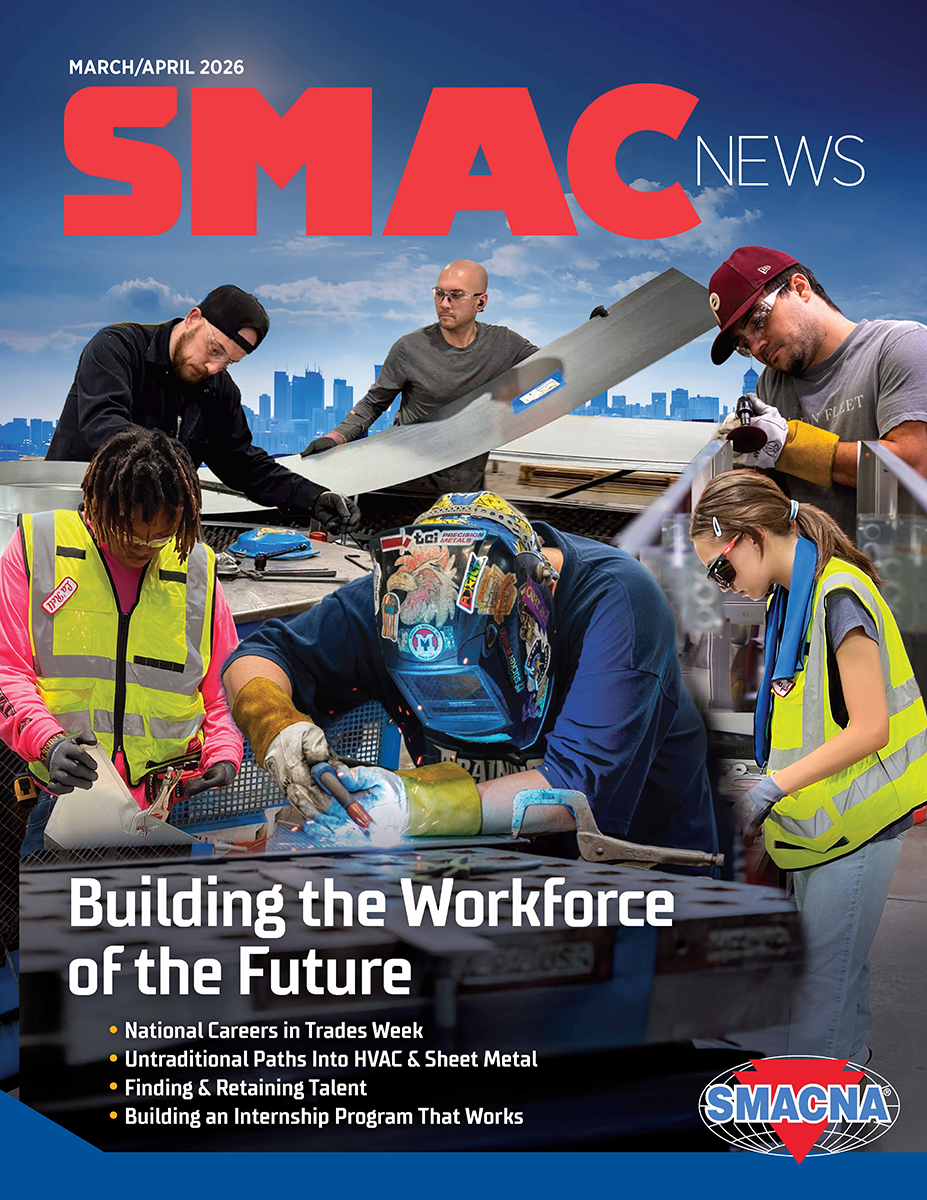
IN THIS ISSUE
AI Is Your New Apprentice: Why Contractors Need Training, Guardrails and an AI Game Plan in 2026
Unlike some technologies, AI is not just something firms adopt; it has a strong individual-level adoption, which presents a problem familiar to leaders who dealt with the introduction of smartphones 15 years ago.
ARCHITECTURAL: Where Metal Meets the Landscape
California Sheet Metal’s award-winning work at Bioterra proves that architectural precision and environmental harmony are not mutually exclusive.
Chapter Spotlight: SMACNA Detroit - America’s Comeback City
The Motor City’s SMACNA chapter works to capture new opportunities in this resurgent community.
Clean Air, Efficient Buildings: SMACNA Pushes Three Bills That Could Transform the Industry
The construction slowdown that began in early 2025 only worsened in 2026 due to increased metal and equipment tariffs,spiking energy costs and stubborn interest rates.
How a Father’s Advice Built a Career
SMACNA's President discusses his story of how he entered the trades and provides advice for those looking to join our industry.
HVAC: 75 Years and Still Ahead of the Curve
Geauga Mechanical’s three-generation bet on innovation pays off in an historic Cleveland renovation.
INDUSTRIAL: Metal and Microclimates
How HVAC is powering America’s next industrial boom.
Powering the Trades
Learn more about the enormous potential of a career in the trades and why it is important for SMACNA to do its part to build a sustainable and dynamic workforce.
RESIDENTIAL: Breathing Life Into Burnaby’s New Skyline
At Gilmore Place, Evergreen Sheet Metal navigated one of the most complex HVAC installations in British Columbia’s history.
TESTING, ADJUSTING AND BALANCING: Tuning the Invisible TAB Orchestra
HVAC systems hum silently when balanced right, delivering comfort, safety and efficiency. But when done wrong, the noise of wasted energy and failed inspections can drown out everything.
Welcome New SMACNA Members
What Contractors Should Know About “No Tax on Overtime”
To keep projects moving and crews in the field, overtime has long been a reality in the construction industry.
Workforce Strategies: A Trade Without Walls
How three professionals from academia, marketing and tech left their careers behind and found their futures in sheet metal and HVAC.
Workforce Strategies: Building the Workforce of the Future
National Careers in Trades Week returns with new partners, new research and a new generation ready to work.
Workforce Strategies: Finding and Retaining Talent in a Shifting Workforce
How to recruit with authenticity, retain through empathy and develop through opportunity.
Workforce Strategies: How to Build an Internship Program That Works
Sheet metal and HVAC leaders reveal proven strategies that turn college talent into industry lifelines, even for small firms.
Privacy Policy |
Terms of Use | Contact Us
Phone: 703.803.2980 | Email:
info@smacna.org
© 1998-2026 SMACNA. All rights reserved.
Web Design & Development by Matrix Group
International, Inc.
