Workforce Strategies: Building the Workforce of the Future
National Careers in Trades Week returns with new partners, new research and a new generation ready to work.
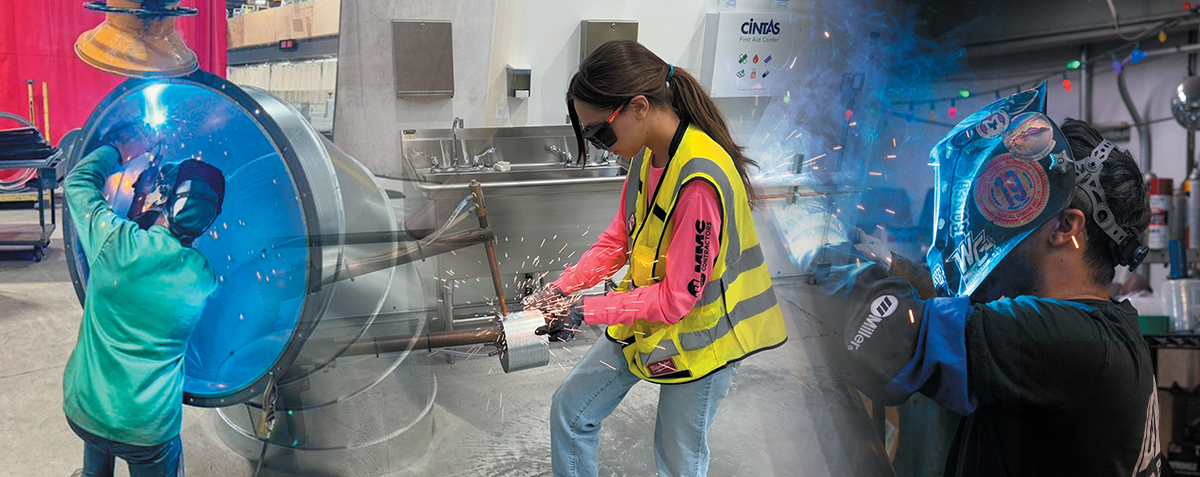
When the first National Careers in Trades Week launched in April 2025, it was a coordinated measure by SMACNA, SMART, and the International Training Institute to see if the nation was ready to have a different conversation about work.
One year later, the returns are in. The Wall Street Journal covered it. So did CNN and Fox News. Local outlets coast to coast ran features and interviews. And the initiative walked away with a Gold W3 Award in the Educational & Instructional section of the Social Campaigns category, one of the most recognized honors in digital outreach.
National Careers in Trades Week was back April 6 - 10 this year, and it was bigger, better funded and more urgently needed than ever. This year, the Mechanical Contractors Association of America (MCAA), the National Electrical Contractors Association (NECA), the National Energy Management Institute (NEMI), the Sheet Metal Occupational Health Institute Trust (SMOHIT) and the Heavy Metal Summer Experience joined the founding coalition, and new research commissioned by SMACNA from Wakefield Research tells a story that no amount of marketing could have manufactured. The American public — Gen Z, in particular — is already coming around to the trades on its own.
The industry just needs to meet them there.
A LABOR MARKET AT A CROSSROADS
The 2026 edition of National Careers in Trades Week arrived at a peculiar moment in the American economy. The broader job market has stagnated — fewer postings, harder-to-land positions and a white-collar hiring freeze in sectors that once felt bulletproof. But skilled trades tell a different story. According to the Bureau of Labor Statistics, professions in the skilled trades are projected to experience faster-than-average job growth from 2024 through 2034. The BLS Occupational Outlook predicts more than 600,000 construction job openings annually, and the median annual wage in the trades has risen to $58,000 — up from $55,000 just a year earlier — surpassing the median for all occupations, depending on your local collective bargaining agreement.
For union members, the picture is even stronger. Nationwide, full-time union construction workers earn a median that is more than $23,500 per year higher than their nonunion counterparts, according to BLS median weekly earnings data. And the Construction Labor Research Council reports that wages across the industry are rising above 4% annually as employers compete for workers in an increasingly tight labor market.
In the sheet metal and HVAC space specifically, the stakes are especially clear. Approximately 35,000 sheet metal workers are expected to retire in the coming years. Over half of the current workforce is already over 45. For every five workers who leave the trade, only two are entering it. The deficit is structural, and it is deepening.
“There is a lot that has changed about our country over the years: technology, artificial intelligence, you name it,” says Michael Coleman, general president of SMART. “But one thing that won’t ever change is this simple fact: We need skilled trades workers to build our country.”
SMART members are building hospitals, managing air quality in schools and ensuring that apartment and office buildings operate efficiently. But the union — and the industry — cannot sustain that work without a new generation of workers ready to carry it forward.
The headline finding from this year’s Wakefield Research study, commissioned by SMACNA, is striking in its directness: 75% of teens aged 13 to 18 say they would consider a trade job over going to college. Not “might consider,” but “would consider” as a viable and appealing alternative, if they knew the pay was higher than average.
The survey asked what would tip a teenager toward the trades, and the results reveal a generation that is thinking practically and economically. Thirty percent cited higher pay, good benefits and paid apprenticeships as the most compelling factors. Twenty-four percent said the opportunity for promotion would sway them. Twenty-one percent said knowing that their work was vital to the economy would matter. And 19% pointed to the sheer growth in available positions.
These are the calculations of a generation that has watched student loan debt cripple its predecessors and has drawn conclusions. College enrollment rates have been declining since 2010, according to data from the National Center for Education Statistics with enrollment rebounding slightly since 2022.
The Wall Street Journal captured this shift in a widely circulated piece that dubbed Gen Z the “toolbelt generation,” a label that has since stuck across the national conversation about workforce development. The numbers behind it are concrete: enrollment in vocational-focused community colleges rose 16% to its highest level since the National Student Clearinghouse began tracking such data in 2018. Enrollment in construction trade programs rose 23%. HVAC and vehicle maintenance programs rose 7%.
An earlier Thumbtack survey of Gen Z graduates found that about nine in 10 said learning a skilled trade offered a more reliable path to economic security than college. And a Jobber survey found that 75% of high school and college-age respondents said they would be interested in vocational schools offering paid, on-the-job training — the very model that apprenticeship programs in the sheet metal industry have perfected over decades.
The gender data is also notable. Interest among Gen Z women and men in the trades is now nearly equal — 52% versus 57%, respectively. That near-parity represents a structural shift from previous generations and an opportunity that the industry should be actively cultivating.
“Skilled professions offer rewarding career opportunities for all people, including young adults, women, veterans and anyone who is looking for a career change,” says Frank Wall, CEO of SMACNA. “The wages and job security that trade careers offer provide a faster means to home ownership, upward mobility and saving for retirement that other pathways don’t always ensure.”
One of the most underappreciated findings in the SMACNA research is about the parents of these teenagers. In the 2025 Wakefield Research survey of 500 parents with children currently enrolled in high school or college, 89% said it was smart for young adults to consider pursuing a trade career, given the job market, the economy and the weight of college debt. And 86% said they would be open to or would actively encourage their child to pursue that path.
Forty-seven percent said their child had already mentioned wanting to go into a trade. That parental shift matters enormously. For decades, the cultural current ran in the opposite direction — the four-year degree was the expected destination, and anything else carried an implicit stigma. That stigma is eroding, and it is eroding at the family dinner table. When a parent hears that a sheet metal apprentice can earn up to $87,500 in their first year and can reach $120,000 to $200,000 in wages and benefits within four to five years of completing an apprenticeship, depending on your local collective bargaining agreement — with no college debt — the math becomes difficult to argue with.
The industry’s task is not to persuade a resistant public. It is to amplify a conversation that is already happening and give it the language, the data and the pathways it needs to turn interest into enrollment.
A COALITION THAT HAS GROWN
The 2025 inaugural National Careers in Trades Week was anchored by SMACNA, SMART and the ITI — the organizations with the most direct stake in recruiting the next generation of sheet metal and HVAC workers. The 2026 edition has expanded that coalition significantly, and the additions signal something important: this is no longer a single-industry recruitment campaign. It is a cross-trades movement.
In 2026, new partners included the Mechanical Contractors Association of America (MCAA), the National Electrical Contractors Association (NECA), the National Energy Management Institute (NEMI), the Sheet Metal Occupational Health Institute Trust (SMOHIT) and the Heavy Metal Summer Experience. Each brings its own member base, its own regional networks and its own workforce development infrastructure to a shared platform.
NECA CEO David Long framed his organization’s participation in terms that resonate far beyond the electrical industry. “A career in the electrical industry offers more than a paycheck; it offers purpose, stability and opportunity,” he says. “Electrical construction professionals are building the systems that power our economy, keep our communities safe and bring us light at the flick of a switch. This industry provides high-quality training, competitive wages, strong benefits and clear pathways for advancement, allowing individuals to successfully transform their lives and families while contributing to a more connected and sustainable future.”
 The expansion of the coalition also positions National Careers in Trades Week alongside a parallel federal push. The U.S. Department of Labor announced that National Apprenticeship Week 2026 — set for April 26 through May 2, under the theme “America at Work: Making America Skilled Again Through Registered Apprenticeship” — will run just weeks after National Careers in Trades Week. The event is tied directly to the Trump administration’s goal of reaching one million active apprentices and to presidential executive orders on skilled trades, AI education and national industrial reinvestment.
Since the start of the current administration, more than 363,000 new individuals have started apprenticeships — a figure that the Department of Labor is actively building on. The timing of both weeks created a month-long national drumbeat around workforce development in the trades, with National Careers in Trades Week generating the public awareness and National Apprenticeship Week translating that attention into specific pathways.
- $58,000 — Median annual wage in skilled trades (2025), up from $55,000 the prior year, exceeding the median for all U.S. occupations.
- $23,556-plus — Annual wage premium for full-time union construction workers over their nonunion counterparts, based on BLS median weekly earnings data.
- 600,000-plus — Construction job openings projected annually through 2034, with faster-than-average growth across the trades.
- $87,500 — What a SMART sheet metal apprentice can earn in their first year, including wages and benefits, depending on your local collective bargaining agreement.
- $120,000–$200,000 — Wages and benefits achievable within four to five years of completing a union sheet metal apprenticeship, depending on your local collective bargaining agreement.
- $0 — Student debt incurred through an earn-while-you-learn apprenticeship, compared to an average of $34,000 for a four-year bachelor’s degree.
- 5 to 2 — The ratio of trade workers retiring to new workers entering the field.
WHAT THE TRADES ACTUALLY OFFER
One of the recurring themes in the National Careers in Trades Week campaign — and in the broader public conversation that the Wall Street Journal, CNN and Fox News helped amplify — is that the trades have shed the image of being low-tech, low-status work. That image was never accurate for sheet metal and HVAC, and it is now actively counterproductive.
HVAC systems account for 30% to 40% of building energy use. The workers who design, install and maintain them are on the front lines of the green building revolution, reducing carbon emissions, increasing energy efficiency and enabling the kind of high-performance infrastructure that chip plants, data centers and healthcare facilities require. Modern laser welding, drone-assisted inspection, BIM coordination and AI-enabled project management are reshaping what it means to work in the trade. The workers entering the field today will spend their careers at that intersection of physical mastery and digital fluency.
The entrepreneurial pathway is also underappreciated. Many of the most successful contractors in the SMACNA network started as apprentices. With experience, those workers can open fabrication shops, manage service operations, move into project management and estimating, or eventually own their own businesses. It is one of the fastest routes to business ownership available in the American economy without requiring a degree.
And unlike industries that have seen jobs migrate offshore or dissolve into automation, sheet metal and mechanical work must be done on site by skilled hands in the buildings where Americans live and work. These jobs cannot be outsourced. In a labor market that has grown increasingly uncertain, that is not a small thing.
“Union apprenticeships aren’t just a career path,” Coleman says, “they’re a gateway to a stable, rewarding future. By investing in the next generation of trade workers, we’re building a skilled workforce that will power our industries and communities for decades to come.”
National Careers in Trades Week 2026 ran April 6 through April 10 with cross-industry visibility efforts designed to reach job seekers, students, parents and the broader public. Throughout the week, participating organizations, including SMACNA, SMART, ITI, MCAA, NECA, NEMI, SMOHIT and HMSE, coordinated outreach across digital platforms, media and local markets.
For SMACNA members, National Careers in Trades Week represented both an opportunity and a responsibility. The research is there. The public appetite is there. The partnership infrastructure is there. What translates all of it into actual workers walking through the door of a local JATC is local engagement — contractors and industry partners showing up in their communities, talking to high school students, hosting tours, partnering with career and technical education programs, and making the invisible visible.
SMACNA members participated by visiting nationalcareersintradesweek.com for resources, toolkits and event information. The Heavy Metal Summer Experience, which gives young people a hands-on introduction to sheet metal work, continues to serve as one of the most effective on-ramps the industry has developed, and its reach is growing.
While the first National Careers in Trades Week landed on the front pages of the Wall Street Journal, CNN and Fox News, the second had the wind at its back with a stagnant broader job market, a generation actively looking for alternatives to college debt, parents who are ready to have the conversation and a coalition of trade organizations larger and better-resourced than the one that launched this effort just one year ago.
Photos: Sheet Metal Werks, Heavy Metal Summer Experience, Ernest D. Menold Inc.
Published: May 18, 2026
IN THIS ISSUE
AI Is Your New Apprentice: Why Contractors Need Training, Guardrails and an AI Game Plan in 2026
Unlike some technologies, AI is not just something firms adopt; it has a strong individual-level adoption, which presents a problem familiar to leaders who dealt with the introduction of smartphones 15 years ago.
ARCHITECTURAL: Where Metal Meets the Landscape
California Sheet Metal’s award-winning work at Bioterra proves that architectural precision and environmental harmony are not mutually exclusive.
Chapter Spotlight: SMACNA Detroit - America’s Comeback City
The Motor City’s SMACNA chapter works to capture new opportunities in this resurgent community.
Clean Air, Efficient Buildings: SMACNA Pushes Three Bills That Could Transform the Industry
The construction slowdown that began in early 2025 only worsened in 2026 due to increased metal and equipment tariffs,spiking energy costs and stubborn interest rates.
How a Father’s Advice Built a Career
SMACNA's President discusses his story of how he entered the trades and provides advice for those looking to join our industry.
HVAC: 75 Years and Still Ahead of the Curve
Geauga Mechanical’s three-generation bet on innovation pays off in an historic Cleveland renovation.
INDUSTRIAL: Metal and Microclimates
How HVAC is powering America’s next industrial boom.
Powering the Trades
Learn more about the enormous potential of a career in the trades and why it is important for SMACNA to do its part to build a sustainable and dynamic workforce.
RESIDENTIAL: Breathing Life Into Burnaby’s New Skyline
At Gilmore Place, Evergreen Sheet Metal navigated one of the most complex HVAC installations in British Columbia’s history.
TESTING, ADJUSTING AND BALANCING: Tuning the Invisible TAB Orchestra
HVAC systems hum silently when balanced right, delivering comfort, safety and efficiency. But when done wrong, the noise of wasted energy and failed inspections can drown out everything.
Welcome New SMACNA Members
What Contractors Should Know About “No Tax on Overtime”
To keep projects moving and crews in the field, overtime has long been a reality in the construction industry.
Workforce Strategies: A Trade Without Walls
How three professionals from academia, marketing and tech left their careers behind and found their futures in sheet metal and HVAC.
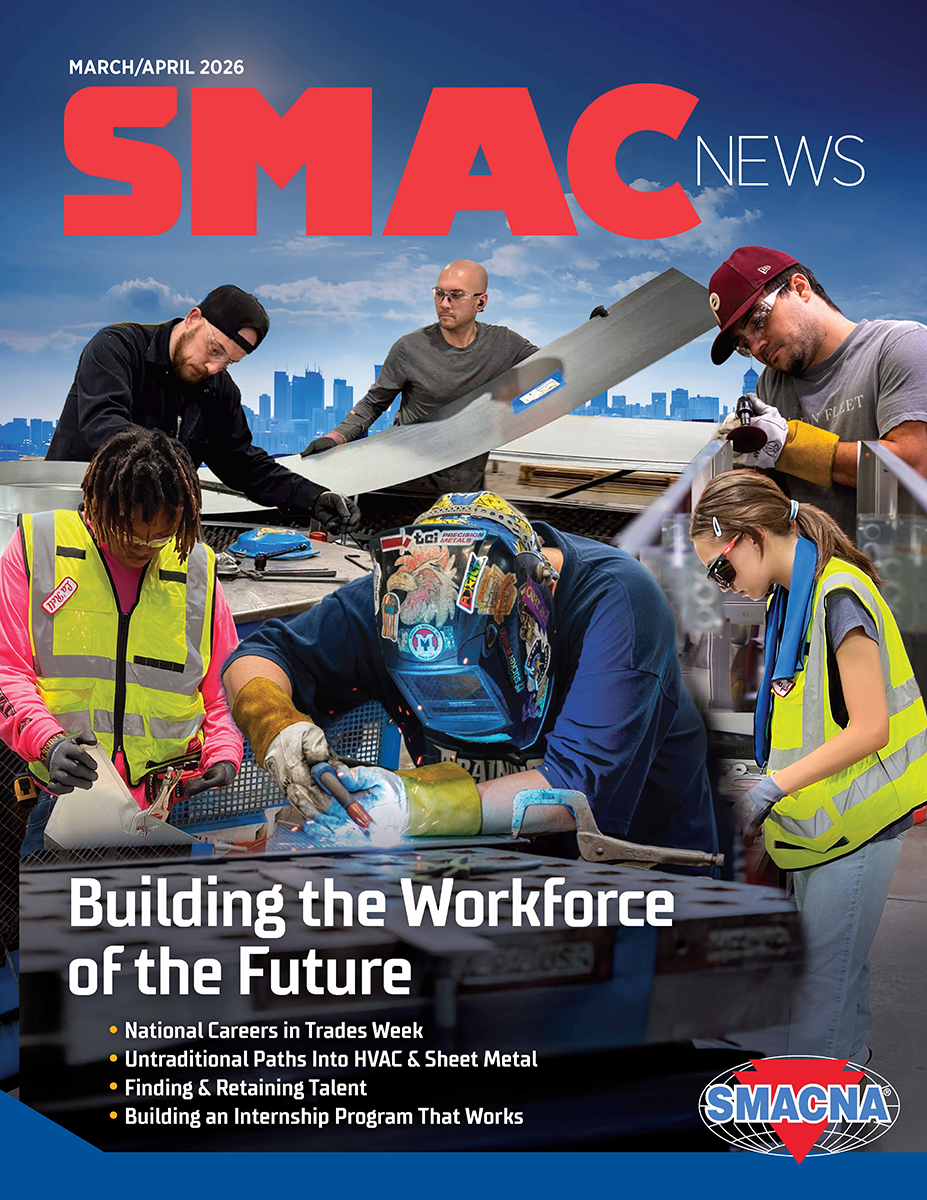
Workforce Strategies: Building the Workforce of the Future
National Careers in Trades Week returns with new partners, new research and a new generation ready to work.
Workforce Strategies: Finding and Retaining Talent in a Shifting Workforce
How to recruit with authenticity, retain through empathy and develop through opportunity.
Workforce Strategies: How to Build an Internship Program That Works
Sheet metal and HVAC leaders reveal proven strategies that turn college talent into industry lifelines, even for small firms.
Privacy Policy |
Terms of Use | Contact Us
Phone: 703.803.2980 | Email:
info@smacna.org
© 1998-2026 SMACNA. All rights reserved.
Web Design & Development by Matrix Group
International, Inc.
